

Iqlab in Tajweed is one of the four rulings of Noon Saakin and Tanween, and it is the only one that depends on a single letter.
If you have ever stumbled over a phrase like سَمِيعٌۢ بَصِيرٌ and felt the “n” sound clash awkwardly with the “b” that follows, you have already met the exact problem this rule was designed to solve.
This guide answers what is Iqlab in Tajweed from definition to physical execution: the one letter that triggers it, the three-step pronunciation sequence, how it is marked in the Mushaf, where it applies, and the three mistakes that non-Arabic speakers repeat most often. Consider this Iqlab in Tajweed explained end to end.
At Tabarak Academy, these are the same checkpoints our certified tutors use when correcting a student’s recitation live.
By the end, you will be able to spot Iqlab on the page before you reach it — and pronounce it without thinking about it.
What You’ll Learn in This Article
- Exactly what is Iqlab in Tajweed and why scholars classify it as “conversion,” not merging
- The single letter that triggers Iqlab — and why no other letter does.
- The 3-step pronunciation sequence, including the nose-block self-check.
- How Iqlab is written in the Uthmani Mushaf for both Noon Saakin and Tanween.
- Verified Quranic examples across all three Iqlab positions.
- The three most common errors and how to correct each one.
What Is Iqlab in Tajweed?
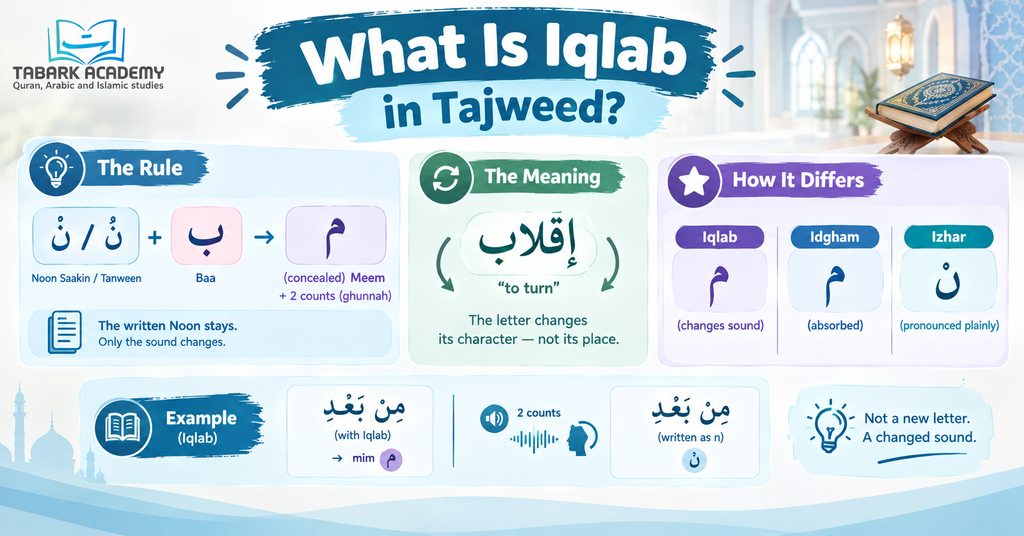
Iqlab in Tajweed is the rule that converts Noon Saakin (نْ) or Tanween (ً ٍ ٌ) into a concealed Meem (م) sound, carried by a nasal resonance of two counts, whenever the letter Baa (ب) follows. The written Noon stays on the page; only its sound changes.
The word إقلاب means “to turn something from its original state.” That is precisely what happens in recitation: the Noon does not vanish and it does not merge into the next letter — it changes character.
This is what separates Iqlab from Idgham, where the letter is absorbed, and from Izhar, where it is pronounced plainly.
Understanding the Iqlab in Tajweed meaning at this level matters, because reciters who treat it as “replacing n with m” tend to produce a heavy, fully-pronounced Meem — which is incorrect, as the pronunciation section below explains.
Why Iqlab Exists: The Phonetic Logic
Iqlab exists because pronouncing Noon directly before Baa is mechanically awkward. Noon is a nasal sound articulated at the tip of the tongue against the upper gum ridge, while Baa is a bilabial stop produced by the lips.
The articulation points sit far apart, and moving between them cleanly requires an unnatural pause.
Meem solves this. It shares nasality with Noon and shares the lips with Baa, which makes it the natural phonetic bridge between the two. Classical scholars did not invent a decorative rule here — they documented how the Arabic sound system already behaves.
This is why Iqlab cannot be applied by memorization alone. A student who understands the mechanism stops forgetting the rule mid-recitation, which is the approach Tabarak Academy tutors take in every Tajweed session: the why before the what.
Experience Our Interactive Learning
Curious about how we teach? Watch these brief video clips from our recent live sessions to see our structured curriculum, advanced learning platform, and dynamic student-teacher interactions firsthand.
What Are The Letters Of Iqlab?
Iqlab has exactly one letter: Baa (ب). No other letter in the Arabic alphabet triggers this ruling.
This single-letter condition makes Iqlab the simplest of the four Noon Saakin rulings to identify. There is no letter group to memorize, no exception list, and no competing condition to weigh — if Baa follows Noon Saakin or Tanween, Iqlab applies without exception.
| Ruling | Letters Involved | What Happens to the Noon | Difficulty to Identify |
| Izhar | 6 (throat letters) | Pronounced clearly, no ghunnah | Moderate |
| Idgham | 6 (ي ر م ل و ن) | Merged into the next letter | Moderate |
| Ikhfa | 15 | Concealed between clear and merged | Higher |
| Iqlab | 1 (ب only) | Converted into a hidden Meem | Simplest |
Because the memorization burden is almost zero, Iqlab is usually introduced early in a structured Tajweed curriculum — often before Ikhfa, whose fifteen letters take considerably longer to internalize.
When Does Iqlab Occur?
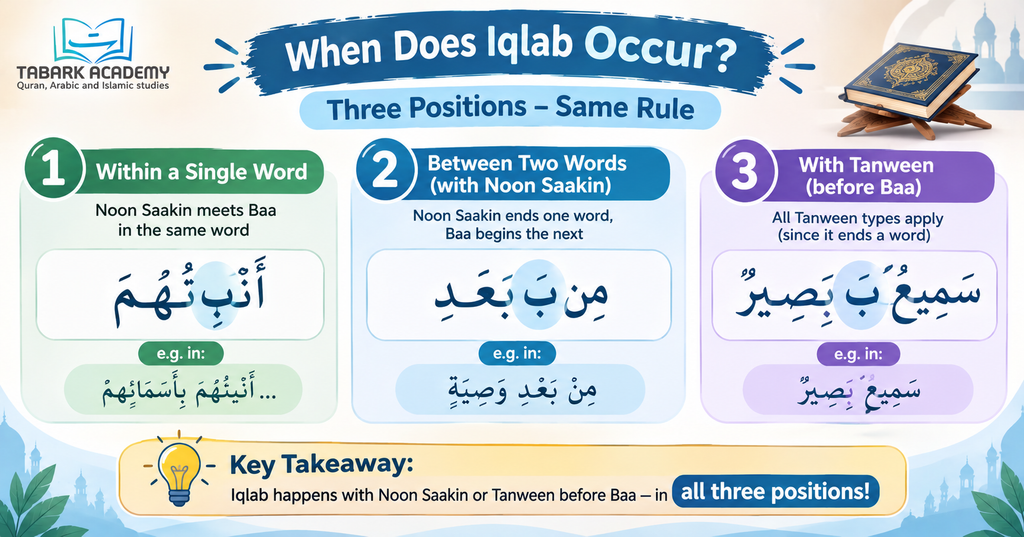
Anyone asking what is Iqlab in Tajweed needs the answer in three positions, not one — the condition never changes, but where it appears on the page does.
The trigger is always Noon Saakin or Tanween followed by Baa, and recognizing all three positions is what turns the rule from theory into automatic application.
1. Iqlab Within A Single Word
This happens when Noon Saakin sits inside a word and Baa follows it directly in that same word.
- أَنۢبِئْهُم — in (قَالَ يَا آدَمُ أَنبِئْهُم بِأَسْمَائِهِمْ), the Noon Saakin meets Baa inside the word
- لَيُنۢبَذَنَّ — in (كَلَّا لَيُنْبَذَنَّ فِي الْحُطَمَةِ)
- يُنۢبِتُ — in (يُنْبِتُ لَكُمْ)
- أَنۢبَتَتْ — Al-Baqarah 2:261, “it produced”
2. Iqlab Between Two Words with Noon Saakin
Here the Noon Saakin ends one word and Baa begins the next. The rule applies identically — word boundaries do not interrupt it.
- مِنۢ بَعْدِ — in (مِن بَعْدِ وَصِيَّةٍ يُوصَىٰ بِهَا)
- وَمِنۢ بَيْنِنَا — in (وَمِن بَيْنِنَا وَبَيْنِكَ حِجَابٌ)
3. Iqlab with Tanween Before Baa
Tanween cannot occur inside a word by grammatical definition — it is always a word-ending marker — so Tanween Iqlab always spans two words. All three types of Tanween behave the same way.
- سَمِيعٌۢ بَصِيرٌ — Tanween Dammah before Baa
- عَلِيمٌۢ بِذَاتِ الصُّدُورِ — Tanween Dammah before Baa
- ذُرِّيَّةًۢ بَعْضُهَا مِنۢ بَعْضٍ — Tanween Fathah before Baa
- مِن كُلِّ زَوْجٍۭ بَهِيجٍ — Tanween Kasrah before Baa
- وَاللّهُ بَصِيرٌۢ بِالْعِبَادِ — Aal ‘Imran 3:15
One nuanced case worth knowing: in Surah Al-‘Alaq (96:15), the word لَنَسْفَعًۢا carries what looks like Tanween but is technically a Noon of Emphasis (نون التوكيد).
Classical Tajweed scholarship holds that it still takes the Iqlab ruling before Baa, because functionally it behaves like Tanween in that position.
Details at this level are exactly what separate a reciter who has memorized rules from one who has studied them — and they are covered directly in the Tajweed track at Tabarak Academy.
Read also: What Is Idgham In Tajweed?
Start Your Quran Learning Journey
Join Tabark Academy today for structured online lessons with qualified tutors, customized to fit your goals.
Book Your Free Trial LessonHow to Pronounce Iqlab Correctly: The 3-Step Sequence
Iqlab pronunciation is a single continuous motion built from three steps that must follow each other without a gap. Treating it as three separate actions is what produces the choppy recitation most beginners are trying to fix — and it is the point where knowing what is Iqlab in Tajweed turns into actually reciting it correctly.
Step 1: Convert the Sound into a Hidden Meem
The first action is to stop the Noon before it is released. Do not pronounce the “n” at all — cut it internally and shift straight into a soft “m” tone.
This Meem exists in sound only, not in writing (لفظًا لا خطًّا). It is light and concealed, never the full, crisp Meem you would pronounce at the start of a word.
Step 2: Hold the Ghunnah for Two Counts
Once the sound has shifted, sustain a nasal resonance (ghunnah) for approximately two counts at your natural recitation tempo. The ghunnah must sit on the hidden Meem — not before it and not after it.
Lightly pinch your nose while producing the hidden Meem. If the sound stops completely, your ghunnah is correct.
If sound still escapes through your mouth, the nasal resonance is not where it should be. This is the fastest self-check available to a reciter practicing alone.
Too short and the rule weakens into something closer to Izhar; too long and the recitation sounds stretched and unnatural.
Step 3: Close the Lips into the Baa
While the ghunnah is still flowing, bring the lips gently together in preparation for Baa. The closure is partial, not sealed — this is Ikhfa Shafawi, a labial concealment.
The sequence completes itself: the hidden Meem prepares the lips, the ghunnah flows through the nose, and the lips close smoothly into Baa. Done correctly, there is no break, no harsh stop, and no extra sound — one continuous, controlled transition.
Step Inside Our Virtual Classrooms
See our engaging teaching methods in action! watch real snippets of our live classes and discover how our expert instructors make learning interactive, memorable, and inspiring for every student.
How Is Iqlab Marked In The Uthmani Mushaf?
Iqlab is marked in the Uthmani Mushaf by a small Meem (ۢ) placed directly above the Noon Saakin or beside the Tanween. The marker is not part of the word’s spelling — it is a recitation instruction printed into the script.
This notation is the most practical part of what is Iqlab in Tajweed for everyday reciters, because it removes guesswork entirely.
Standard printed Qurans worldwide signal every Iqlab position visually, which means a reciter who learns to read the marker never has to identify the rule from memory under pressure.
| What You See in the Mushaf | What It Means | What You Do |
| Small م above a Noon Saakin | Iqlab is required | Convert to hidden Meem + ghunnah |
| Tanween shown as a single diacritic + small م | Iqlab is required | Convert to hidden Meem + ghunnah |
| نْ followed by ب, no visible marker | Iqlab still applies | Apply the full rule |
| ً ٍ ٌ followed by ب | Iqlab still applies | Apply the full rule |
A practitioner habit worth building: scan each new page for small Meem markers before you begin reciting it.
Students who pre-scan make noticeably fewer Iqlab errors than those who react to the marker as they reach it — because by the time your eye lands on the marker mid-flow, your tongue has often already committed to the Noon.
Tutors at Tabarak Academy train this pre-reading habit from the first Tajweed lesson, precisely because it prevents the error instead of correcting it afterward.
Three Common Iqlab Mistakes and How to Fix Them
Knowing what is Iqlab in Tajweed academically does not automatically produce correct recitation. These three errors account for the large majority of Iqlab corrections in live sessions with non-Arabic speakers.
1. Pronouncing a Full Noon Before the Baa
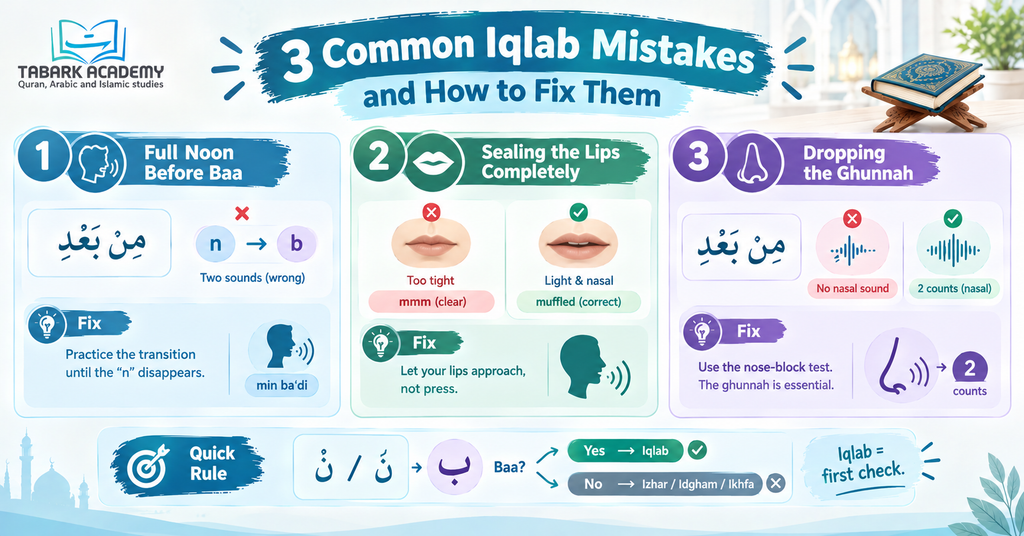
The reciter says the Noon, then says Baa, producing a two-step sound instead of a single converted Meem-Baa. This is the most frequent early error.
Practice the transition in isolation on مِنۢ بَعْدِ until the “n” never surfaces. If you can hear two distinct consonants, the conversion has not happened.
2. Sealing the Lips Completely
Students who learn Iqlab from written explanations alone tend to press their lips fully together, producing a heavy, clearly audible Meem. That is stronger than the rule requires.
If you hear a sharp “mmm,” your lips are too tight. The correct sound is muffled, resonant, and nasal — the lips approach without pressing.
3. Dropping the Ghunnah
Some reciters concentrate so hard on converting the Noon that they skip the nasal resonance entirely. The ghunnah is not decorative; it is the acoustic signature that defines Iqlab.
The fix: apply the nose-block test. No ghunnah means the rule is technically incomplete, even if the Meem sound is correct.
When you reach Noon Saakin or Tanween, ask one question: is the next letter Baa? If yes, Iqlab — no further analysis needed.
If not, you are in Izhar, Idgham, or Ikhfa territory. Because Iqlab owns a single letter, it should be the first rule you rule in or out, which keeps your mental processing fast enough to keep pace with recitation.
Read also: Idgham With Ghunnah Vs Idgham Without Ghunnah
Why Iqlab Matters for Accurate Quran Recitation?
Iqlab preserves the Quran as it was revealed and transmitted. Tajweed rulings were not added to beautify recitation — they document the pronunciation received through unbroken chains of transmission, and applying them is how a reciter stays faithful to that transmission.
There is a practical dimension too. Iqlab removes the clash between two distant articulation points, so transitions stay smooth and the reciter’s breath and rhythm hold steady across longer passages. Reciters who apply it correctly report that difficult verses stop feeling difficult.
Most importantly, Iqlab is a confidence rule. Because it rests on one letter and one clear marker, it is usually the first ruling a student masters completely — and that early success is what carries many learners through the heavier work of Ikhfa and the Madd rules later on.
Start Your Quran Learning Journey
Join Tabark Academy today for structured online lessons with qualified tutors, customized to fit your goals.
Book Your Free Trial LessonStart Your Tajweed Journey with Tabarak Academy Today
You can read every rule on this page and still mispronounce Iqlab — because ghunnah length, lip pressure, and sound concealment are things an ear catches and a text cannot. That is the gap a qualified tutor closes in minutes.
Tabarak Academy connects you with certified Quran and Tajweed tutors who correct your recitation live, verse by verse, at your own pace.
Lessons are one-to-one and scheduled around you — learn from home, in your own time zone, with a tutor who tracks exactly which rules you have mastered and which still need work.
Our Tajweed Courses:
- Online Tajweed Classes
- Tajweed Course for Beginners
- Tajweed Course for Kids
- Tajweed Course for Adults
- Tajweed Course for Sisters
- Advanced Tajweed Course
- Amali (Practical) Tajweed Course
- Learn Quran with Tajweed
- Learn Quran with Tajweed for Kids
- Learn Quran with Tajweed for Sisters

Conclusion
What is Iqlab in Tajweed, in one line: it is the conversion of Noon Saakin or Tanween into a concealed Meem with a two-count ghunnah whenever Baa follows.
It is triggered by a single letter, appears in three recognizable positions, is marked visibly in the Uthmani Mushaf, and is executed through one three-step motion — shift the sound, hold the nasal resonance, close the lips.
The rule rewards understanding over memorization. Reciters who grasp why Meem bridges Noon and Baa apply Iqlab consistently; those who memorize the instruction alone tend to drop the ghunnah or over-pronounce the Meem under pressure.
Master this one rule properly and you have a working model for every other Noon Saakin ruling.
Practice it with the nose-block test, pre-scan your pages for the small Meem marker, and get your recitation checked by a qualified tutor — the path to accurate Quran recitation runs through exactly this kind of deliberate, corrected practice.

Frequently Asked Questions About Iqlab in Tajweed
These are the questions learners ask most often once they begin applying Iqlab in actual recitation. Each answer is kept short and direct so you can use it as a quick reference while practicing.
1. How many letters does Iqlab have in Tajweed?
Iqlab has exactly one letter: Baa (ب). It is the only letter that triggers the Iqlab ruling, which makes it the simplest of the four Noon Saakin and Tanween rules to identify.
2. What is the difference between Iqlab and Ikhfa Shafawi?
Iqlab is the rule that converts Noon Saakin or Tanween into a hidden Meem before Baa. Ikhfa Shafawi is the manner in which that resulting Meem is pronounced — partially concealed, with the lips approaching but not pressing together. Iqlab is the ruling; Ikhfa Shafawi describes its execution.
3. Does Iqlab apply within a single word or only between two words?
Iqlab applies in both positions. Noon Saakin can meet Baa inside one word (أَنۢبِئْهُم) or across two words (مِنۢ بَعْدِ). Tanween, however, only ever occurs at a word ending, so Tanween Iqlab always spans two words.
4. How do I recognize Iqlab when reading the Mushaf?
Look for a small Meem (ۢ) written above the Noon Saakin, or beside a Tanween that appears as a single diacritic instead of a double one. In the Uthmani script this marker appears at every Iqlab position, so no guesswork is required.
5. Is the ghunnah in Iqlab the same length as in Idgham?
Yes — the ghunnah in Iqlab is held for approximately two counts, the same standard length applied in Idgham with ghunnah. What differs is the sound it sits on: in Iqlab it rides a concealed Meem, not a merged letter.
6. Can I learn Iqlab correctly without a teacher?
You can learn the theory independently, but ghunnah length and lip pressure are judged by ear, not by text. Most learners need a tutor to confirm their Iqlab is accurate, which is why Tabarak Academy offers a free trial lesson for exactly this kind of correction.




0 Comments