
Most students can recite the ikhfa letters list with examples within a week — and still apply the rule incorrectly for years.
The gap is not memorization. Ikhfa is a sound, not a list, and that sound changes depending on which of the 15 letters follows the noon sakinah.
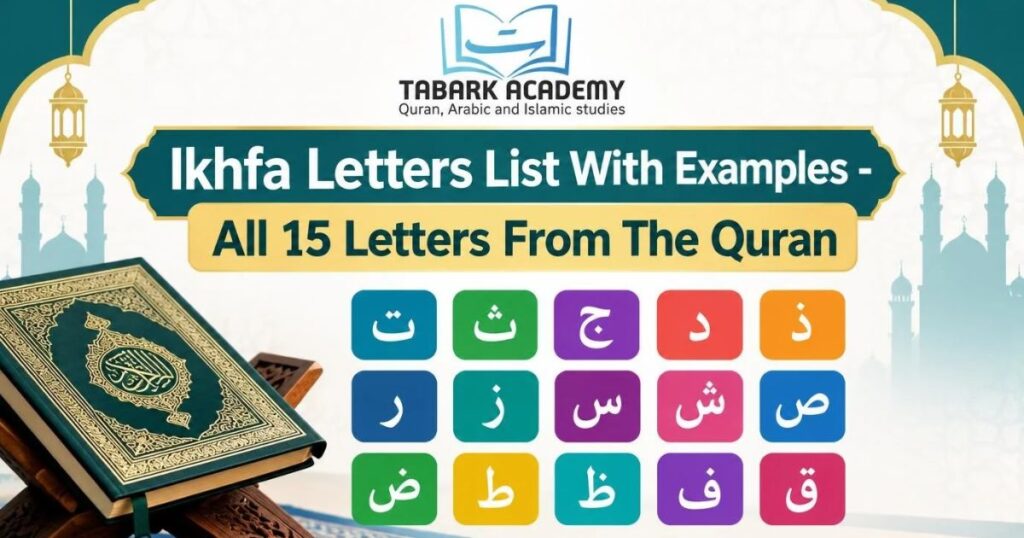
This guide gives you every one of the 15 ikhfa letters with verified Quranic examples, the articulation detail behind each one, the levels of ikhfa strength, and the practice method Tabarak Academy teachers use to correct ikhfa during live recitation.
What You’ll Learn in This Article
- All 15 ikhfa letters with Quranic examples and articulation notes for each.
- The three levels of ikhfa strength and why the following letter decides the level.
- Which 5 letters make the ghunnah heavy and which 10 keep it light.
- How ikhfa differs from idgham, izhar, and ikhfa shafawi.
- The most common ikhfa mistakes and a drill that corrects them.
All 15 Ikhfa Letters With Quranic Examples
Below is the complete ikhfa letters list with examples, ordered as the classical mnemonic presents them. Each letter is treated separately because each one changes what your mouth does during the ghunnah — the level of concealment, the weight of the nasal sound, and the position the tongue is already moving toward.
1. The Letter Sad (ص)
Sad is a moderate-level ikhfa letter with a heavy ghunnah. It is articulated from the tip of the tongue against the lower front teeth and carries both tafkheem (heaviness) and safir (a whistling quality), so the nasal sound before it must thicken in preparation.
- مِنْ صَلْصَالٍ — min salsalin — “from clay” — noon sakinah across two words.
- يَنْصُرْكُمُ — yansurukum — “He will support you” — noon sakinah within one word.
- صَفًّا صَفًّ — saffan saffa — “row upon row” — tanween before ص.
The common error here is producing the heavy ghunnah but then releasing the tongue toward a light sad. Keep the mouth rounded through both the ghunnah and the letter itself.
2. The Letter Dhal (ذ)
Dhal is a moderate-level ikhfa letter with a light ghunnah. Its makhraj is the tip of the tongue touching the edge of the upper front teeth, which places it close enough to noon to prevent izhar but far enough to prevent merging.
- مَنْ ذَا الَّذِي — man dhal-ladhi — “who is it that” — noon sakinah across two words.
- أَنْذَرْنَاكُمْ — andharnakum — “we have warned you” — noon sakinah within one word.
Because dhal is a soft, breathy letter, students often let the ghunnah fade into it early. Hold the full two counts before the tongue reaches the teeth.
3. The Letter Tha (ث)
Tha is a moderate-level ikhfa letter with a light ghunnah, sharing the same articulation point as dhal — the tip of the tongue against the edge of the upper front teeth — but without voicing.
- مِنْ ثَمَرَةٍ — min thamaratin — “from any fruit” — noon sakinah across two words.
- الْأُنْثَى — al-untha — “the female” — noon sakinah within one word.
- مَاءً ثَجَّاجًا — maa’an thajjaja — “pouring water” — tanween before ث.
Tha is unvoiced, so the contrast between the voiced ghunnah and the silent letter is sharp. Any gap between them turns the ikhfa into a stop.
4. The Letter Kaf (ك)
Kaf is the weakest-level ikhfa letter with a light ghunnah. Its makhraj is the back of the tongue against the hard palate, far from noon, which is why the concealment here feels the least complete of all 15 letters.
- مِنْكُمْ — minkum — “among you” — noon sakinah within one word.
- إِنْ كَانَ — in kana — “if he was” — noon sakinah across two words.
- رِزْقًا كَرِيمًا — rizqan karima — “noble provision” — tanween before ك.
- كِرَامًا كَاتِبِي — kiraman katibin — “noble scribes” — tanween before ك.
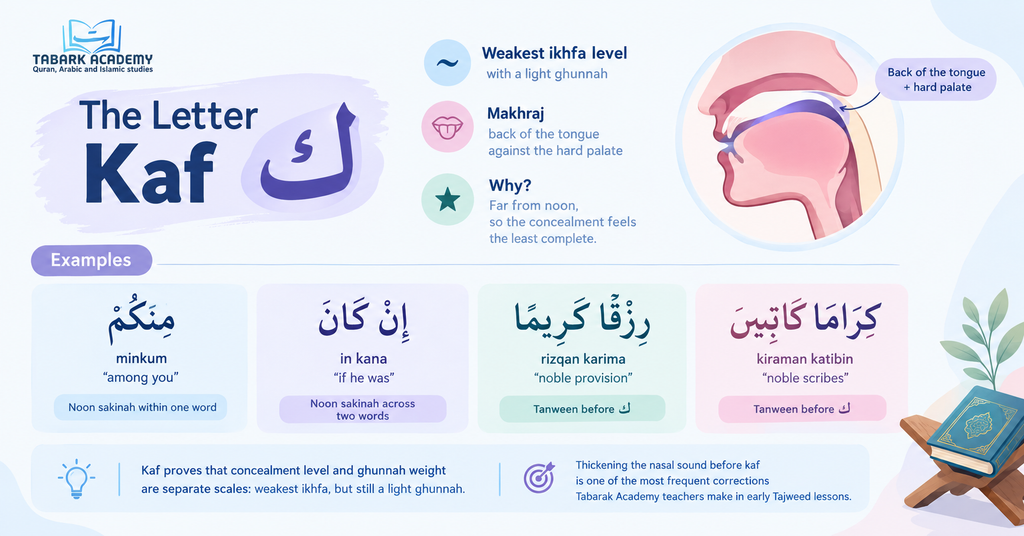
Kaf is the letter that proves concealment level and ghunnah weight are separate scales: weakest ikhfa, but still a light ghunnah. Thickening the nasal sound before kaf is one of the most frequent corrections Tabarak Academy teachers make in early Tajweed lessons.
5. The Letter Jeem (ج)
Jeem is a moderate-level ikhfa letter with a light ghunnah. It is articulated from the middle of the tongue against the roof of the mouth and belongs to the qalqalah group, which affects how the letter is released after the ghunnah ends.
- مَنْ جَاءَ — man jaa’a — “whoever comes” — noon sakinah across two words.
- خَلْقٍ جَدِيدٍ — khalqin jadid — “a new creation” (50:15) — tanween before ج
- مِنْ جُوع — min joo’ — “from hunger” — noon sakinah across two words.
Do not apply qalqalah to jeem here — it carries a vowel in all these examples. Qalqalah only applies when jeem is sakin.
6. The Letter Sheen (ش)
Sheen is a moderate-level ikhfa letter with a light ghunnah. It shares the middle-of-tongue makhraj with jeem and carries tafashshi — the spreading of air across the mouth — which should begin only after the ghunnah completes.
- مِنْ شَيْءٍ — min shay’ — “of anything” — noon sakinah across two words.
- أَنْشَرَهُ — ansharahu — “He resurrected him” — noon sakinah within one word.
- سَبْعًا شِدَادًا — sab’an shidada — “seven strong ones” — tanween before ش.
- فَمَنْ شَاء — faman shaa’a — “so whoever wills” — noon sakinah across two words.
The air spread of sheen tempts students to start the hiss during the ghunnah. The nasal sound must finish cleanly before any air escapes through the mouth.
7. The Letter Qaf (ق)
Qaf is the weakest-level ikhfa letter with a heavy ghunnah — the only letter that combines both extremes. Its makhraj is the deepest part of the tongue against the soft palate, the furthest point from noon among all 15 letters.
- مِنْ قَبْلِ — min qabli — “before” — noon sakinah across two words.
- يَنْقَلِبُ — yanqalibu — “he will return” — noon sakinah within one word.
- مِنْ كُلِّ أَمْرٍ — contrast this with qaf examples to feel the weight difference.
- رِزْقًا قَالُوا — tanween before ق.
Qaf is the clearest demonstration of the two-scale principle in this article: weak concealment, heavy ghunnah. Students who assume strong concealment equals heavy preparation get this letter wrong every time.
The heavy ghunnah before ق and the light one before ك are a few milliseconds apart — too close to self-diagnose. Tabarak Academy teachers correct both in live recitation, verse by verse.
8. The Letter Seen (س)
Seen is a moderate-level ikhfa letter with a light ghunnah. It is articulated from the tip of the tongue near the lower front teeth and is a safir letter, producing a high, thin whistle that must stay distinct from the nasal sound preceding it.
- مَنْسَأَتَهُ — mansa’atahu — “his staff” — noon sakinah within one word.
- الْإِنْسَان — al-insan — “the human being” — noon sakinah within one word.
- وَإِنْ سَأَلْتَهُمْ — wa in sa’altahum — “and if you ask them” — noon sakinah across two word.
- قَوْلًا سَدِيدًا — qawlan sadida — “upright speech” (33:70)— tanween before س.
Seen’s whistle is thin and forward; the ghunnah before it must stay equally light. Any thickening here is a tafkheem error.
Read also: What Is Ikhfa In Tajweed?
9. The Letter Dal (د)
Dal is a strongest-level ikhfa letter with a light ghunnah. Its makhraj — the tip of the tongue against the gums of the upper front teeth — is almost identical to that of noon, which is why the concealment here comes closest to idgham.
- أَنْدَادًا — andadan — “rivals” — noon sakinah within one word.
- قِنْوَانٌ دَانِيَةٌ — qinwanun daniyah — “clusters hanging low” — tanween before د.
- كَأْسًا دِهَاقًا — ka’san dihaqa — “a full cup” — tanween before د.
Because dal sits where noon sits, the tongue wants to complete the contact and produce a clear noon. Resist it — hold the tongue just short of the gum line while the ghunnah runs.
Start Your Quran Learning Journey
Join Tabark Academy today for structured online lessons with qualified tutors, customized to fit your goals.
Book Your Free Trial Lesson10. The Letter Taa (ط)
Taa is a strongest-level ikhfa letter with a heavy ghunnah — the deepest concealment in the entire ikhfa letters list with examples. It shares dal’s articulation point but adds full tafkheem and isti’la (elevation of the tongue).
- يَنْطِقُونَ — yantiqun — “they speak” — noon sakinah within one word.
- مَنْ طَغَى — man tagha — “whoever transgressed” — noon sakinah across two words.
- حَلَالًا طَيِّبًا — halalan tayyiba — “lawful and good” — tanween before ط.
- بَلْدَةٌ طَيِّبَة — baldatun tayyibah — “a good land” — tanween before ط.
Taa demands the thickest ghunnah of any ikhfa letter while the tongue sits in nearly the noon position. This combination is the single hardest ikhfa for non-Arabic speakers to produce accurately.
11. The Letter Zay (ز)
Zay is a moderate-level ikhfa letter with a light ghunnah. Like seen, it is a safir letter articulated from the tip of the tongue near the lower front teeth, but voiced rather than whispered.
- يَنْزِغُ — yanzighu — “he incites” — noon sakinah within one word.
- وَأَنْزَلْنَا — wa anzalna — “and We sent down” — noon sakinah within one word.
- مَنْ زَكَّاهَا — man zakkaha — “whoever purifies it” — noon sakinah across two words.
- صَعِيدًا زَلَقًا — sa’idan zalaqa — “smooth ground” — tanween before ز.
Zay is voiced, so students often let it start during the ghunnah, blurring the two sounds into one buzz. Separate them cleanly at the two-count mark.
12. The Letter Fa (ف)
Fa is a moderate-level ikhfa letter with a light ghunnah. It is the only ikhfa letter articulated with the lips and teeth together — the inside of the lower lip against the tips of the upper front teeth.
- الْأَنْفَال — al-anfal — “the spoils of war” — noon sakinah within one word.
- يَنْفَخُ — yanfakhu — “he blows” — noon sakinah within one word.
- كَدْحًا فَمُلَاقِيهِ — kadhan famulaqih — “laboring, and you will meet it” — tanween before ف.
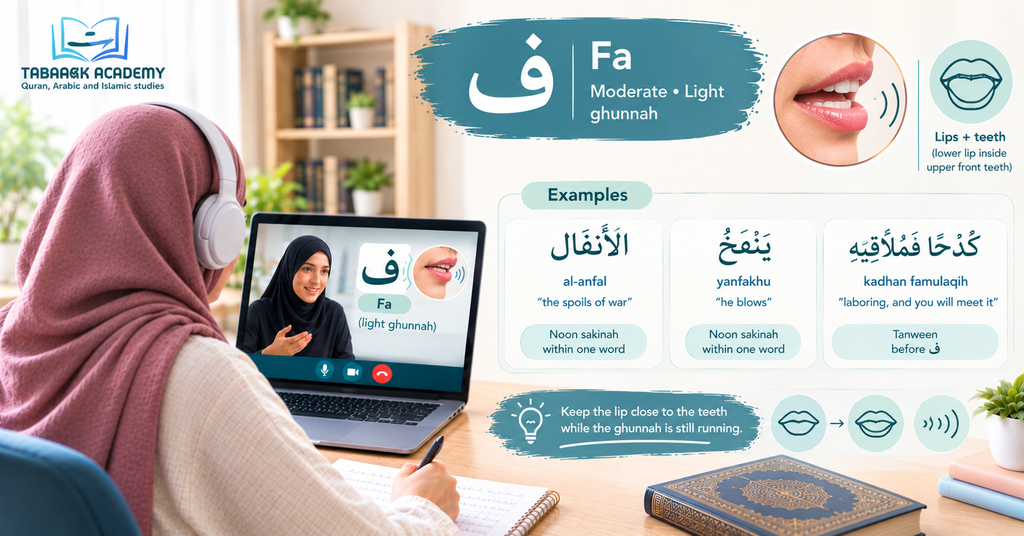
Because fa uses the lip, the mouth closes while the ghunnah is still running. Let the lip approach the teeth during the nasal sound rather than after it — this is what makes the transition sound unforced.
13. The Letter Ta (ت)
Ta is a strong-level ikhfa letter with a light ghunnah. It shares the exact makhraj of dal and taa — the tip of the tongue at the upper gum line — so the concealment is deep, but the letter itself stays thin.
- أَنْتُمْ — antum — “you (plural)” — noon sakinah within one word.
- مِنْ تَحْتِهَا — min tahtiha — “beneath it” — noon sakinah across two words.
- جَنَّاتٌ تَجْرِي — jannatun tajri — “gardens beneath which rivers flow” — tanween before ت
- نَارًا تَلَظَّى — naran talazza — “a blazing fire” — tanween before ت.
Ta is the mirror image of taa: same tongue position, opposite weight. Practicing أَنْتُمْ and يَنْطِقُونَ back to back is the fastest way to train the heavy/light distinction, which is why Tabarak Academy pairs them in the same drill.
14. The Letter Dad (ض)
Dad is a moderate-level ikhfa letter with a heavy ghunnah. It is articulated from the side of the tongue against the upper molars — the most distinctive makhraj in Arabic — and carries full tafkheem plus istitalah (elongation along the tongue’s edge).
- مَنْضُودٍ — mandudin — “layered” — noon sakinah within one word.
- مِنْ ضَرِيعٍ — min dari’ — “from a bitter thorn” — noon sakinah across two words.
- مَسْجِدًا ضِرَارًا — masjidan dirara — “a mosque built for harm” — tanween before ض.
- مِنْ ضُرٍّ — min durr — “from harm” — noon sakinah across two words.
The side of the tongue must already be rising toward the molars while the ghunnah runs. Students who wait until the ghunnah ends produce a dad that sounds closer to dal.
15. The Letter Dha (ظ)
Dha is a moderate-level ikhfa letter with a heavy ghunnah. It shares the makhraj of dhal and tha — tip of tongue at the edge of the upper teeth — but adds tafkheem, making it the heavy counterpart of dhal.
- يَنْظُرُونَ — yandhurun — “they look” — noon sakinah within one word.
- فَأَنْظِرْنِي — fa andhirni — “so grant me respite” — noon sakinah within one word.
- وَلَٰكِنْ ظَنَنْتُمْ — wa lakin zanantum — “but you assumed” — noon sakinah across two words.
- ظِلًّا ظَلِيلًا — zillan zalila — “a thick shade” — tanween before ظ.
Comparing أَنْذَرْنَاكُمْ (light dhal) with يَنْظُرُونَ (heavy dha) isolates tafkheem at a single articulation point — the cleanest heavy/light contrast available in the whole ikhfa letters list with examples.
The density of these examples reflects a practical reality: ikhfa appears on nearly every page of the Mushaf, dozens of times within a single juz’.
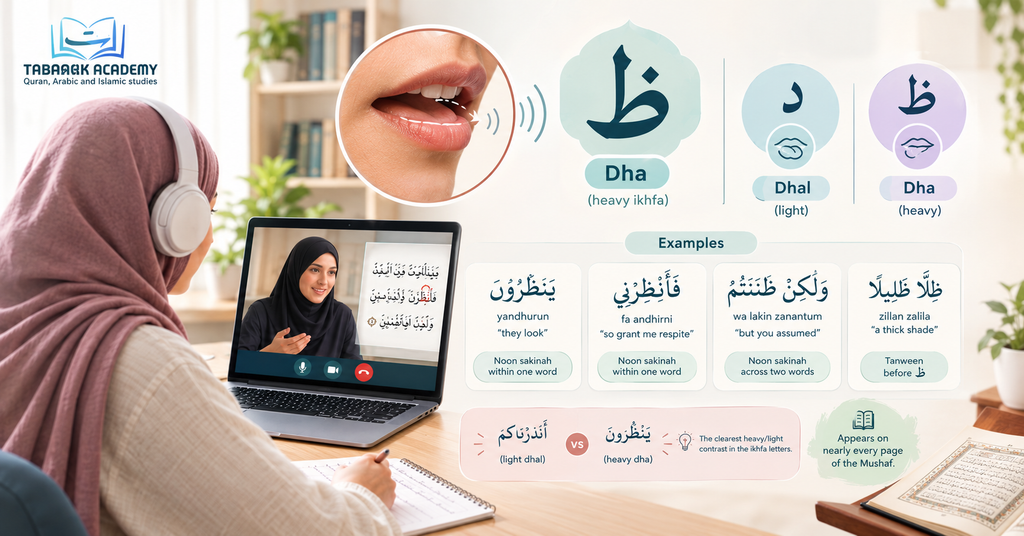
That frequency is why Tabarak Academy introduces all 15 letters early in its Tajweed curriculum rather than holding them for an advanced stage.
Experience Our Interactive Learning
Curious about how we teach? Watch these brief video clips from our recent live sessions to see our structured curriculum, advanced learning platform, and dynamic student-teacher interactions firsthand.
How Do You Apply The Ikhfa Rule Correctly?
Correct ikhfa requires four things happening at once — and a failure in any one of them produces a recognizable error.
- Conceal the Noon Instead of Completing Its Contact: In a normal noon, the tongue tip makes full contact behind the upper front teeth. In ikhfa, do not complete that contact. Producing a clear “n” and then adding ghunnah afterward is not ikhfa — it is izhar with an extra sound attached.
- Move the Mouth Toward the Next Letter: While the ghunnah runs, the tongue and lips are already shaping the following letter’s makhraj.
- This is why ikhfa has no single fixed mouth position: مِنْكُمْ and يَنْطِقُونَ feel completely different inside the mouth even though both are ikhfa.
- Hold the Ghunnah for Two Full Counts: Ghunnah is produced through the nasal passage (khayshum). Hold it for roughly two counts — two finger taps at a steady pace — neither rushed nor stretched.
- Match the Ghunnah’s Weight to the Following Letter: Fuller before ص، ض، ط، ظ، ق. Lighter before the other ten. This is the detail that separates mechanically correct ikhfa from refined recitation.
The Two-Count Drill That Fixes the Most Common Error
The most frequent error pattern among non-Arabic speakers is what teachers call the half-finish: the student conceals the noon correctly, then releases the ghunnah too early, producing something closer to a stopped consonant than a sustained nasal.
Here is the drill:
- Isolate one word — start with مِنْكُمْ
- Stop at the noon and hold a sustained nasal “ng” sound
- Count two slow beats while the sound keeps flowing
- Release into the ك only after the second beat completes
- Repeat until the transition requires no conscious effort
Then repeat the same drill with يَنْطِقُونَ to feel the heavy ghunnah, and compare the two. Students who practice both in the same session internalize the heavy/light distinction far faster than students who drill letters in isolation.
If you want this correction applied to your own recitation rather than guessed at, Tabarak Academy’s Tajweed courses build it directly into live Quran reading.
Step Inside Our Virtual Classrooms
See our engaging teaching methods in action! watch real snippets of our live classes and discover how our expert instructors make learning interactive, memorable, and inspiring for every student.
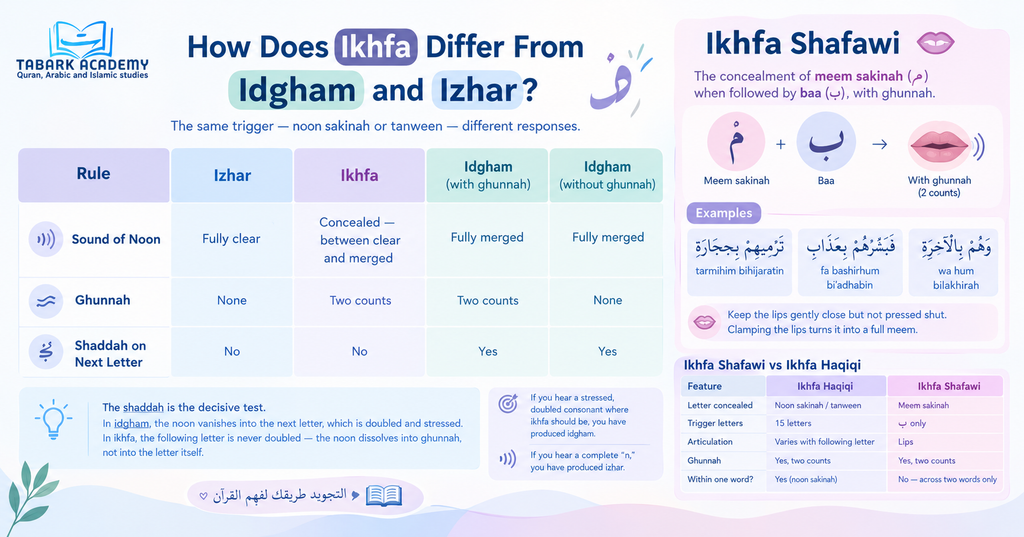
How Does Ikhfa Differ From Idgham and Izhar?
Ikhfa, idgham, and izhar are three different responses to the same trigger — noon sakinah or tanween — determined entirely by which letter category follows.
| Rule | Sound of Noon | Ghunnah | Shaddah on Next Letter |
| Izhar | Fully clear | None | No |
| Ikhfa | Concealed — between clear and merged | Two counts | No |
| Idgham with ghunnah | Fully merged | Two counts | Yes |
| Idgham without ghunnah | Fully merged | None | Yes |
The shaddah is the decisive test. In idgham, the noon vanishes into the next letter, which is doubled and stressed. In ikhfa, the following letter is never doubled — the noon dissolves into ghunnah, not into the letter itself.
If you hear a stressed, doubled consonant where ikhfa should be, you have produced idgham. If you hear a complete “n,” you have produced izhar.
What Is Ikhfa Shafawi, and How Is It Different?
Ikhfa Shafawi is the concealment of meem sakinah (مْ) when followed by baa (ب), accompanied by ghunnah. It is called shafawi (labial) because both letters are articulated with the lips.
Examples: تَرْمِيهِمْ بِحِجَارَةٍ, فَبَشِّرْهُمْ بِعَذَابٍ, وَهُمْ بِالْآخِرَةِ.
Keep the lips gently close but not pressed shut. Clamping the lips before the baa turns the concealment into a full meem.
| Feature | Ikhfa Haqiqi | Ikhfa Shafawi |
| Letter concealed | Noon sakinah / tanween | Meem sakinah |
| Trigger letters | 15 letters | ب only |
| Articulation | Varies with following letter | Lips |
| Ghunnah | Yes, two counts | Yes, two counts |
| Within one word? | Yes (noon sakinah) | No — across two words only |
Read also: What Is Iqlab in Tajweed?
How Can You Recognize Ikhfa In The Mushaf?
Many Uthmani Mushaf editions include visual cues for ikhfa.
For noon sakinah in an ikhfa position, the noon typically appears without a sukoon mark. For tanween, the two vowel marks appear staggered rather than aligned vertically.
A practitioner warning: typography and Tajweed notation vary between printings, and color-coded Mushafs use different schemes. Learn the letter rule itself. A student who depends on colors reads one edition fluently and stumbles in every other.
Start Your Quran Learning Journey
Join Tabark Academy today for structured online lessons with qualified tutors, customized to fit your goals.
Book Your Free Trial LessonStart Applying Ikhfa Correctly With Tabarak Academy
Reading about ghunnah timing and hearing your own ghunnah are different skills. Ikhfa errors are nearly impossible to catch alone because the sound you intend and the sound you produce feel identical from the inside.
At Tabarak Academy, you recite to a qualified teacher who hears the half-finished ghunnah, the over-thickened kaf, and the merged idgham — and corrects each one in the moment it happens, inside real Quranic verses rather than isolated drills.
Book your free trial lesson with Tabarak Academy and turn the ikhfa letters list with examples from something you’ve read into something you apply automatically.
Our Tajweed Courses:
- Online Tajweed Classes
- Tajweed Course for Beginners
- Tajweed Course for Kids
- Tajweed Course for Adults
- Tajweed Course for Sisters
- Advanced Tajweed Course
- Amali (Practical) Tajweed Course
- Learn Quran with Tajweed
- Learn Quran with Tajweed for Kids
- Learn Quran with Tajweed for Sisters

Conclusion
Ikhfa in Tajweed means concealing noon sakinah or tanween when one of 15 specific letters follows, producing a sound between izhar and idgham while the ghunnah runs for two counts.
The ikhfa letters list with examples is the entry point, not the destination. Correct application depends on four things working together: avoiding full noon contact, moving the mouth toward the next letter’s makhraj, holding the ghunnah for its full duration, and matching its weight to the heavy or light letter that follows.
Keep the two scales separate — concealment depth comes from distance to noon, ghunnah weight comes from the letter’s own tafkheem — and ikhfa stops being a rule you recall and becomes a transition you simply produce.
With guided correction from Tabarak Academy, that shift happens in weeks rather than years.
Frequently Asked Questions About Ikhfa Letters
These are the questions students most often raise when working through the ikhfa letters list with examples — covering letter count, level classification, and the distinctions that cause the most confusion in practice.
1. How many ikhfa letters are there?
There are 15 ikhfa letters: ت، ث، ج، د، ذ، ز، س، ش، ص، ض، ط، ظ، ف، ق، ك. They are the remaining letters after izhar’s 6, idgham’s 6, and iqlab’s single letter are removed from the alphabet. Students memorize them through the line صِفْ ذَا ثَنَا كَمْ جَادَ شَخْصٌ قَدْ سَمَا.
2. What is the difference between ikhfa and idgham?
The difference is the shaddah. In idgham, the noon merges completely into the following letter, which becomes doubled and stressed. In ikhfa, the noon is concealed into a two-count ghunnah and the following letter is never doubled.
3. Which ikhfa letters are the strongest?
ط، د، and ت produce the strongest ikhfa because their articulation points are closest to the makhraj of noon. ق and ك produce the weakest ikhfa, being furthest from noon. The remaining 10 letters fall in the moderate level.
4. Can ikhfa occur inside a single word?
Yes, ikhfa with noon sakinah occurs both inside one word (مِنْكُمْ، يَنْطِقُونَ) and across two words (مِنْ قَبْلِ). Tanween ikhfa only occurs across two words, because tanween appears at the end of a word.
5. How long should the ghunnah be held in ikhfa?
The ghunnah in ikhfa is held for approximately two counts — two steady finger taps. Shorter than that leaves the concealment incomplete; longer distorts the verse’s rhythm.
6. Is ikhfa shafawi the same as ikhfa haqiqi?
No. Ikhfa Haqiqi conceals noon sakinah or tanween before 15 letters. Ikhfa Shafawi conceals meem sakinah before baa (ب) only, using the lips. Both carry a two-count ghunnah, but they involve different letters and different articulation.


0 Comments