

Most learners discover ikhfa the same way: they reach a word like مِنْكُمْ, pronounce the noon clearly, and the teacher stops them. So what is ikhfa in tajweed, exactly? Ikhfa is the rule that tells you not to pronounce the noon clearly — and not to merge it either, but to hold it in a nasal middle state for two counts.
That middle state is where most mistakes happen. Learners either over-pronounce the noon (turning ikhfa into izhar) or drop it completely and double the next letter (turning it into idgham). Both errors change the recitation.
This guide covers the definition, the 15 ikhfa letters with Quranic examples, the two types, the three strength levels, and a practice drill used in Tajweed classes at Tabarak Academy to fix the most common ikhfa error in a single session.
What You’ll Learn in This Article
- A precise answer to what is ikhfa in tajweed, plus the three conditions that must all be present for it to be correct
- All 15 ikhfa letters, the classical verse used to memorize them, and a Quranic example for each.
- The difference between Ikhfa Haqiqi and Ikhfa Shafawi.
- The three levels of ikhfa strength and why they are not all pronounced identically.
- A step-by-step drill to correct the “half-finished ghunnah” — the most frequent learner error.
What Is Ikhfa in Tajweed?
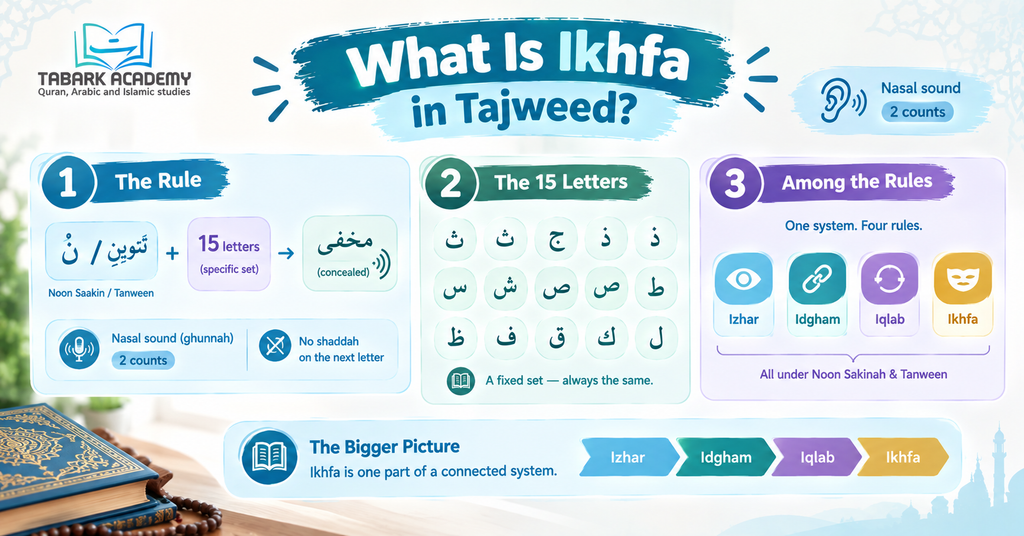
Ikhfa is the rule that conceals noon sakinah (نْ) or tanween when followed by any of 15 specific Arabic letters, producing a nasal sound (ghunnah) held for two counts, with no shaddah on the following letter.
The rule belongs to the rules of noon sakinah and tanween, alongside izhar, idgham, and iqlab. Understanding where ikhfa sits among them is what makes the whole system usable rather than memorized.
Ikhfa in Tajweed Meaning: Linguistic and Technical
The ikhfa in tajweed meaning comes from the Arabic root meaning to hide or to conceal. Technically, it means pronouncing a consonant letter without stress (shaddah), in a quality between izhar and idgham, while the ghunnah remains in the first letter — the noon sakinah or tanween.
That technical definition contains three conditions. All three must be present at the same time:
- The noon sakinah or tanween is not pronounced with full clarity — no izhar
- The following letter carries no shaddah — no idgham
- A ghunnah of two counts continues and flows into the following letter
If any one of the three is missing, the ikhfa is incorrect. A reciter who keeps the ghunnah but doubles the next letter has produced idgham; one who conceals the noon but cuts the ghunnah short has produced neither rule cleanly.
Why Ikhfa Sits Between Izhar and Idgham?
Ikhfa exists because of phonetic distance. The 15 ikhfa letters are neither close enough to the articulation point (makhraj) of the noon to require full merger, nor far enough to require full clarity.
The izhar letters are the six throat letters (ء، ه، ع، ح، غ، خ) — the furthest point in the mouth from the noon’s makhraj at the tip of the tongue, so the noon is left fully clear.
The idgham letters sit close enough to the noon that the sound merges. Everything in between received the middle ruling: concealment with ghunnah.
This is the logic worth holding on to. Anyone asking what is ikhfa in tajweed is really asking a question about distance between two articulation points — which is also why the 15 letters themselves split into strength levels further down.
Experience Our Interactive Learning
Curious about how we teach? Watch these brief video clips from our recent live sessions to see our structured curriculum, advanced learning platform, and dynamic student-teacher interactions firsthand.
The 15 Ikhfa Letters In Tajweed With Quranic Examples
The 15 ikhfa letters are: ص، ذ، ث، ك، ج، ش، ق، س، د، ط، ز، ف، ت، ض، ظ — every Arabic letter not already assigned to izhar, idgham, or iqlab.
Classical scholars did not teach these as a numbered list. They encoded them into two lines of verse from Tuhfat al-Atfal, so the first letter of each word gives you the next ikhfa letter in order:
صِفْ ذَا ثَنَا كَمْ جَادَ شَخْصٌ قَدْ سَمَا
دُمْ طَيِّبًا زِدْ فِي تُقًى ضَعْ ظَالِمًا
Students who learn the verse retain the letters far longer than students who learn the list, because the verse carries rhythm and meaning.
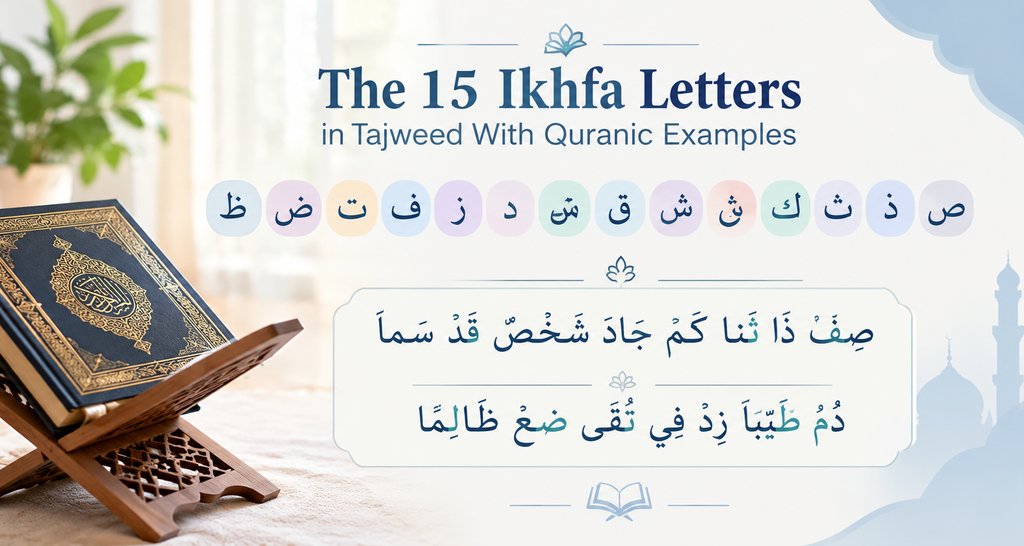
It remains the standard teaching tool across Tajweed traditions, and it is how the letters are introduced in Tabarak Academy’s Tajweed courses before a single example is recited.
- ص (Sad) — مِنْ صَلْصَالٍ (min salsalin), “from clay” — noon sakinah across two words.
- ذ (Dhal) — مَنْ ذَا الَّذِي (man dhal-ladhi), “who is it that” — noon sakinah across two words.
- ث (Tha) — مِنْ ثَمَرَةٍ (min thamaratin), “from any fruit” — noon sakinah across two words.
- ك (Kaf) — مِنْكُمْ (minkum), “among you” — noon sakinah within one word, weakest level.
- ج (Jim) — مَنْ جَاءَ (man jaa’a), “whoever comes” — noon sakinah across two words.
- ش (Shin) — مِنْ شَيْءٍ (min shay’), “from anything” — noon sakinah across two words.
- ق (Qaf) — يَنْقَلِبُ (yanqalibu), “he will return” — noon sakinah within one word, weakest level.
- س (Sin) — الْإِنْسَان (al-insan), “the human being” — noon sakinah within one word.
- د (Dal) — أَنْدَادًا (andadan), “rivals” — noon sakinah within one word, strongest level.
- ط (Ta) — يَنْطِقُونَ (yantiqun), “they speak” — noon sakinah within one word, strongest level.
- ز (Zay) — وَأَنْزَلْنَا (wa anzalna), “and We sent down” — noon sakinah within one word.
- ف (Fa) — الْأَنْفَال (al-anfal), “the spoils of war” — noon sakinah within one word.
- ت (Ta) — أَنْتُمْ (antum), “you” — noon sakinah within one word, strongest level.
- ض (Dad) — مَنْضُودٍ (mandudin), “layered” — noon sakinah within one word, strongest level.
- ظ (Dha) — يَنْظُرُونَ (yandhurun), “they look” — noon sakinah within one word, strongest level.
Tanween follows the same rule with the same two-count ghunnah: حَلَالًا طَيِّبًا (tanween before ط), جَنَّاتٌ تَجْرِي (tanween before ت), خَلْقٍ جَدِيدٍ (tanween before ج), عَذَابًا قَرِيبًا (tanween before ق).
Because ikhfa covers 15 of the 28 Arabic letters, it is the most frequently occurring of all the noon sakinah rules — which is why it appears in a learner’s very first surah-level practice, long before the rarer rules do.
Types of Ikhfa in Tajweed
There are two types of ikhfa, and they are distinguished by which letter is being concealed: the noon sakinah, or the meem sakinah.
Confusing the two is common among self-taught learners, because both share the word ikhfa and both involve a ghunnah. The letters, the triggers, and the lip position are completely different.
1. Ikhfa Haqiqi (True Ikhfa)
Ikhfa Haqiqi is the concealment of noon sakinah or tanween before any of the 15 ikhfa letters. It is called haqiqi (true, real) because the concealment of the noon here is complete — the noon’s own articulation point is abandoned entirely, and only the nasal resonance remains.
All the examples in the list above are Ikhfa Haqiqi. It occurs in three positions, covered in the next section.
2. Ikhfa Shafawi (Oral Ikhfa)
Ikhfa Shafawi is the concealment of meem sakinah (مْ) when it is followed by the letter baa (ب) at the start of the next word. It is called shafawi (labial) because both the meem and the baa are articulated from the lips.
Quranic examples include تَرْمِيهِمْ بِحِجَارَةٍ,(88:22) لَسْتَ عَلَيْهِمْ بِمُصَيْطِرٍ,(18:32)عَلَيْهِمْ بُنْيَانًا,
and صَاحِبُكُمْ بِمَجْنُونٍ (81:22).
The practitioner detail that matters here: when pronouncing Ikhfa Shafawi, the lips come together lightly, without pressing.
Pressing the lips shut produces a clear meem (izhar shafawi); leaving a visible gap produces a distorted sound that is neither. Light contact with the ghunnah flowing through is the correct position — and it is almost impossible to self-diagnose without a teacher listening.
Read also: What Is Iqlab in Tajweed?
Start Your Quran Learning Journey
Join Tabark Academy today for structured online lessons with qualified tutors, customized to fit your goals.
Book Your Free Trial LessonThe Three Positions Where Ikhfa Haqiqi Occurs
Ikhfa Haqiqi appears in three positional forms, depending on whether the noon sits inside one word or at a word boundary, and whether tanween is involved.
| Position | Description | Example |
| Noon sakinah within one word | Noon sakinah and ikhfa letter in the same word | مِنْكُمْ |
| Noon sakinah across two words | First word ends in noon sakinah, next begins with an ikhfa letter | مِنْ قَبْلِ |
| Tanween before an ikhfa letter | Tanween ends the first word, ikhfa letter starts the next | رِزْقٌ كَرِيمٌ |
All three carry the identical ruling and the identical two-count ghunnah. The position changes only where the noon appears in the written text, never the sound.
One rule worth noting: noon sakinah can produce ikhfa within a single word or across two words, but tanween only ever produces ikhfa across two words — because tanween, by definition, falls at the end of a word.
Step Inside Our Virtual Classrooms
See our engaging teaching methods in action! watch real snippets of our live classes and discover how our expert instructors make learning interactive, memorable, and inspiring for every student.
The Three Levels of Ikhfa Strength
Ikhfa is not pronounced identically across all 15 letters. Its strength varies with how close each letter’s makhraj is to the articulation point of the noon.
This is the detail most beginner material omits entirely, and it is the difference between recitation that is technically correct and recitation that sounds right.
| Level | Letters | Reason |
| Strongest (Aqwa) | ط، د، ت | Closest to the noon’s makhraj — nearly approaching idgham |
| Moderate (Awsat) | ث، ج، ذ، ز، س، ش، ص، ض، ظ، ف | Neither extreme proximity nor extreme distance |
| Weakest (Adna) | ق، ك | Furthest from the noon’s makhraj — approaching izhar |
In practice, before ط، د، ت the tongue approaches the same region of the upper gums where the noon would land, so the concealment feels deep and the ghunnah sits almost inside the following letter — as in أَنْتُمْ and يَنْطِقُونَ.
Before ق and ك, the articulation point is far back in the mouth, the noon’s disappearance feels less total, and the ghunnah is noticeably lighter — as in مِنْ قَبْلِ and مِنْكُمْ.
The ten moderate letters sit between the two, which is why they are the safest group to practise first: the margin for error is widest.
A learner who only knows what is ikhfa in tajweed at the definition level will flatten all three levels into one sound; a learner who knows the gradation will not.
How To Practice Ikhfa Correctly?
Correct ikhfa requires training two things at once — suppressing the urge to pronounce the noon, and sustaining the ghunnah instead of letting it fade.
The most persistent error pattern among non-Arabic speakers is what we call the half-finish: the learner conceals the noon correctly, then releases the ghunnah too early, producing something closer to a stopped consonant than a nasal resonance.
The first half of the rule is right; the second half collapses.
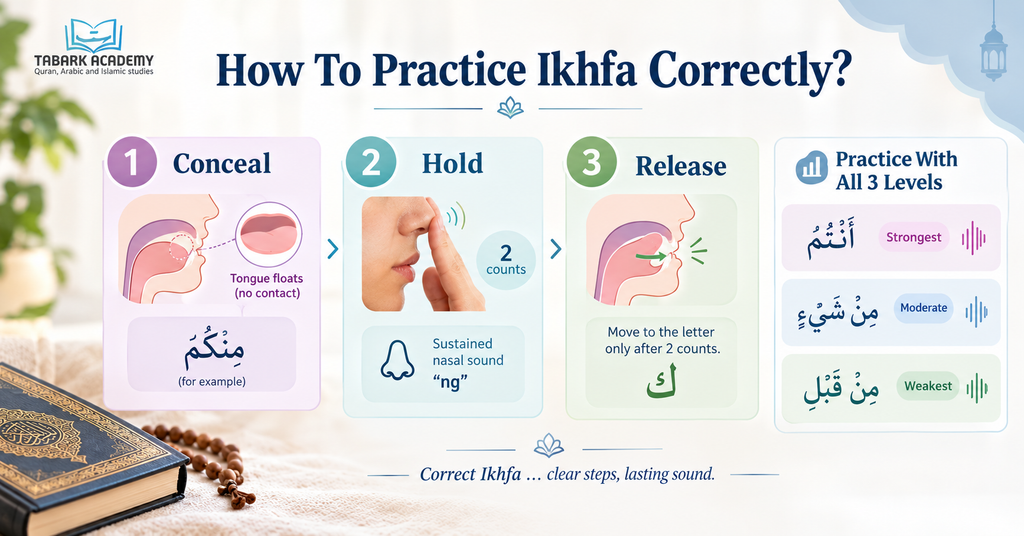
Separating the rule into three deliberate steps fixes it, because it forces the ghunnah to be timed rather than guessed.
- Conceal:Take a word with noon sakinah before an ikhfa letter, such as مِنْكُمْ. Stop the tongue before it touches the upper gums where the noon would be articulated. The tongue should be floating, not contacting.
- Hold: Hold a sustained nasal “ng” sound for a slow count of two. Place a hand lightly on the bridge of the nose — if there is no vibration, there is no ghunnah, and the exercise has already failed.
- Release: Move into the ك only after the two counts are complete. Do not shorten the hold to reach the letter faster; the ghunnah belongs to the noon, not to the letter that follows.
Repeat with one letter from each strength level — أَنْتُمْ (strongest), مِنْ شَيْءٍ (moderate), مِنْ قَبْلِ (weakest) — so the ear learns the gradation rather than a single flat sound.
Three Mistakes to Check Yourself For:
- Doubling the following letter: If the ك in مِنْكُمْ sounds stressed, you have produced idgham. Ikhfa never adds shaddah.
- A visible noon: If a listener can clearly hear the “n”, the tongue touches the gums. Keep it floating.
- An uncounted ghunnah: “About two counts” is not two counts. Count aloud while drilling until the duration becomes automatic.
Self-correction has a ceiling here, because the error is in a sound you cannot hear in your own recitation.
A teacher listening live catches it in the first minute — which is exactly how ikhfa is corrected in one-to-one sessions at Tabarak Academy, where every rule is corrected during actual Quran reading rather than taught as theory and left to the student to apply.
Read also: Idgham With Ghunnah Vs Idgham Without Ghunnah
Ikhfa Vs Idgham Vs Izhar: The Comparison That Prevents Errors
Ikhfa, idgham, and izhar are three different responses to noon sakinah and tanween, triggered by three different groups of letters.
Seeing them side by side is what makes the boundaries stick, and it is the fastest way to turn the answer to what is ikhfa in tajweed into something you can apply mid-recitation.
| Rule | Sound of the Noon | Ghunnah | Shaddah on Next Letter |
| Izhar | Fully clear | None | No |
| Ikhfa | Concealed — between clear and merged | Two counts | No |
| Idgham with ghunnah | Fully merged | Two counts | Yes |
| Idgham without ghunnah | Fully merged | None | Yes |
The single most useful distinction is the shaddah. In idgham, the noon disappears and the following letter is doubled and stressed. In ikhfa, the following letter is never doubled — the noon dissolves into the ghunnah, not into the letter.If you are ever unsure which rule applies, ask one question: is the next letter stressed? Stressed means idgham. Not stressed, but nasal, means ikhfa. Not stressed and not nasal means izhar.
Start Your Quran Learning Journey
Join Tabark Academy today for structured online lessons with qualified tutors, customized to fit your goals.
Book Your Free Trial LessonStart Learning Tajweed Properly — Book Your Free Trial Lesson
Ikhfa is one rule out of dozens, and every one of them has the same problem: the mistake is in a sound you cannot hear yourself making. A qualified teacher hears it immediately.
Tabarak Academy teaches Tajweed one-to-one, online, with certified instructors who correct your recitation live — not after the fact. Lessons are scheduled around your availability, and you can start with a free trial before committing to anything.
Our Tajweed Courses:
- Tajweed Course for Beginners
- Tajweed Course for Kids
- Tajweed Course for Adults
- Tajweed Course for Sisters
- Advanced Tajweed Course
- Amali (Practical) Tajweed Course
- Learn Quran with Tajweed
- Learn Quran with Tajweed for Kids
- Learn Quran with Tajweed for Sisters

Conclusion
So, what is ikhfa in tajweed? It is the concealment of noon sakinah or tanween before 15 specific letters, held with a two-count ghunnah, with no stress on the letter that follows.
It is the middle ruling between izhar and idgham, and it exists because those 15 letters sit at a middle phonetic distance from the noon’s articulation point.
With ikhfa in tajweed explained through its three conditions — no clear noon, no shaddah, a sustained two-count ghunnah — the rule stops being something to memorize and becomes something to hear. Add the three strength levels on top of that, and your recitation moves from technically correct to properly measured.
Learn the 15 letters through the classical verse, drill them with the Conceal–Hold–Release method, and have a teacher verify what your own ear cannot.
Frequently Asked Questions About Ikhfa in Tajweed
These are the questions learners ask most often once they begin applying ikhfa to actual recitation rather than studying it in isolation. Each answer is kept short enough to use as a quick reference during practice.
1. What is the difference between Ikhfa Haqiqi and Ikhfa Shafawi?
Ikhfa Haqiqi conceals noon sakinah or tanween before 15 letters, while Ikhfa Shafawi conceals meem sakinah before only one letter, baa (ب). Haqiqi involves the tongue; shafawi involves light contact between the lips.
2. Do all 15 ikhfa letters have the same strength of ghunnah?
No. Ikhfa has three strength levels: strongest before ط، د، ت, weakest before ق، ك, and moderate before the remaining ten letters. The ghunnah is always two counts, but the depth of concealment varies with the letter’s distance from the noon’s makhraj.
3. How can I memorize the 15 ikhfa letters quickly?
Use the classical verse صِفْ ذَا ثَنَا كَمْ جَادَ شَخْصٌ قَدْ سَمَا / دُمْ طَيِّبًا زِدْ فِي تُقًى ضَعْ ظَالِمًا. The first letter of each word is an ikhfa letter, in order. This mnemonic from Tuhfat al-Atfal is retained far longer than a numbered list.
4. Does tanween follow the same ikhfa rules as noon sakinah?
Yes. Tanween before any of the 15 letters produces the identical ikhfa with the same two-count ghunnah. The only difference is positional: tanween always falls at the end of a word, so its ikhfa only ever occurs across two words.
5. Is ikhfa considered a form of idgham?
No. Ikhfa and idgham are separate rules, and the shaddah is what separates them. In idgham the noon merges fully and the following letter is doubled; in ikhfa the following letter is never doubled and the noon dissolves into the ghunnah alone.
6. How long should the ghunnah be held in ikhfa?
Two counts — the same duration as the ghunnah in idgham with ghunnah. A count is roughly the time taken to say one short vowel at a measured recitation pace, so the duration should be consistent across your entire recitation, not estimated per word.


0 Comments