
What is juz tabarak, and why do so many Quran students start it right after Juz Amma? Juz Tabarak is the 29th of the Quran’s 30 parts. It begins with Surah Al-Mulk and ends with Surah Al-Mursalat, and for many children and new Muslims it is the second juz they memorize.
This guide gives you juz tabarak explained in simple, reliable terms: where its name comes from, which 11 surahs it contains, how many verses and pages it covers, and what its surahs teach about Allah, the Hereafter, and the message of Prophet Muhammad ﷺ.
It also shares a practical memorization plan from the teaching team at Tabarak Academy, including when a child is ready to begin Juz Tabarak, the best order to follow.
Key Takeaways – What You Will Learn
- The juz tabarak meaning, and why the 29th part of the Quran is named after its first word, “Tabarak.”
- The 11 surahs of Juz Tabarak in order, with verse counts and starting pages in the 604-page Madinah Mushaf.
- The main themes of Juz Tabarak, including Tawheed, the Day of Judgment, and the truth of the Quran.
- Authentic hadith about the virtue of Surah Al-Mulk, the opening surah of the juz.
- A three-stage memorization plan for children and beginners, with a realistic timeline.
What Is Juz Tabarak
Juz Tabarak is the twenty-ninth juz (part) of the Holy Quran. It contains 11 complete surahs, from Surah Al-Mulk (chapter 67) to Surah Al-Mursalat (chapter 77), with a total of 431 verses. In the standard 604-page Madinah Mushaf, Juz Tabarak covers 20 pages, from page 562 to page 581.
A juz (plural: ajza’) is one of the 30 roughly equal parts the Quran is divided into to make regular reading and memorization easier. Each juz is commonly known by the word it begins with, so the 29th juz is called Juz Tabarak and the 30th juz is called Juz Amma.
Its surahs also remind Muslims of the importance of reflecting on the Quran’s message and preparing for the Hereafter through righteous deeds and sincere worship.
Juz Tabarak Meaning – Why It Is Called Tabarak
The juz tabarak meaning comes from its very first word. Tabarak (تَبَارَكَ) is an Arabic word meaning “Blessed is He” or “Exalted is He.” It describes Allah as abundant in goodness and blessing and far above any imperfection. The juz carries this name because it opens with the first verse of Surah Al-Mulk.
تَبَارَكَ الَّذِي بِيَدِهِ الْمُلْكُ وَهُوَ عَلَىٰ كُلِّ شَيْءٍ قَدِيرٌ
“Blessed is He in whose hand is dominion, and He is over all things competent.”
The word Tabarak in this verse praises Allah as the One who holds all dominion (al-mulk) and has power over everything. This opening sets the tone for the whole of Juz Tabarak, which repeatedly points to Allah’s power in creation and His authority over life, death, and the Day of Judgment.
Where Juz Tabarak Comes In The Quran
Juz Tabarak comes directly before Juz Amma, the 30th and final juz of the Quran. Because of this position, it is usually the second juz a child memorizes after completing Juz Amma, especially in programs that start from Surah An-Nas and move upward through the Mushaf.
Juz Tabarak also differs clearly from the 28th juz before it. The surahs of the 28th juz are Madani, revealed after the Hijrah to Madinah, and many of them address rulings for the Muslim community. Most surahs of Juz Tabarak are Makki, revealed in Makkah, and focus on faith, the Hereafter, and the Prophet’s message.
Most scholars classify the surahs of Juz Tabarak as Makki. Surah Al-Insan is the main exception discussed, because scholars differ over whether it was revealed in Makkah or Madinah.
Surahs Of Juz Tabarak In Order
The surahs of Juz Tabarak, in the order of the Mushaf, are 11 chapters numbered from 67 to 77. The table below lists each surah’s English name, its Arabic name, its number in the Quran, its verse count, and the page where it begins in the 604-page Madinah Mushaf.
Verse counts in the table follow the Kufan counting printed in most copies of the Quran today. A surah that starts on the same page where the previous surah ends begins in the middle of that page rather than at the top.
| # | Surah | Arabic Name | Surah Number | Verses | Starts On Page |
|---|---|---|---|---|---|
| 1 | Surah Al-Mulk | الملك | 67 | 30 | 562 |
| 2 | Surah Al-Qalam | القلم | 68 | 52 | 564 |
| 3 | Surah Al-Haqqah | الحاقة | 69 | 52 | 566 |
| 4 | Surah Al-Ma’arij | المعارج | 70 | 44 | 568 |
| 5 | Surah Nuh | نوح | 71 | 28 | 570 |
| 6 | Surah Al-Jinn | الجن | 72 | 28 | 572 |
| 7 | Surah Al-Muzzammil | المزمل | 73 | 20 | 574 |
| 8 | Surah Al-Muddaththir | المدثر | 74 | 56 | 575 |
| 9 | Surah Al-Qiyamah | القيامة | 75 | 40 | 577 |
| 10 | Surah Al-Insan | الإنسان | 76 | 31 | 578 |
| 11 | Surah Al-Mursalat | المرسلات | 77 | 50 | 580 |
| Total | 67-77 | 431 | 562-581 |
Juz Tabarak Explained Surah By Surah
Having Juz Tabarak explained one surah at a time helps students understand the meaning and message of what they memorize, rather than focusing only on correct recitation. By exploring each surah separately, learners can become familiar with its main themes, important lessons, and the guidance it offers in everyday life.
Each section below includes the surah’s number, its total number of verses, and a brief summary of its central message, based on the subjects addressed in its verses.
This step-by-step approach makes juz tabarak explained easier to follow, helping students connect the verses with their meanings, strengthen their understanding, and develop a deeper appreciation of the Quran.
a. Surah Al-Mulk (67) – The Sovereignty
Surah Al-Mulk is the first surah of Juz Tabarak and contains 30 verses. It affirms Allah’s complete dominion, explains that life and death were created as a test of deeds, and invites the reader to look at the flawless creation of the heavens.
Surah Al-Mulk also describes the regret of the people of the Fire, who admit they did not listen or reason. Many Muslims recite it every night, following the authentic narrations discussed later in this article.
b. Surah Al-Qalam (68) – The Pen
Surah Al-Qalam contains 52 verses and opens with an oath by the pen and what is written. It defends Prophet Muhammad ﷺ against the accusation of madness and praises his great moral character, a key theme for anyone studying the Prophet’s example.
Surah Al-Qalam also tells the story of the garden owners who planned to deny the poor their share and lost their harvest. It closes by encouraging patience with the decision of Allah.
Experience Our Interactive Learning
Curious about how we teach? Watch these brief video clips from our recent live sessions to see our structured curriculum, advanced learning platform, and dynamic student-teacher interactions firsthand.
Start Your Quran Learning Journey
Join Tabark Academy today for structured online lessons with qualified tutors, customized to fit your goals.
Book Your Free Trial Lessonc. Surah Al-Haqqah (69) – The Inevitable Reality
Surah Al-Haqqah contains 52 verses. Its name, Al-Haqqah, is one of the names of the Day of Judgment, meaning the certain reality that will surely come. The surah recalls the destruction of ‘Aad, Thamud, and Pharaoh for denying their messengers.
Surah Al-Haqqah contrasts the joy of those given their record in the right hand with the regret of those given it in the left. It affirms that the Quran is revelation, not poetry or soothsaying.
d. Surah Al-Ma’arij (70) – The Ascending Stairways
Surah Al-Ma’arij contains 44 verses. It describes the angels and the Spirit ascending to Allah in a day whose measure is fifty thousand years, and it warns those who mocked the coming punishment.
Surah Al-Ma’arij explains that humans were created anxious and impatient, except those who pray. It lists their qualities: steady prayer, giving a known share of wealth to the needy, fearing Allah’s punishment, guarding chastity, and keeping trusts and promises.
e. Surah Nuh (71) – Noah
Surah Nuh contains 28 verses and is devoted entirely to the call of Prophet Nuh (Noah), peace be upon him. He invited his people night and day, in public and in private, to worship Allah alone and seek His forgiveness.
Surah Nuh shows that seeking forgiveness (istighfar) is linked to rain, wealth, and children, as Prophet Nuh promised his people. They stubbornly refused, and the surah ends with his supplication against the persistent disbelievers.
f. Surah Al-Jinn (72) – The Jinn
Surah Al-Jinn contains 28 verses. It describes how a group of jinn listened to the Quran, recognized that it guides to what is right, and believed in Allah without associating partners with Him.
Surah Al-Jinn affirms that places of worship belong to Allah alone, so no one should be called upon besides Him. It also teaches that only Allah knows the unseen, except what He reveals to messengers He chooses.
g. Surah Al-Muzzammil (73) – The Enwrapped One
Surah Al-Muzzammil contains 20 verses and addresses Prophet Muhammad ﷺ, instructing him to stand in prayer at night and to recite the Quran slowly and clearly. This instruction is the Quranic basis for tarteel, measured and careful recitation.
أَوْ زِدْ عَلَيْهِ وَرَتِّلِ الْقُرْآنَ تَرْتِيلًا
“Or add to it, and recite the Qur’an with measured recitation.”
The final verse of Surah Al-Muzzammil eases the night prayer, telling believers to recite what is easy for them. Students who want to apply tarteel in their own reading can build this skill through our Quran recitation course.

h. Surah Al-Muddaththir (74) – The Cloaked One
Surah Al-Muddaththir contains 56 verses, making it the longest surah in Juz Tabarak. It commands the Prophet ﷺ to arise and warn, to magnify his Lord, and to purify his garments, marking the start of the public call to Islam.
Surah Al-Muddaththir also describes a man who reflected on the Quran and then called it magic. It warns of Saqar, one of the names of Hellfire, and mentions its nineteen keepers.
i. Surah Al-Qiyamah (75) – The Resurrection
Surah Al-Qiyamah contains 40 verses and opens with an oath by the Day of Resurrection and by the self-reproaching soul. It answers those who doubted resurrection by stating that Allah is able to restore even a person’s fingertips.
Surah Al-Qiyamah also instructs the Prophet ﷺ not to hurry his tongue when receiving revelation, because Allah guarantees its collection and recitation. It describes radiant faces on that Day, looking at their Lord.
j. Surah Al-Insan (76) – Man
Surah Al-Insan contains 31 verses and is also known as Surah Ad-Dahr. It reminds people that there was a time when they were nothing worth mentioning, and that Allah created them from a mixed drop to test them.
Surah Al-Insan describes the righteous who feed the poor, the orphan, and the captive purely for Allah’s sake. It then describes their reward in Paradise in vivid detail.
k. Surah Al-Mursalat (77) – Those Sent Forth
Surah Al-Mursalat contains 50 verses and closes Juz Tabarak. It begins with oaths by the winds sent forth and affirms that what people are promised, the Day of Judgment, will certainly take place.
Surah Al-Mursalat repeats the warning “Woe that Day to the deniers” ten times. This refrain makes the surah memorable and reinforces the main message of the juz about accountability.
Read also: List of the most frequent words in the Quran
Main Themes Of Juz Tabarak
The main themes of Juz Tabarak center on Tawheed (the Oneness of Allah), His power shown in creation, and the certainty of the Day of Judgment. Because most of its surahs are Makki, they focus on the foundations of faith rather than the detailed rulings found in many Madani surahs.
الَّذِي خَلَقَ الْمَوْتَ وَالْحَيَاةَ لِيَبْلُوَكُمْ أَيُّكُمْ أَحْسَنُ عَمَلًا ۚ وَهُوَ الْعَزِيزُ الْغَفُورُ
“[He] who created death and life to test you [as to] which of you is best in deed – and He is the Exalted in Might, the Forgiving.”
This verse from Surah Al-Mulk summarizes a core message of Juz Tabarak: life is a test of deeds, and Allah is both Almighty and Forgiving. The themes below return to this idea throughout the juz.
Virtues Of Surah Al-Mulk In Authentic Hadith
The best-known virtue connected to Juz Tabarak concerns its first surah, Surah Al-Mulk. Authentic hadith describe it as a surah of thirty verses that intercedes for the one who recites it, and they report that the Prophet ﷺ recited it regularly before sleeping.
These narrations highlight the importance of making Surah Al-Mulk part of a Muslim’s daily Quran recitation routine.
عَنِ النَّبِيِّ صلى الله عليه وسلم قَالَ: “إِنَّ سُورَةً مِنَ الْقُرْآنِ ثَلاَثُونَ آيَةً شَفَعَتْ لِرَجُلٍ حَتَّى غُفِرَ لَهُ، وَهِيَ سُورَةُ تَبَارَكَ الَّذِي بِيَدِهِ الْمُلْكُ”
“The Prophet ﷺ said: “There is a surah in the Quran of thirty verses that interceded for a man until he was forgiven, and it is: Tabarakalladhi biyadihil-mulk (Blessed is He in whose hand is dominion).””
Following this Sunnah is a practical first goal for anyone beginning Juz Tabarak.
Longest And Shortest Surahs In Juz Tabarak
The longest surah in Juz Tabarak is Surah Al-Muddaththir with 56 verses, followed by Surah Al-Qalam and Surah Al-Haqqah with 52 verses each. The shortest surah is Surah Al-Muzzammil with 20 verses, followed by Surah Nuh and Surah Al-Jinn with 28 verses each.
The average surah in Juz Tabarak has about 39 verses, compared with about 15 in Juz Amma, based on dividing each juz’s verses by its number of surahs. A child memorizing Juz Amma may finish a short surah in a week, while one Juz Tabarak surah can take a month or more.
Breaking longer surahs into smaller sections and following a realistic daily memorization plan can help children make steady progress without feeling overwhelmed.
When Is A Child Ready To Memorize Juz Tabarak
A child is ready to memorize Juz Tabarak when they can recite Juz Amma in order with few mistakes and read new verses from the Mushaf smoothly without sounding out letters. Readiness for Juz Tabarak depends on these two skills, not on reaching a specific age.
Age is a weak measure of readiness for Juz Tabarak, because two nine-year-olds can be at very different stages.
The table below is a simple readiness guide based on teaching experience, not a formal test. It compares the two skills a child needs before starting Juz Tabarak and shows what readiness looks like for each one.
| Skill | Ready For Juz Tabarak | Not Ready Yet | Suggested Next Step |
|---|---|---|---|
| Memorizing Juz Amma | Recites each stage of Juz Amma continuously without repeated prompting | Needs frequent prompting or mixes up surahs | Keep reviewing Juz Amma before adding new surahs |
| Reading from the Mushaf | Reads an unmemorized verse smoothly from the page | Sounds out letters or reads word by word | Strengthen reading with the Noorani Qaida first |
The Best Order To Memorize Juz Tabarak
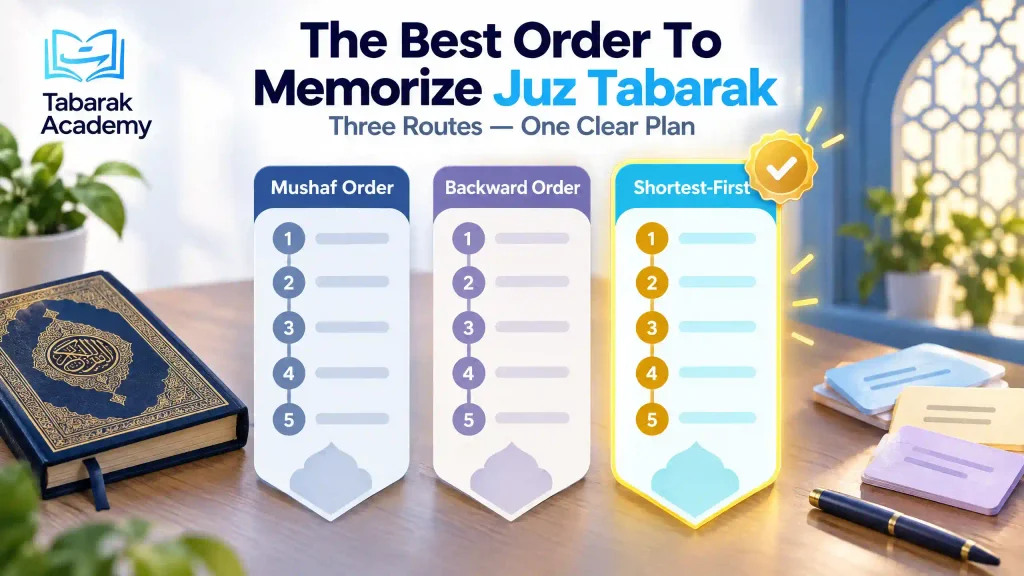
Juz Tabarak can be memorized in three orders: in Mushaf order starting from Surah Al-Mulk, backward from Surah Al-Mursalat as many students do with Juz Amma, or from the shortest surahs to the longest. For children, we suggest the shortest-first option, organized in three stages.
Starting from the end works well in Juz Amma because its shortest surahs come last. In Juz Tabarak, the last surah, Surah Al-Mursalat, has 50 verses, while the three shortest surahs sit together in the middle of the juz.
The same principle of starting with the shortest therefore leads to a different order. This approach allows children to build confidence with shorter passages before gradually moving on to longer and more challenging surahs.
Read also: Hifz academies in Egypt.
1. Stage One – Surah Nuh, Surah Al-Jinn, And Surah Al-Muzzammil
Stage one of Juz Tabarak covers Surah Nuh, Surah Al-Jinn, and Surah Al-Muzzammil, three neighboring surahs with 76 verses in total. As the shortest surahs in the juz, they help a child adjust to longer surahs. Al-Muzzammil’s verses are long, so split each one into short phrases when needed.
Students who still need practice with shorter chapters can strengthen their foundation through our short surah memorization course before or alongside this first stage.
2. Stage Two – Surah Al-Muddaththir To Surah Al-Mursalat
Stage two of Juz Tabarak continues forward from the end of stage one and covers Surah Al-Muddaththir, Surah Al-Qiyamah, Surah Al-Insan, and Surah Al-Mursalat, with 177 verses in total. Memorizing these surahs in Mushaf order helps the child connect each surah smoothly to the next.
Surah Al-Muddaththir is the longest surah in Juz Tabarak, so dividing it into two or three sections keeps daily portions manageable and reduces errors.
3. Stage Three – Surah Al-Mulk To Surah Al-Ma’arij
Stage three of Juz Tabarak returns to the opening of the juz and covers Surah Al-Mulk, Surah Al-Qalam, Surah Al-Haqqah, and Surah Al-Ma’arij, with 178 verses in total. By this stage, the child is used to long surahs and steady review.
After finishing stage three, the student should recite the whole of Juz Tabarak in Mushaf order, from Al-Mulk to Al-Mursalat, to join the endings and beginnings of all 11 surahs.
Read also: How many pages a day you need to finish hifz in 3 years.
Step Inside Our Virtual Classrooms
See our engaging teaching methods in action! watch real snippets of our live classes and discover how our expert instructors make learning interactive, memorable, and inspiring for every student.
How Long Does It Take To Memorize Juz Tabarak
The time needed to memorize Juz Tabarak equals its 431 verses divided by the number of new verses learned each week, plus extra weeks for review. At 10 new verses per week, the calculation gives about 44 weeks, or roughly ten months, before review time is added.
The table below shows how the weekly pace changes the timeline for memorizing Juz Tabarak. Each figure is a simple calculation, rounded up, that divides the 431 verses of the juz by the number of new verses learned each week.
Families can use the table to choose a weekly target that fits the child’s age, schedule, and memorization strength.
| New Verses Per Week | Estimated Weeks | Approximate Months |
|---|---|---|
| 5 | 87 | About 20 |
| 10 | 44 | About 10 |
| 15 | 29 | About 7 |
| 20 | 22 | About 5 |
How To Review Juz Tabarak And Keep It Strong
Reviewing Juz Tabarak regularly is as important as memorizing it, because longer surahs fade faster when they are not repeated. A simple plan is to recite new verses daily, review the current surah every few days, and recite one completed surah of the juz each week.
Linking the end of each Juz Tabarak surah to the beginning of the next prevents gaps during full recitation. Students who want to understand why consistent review matters can read our article on the hadith about forgetting the Quran explained.
Children usually stay more consistent with a structured class and a patient tutor. Our online Quran course for kids combines memorization, review, and Tajweed in short, engaging sessions designed for young learners working through Juz Amma and Juz Tabarak.
Start Your Quran Learning Journey
Join Tabark Academy today for structured online lessons with qualified tutors, customized to fit your goals.
Book Your Free Trial LessonMemorize Juz Tabarak With A Qualified Tutor At Tabarak Academy
Memorizing Juz Tabarak is a meaningful step after Juz Amma, and the right guidance makes it much easier. At Tabarak Academy, qualified tutors build a personal plan for each student, correct recitation and Tajweed in every lesson, and schedule steady review so longer surahs stay firm.
Lessons at Tabarak Academy are one-to-one, online, and flexible for children, adults, and new Muslims. Book a free trial lesson today to assess your current level and start memorizing Juz Tabarak with confidence.

Our Quran Courses
- Online Quran Classes
- Online Quran Classes for Beginners
- Online Quran Classes for Kids
- Online Quran Classes for Adults
- Online Quran Classes for Men
- Online Quran Classes for Sisters
- Quran Reading Course
- Quran Recitation Course
Conclusion – Juz Tabarak Explained In Brief
So, what is Juz Tabarak? It is the 29th juz of the Quran, named after its first word, Tabarak, and made up of 11 surahs and 431 verses from Surah Al-Mulk to Surah Al-Mursalat. Its surahs focus on Allah’s power, the Day of Judgment, and the truth of the Prophet’s message.
Understanding the juz tabarak meaning, its surahs, and its themes turns memorization into a deeper connection with the Quran. With a clear readiness check, a stage-by-stage plan, and steady review, students can memorize Juz Tabarak confidently, one verse at a time, seeking the reward of Allah.
Parents and teachers can support this journey by creating a positive learning environment, In this way, memorization becomes not just a goal to complete but a meaningful habit that strengthens their relationship with the Quran.
Frequently Asked Questions About Juz Tabarak
Which Juz Is Juz Tabarak?
Juz Tabarak is the 29th juz of the Quran. It comes directly before Juz Amma and starts with Surah Al-Mulk, chapter 67, on page 562 of the 604-page Madinah Mushaf.
How Many Surahs Are In Juz Tabarak?
Juz Tabarak contains 11 surahs, from Surah Al-Mulk (67) to Surah Al-Mursalat (77). Together, these surahs include 431 verses spread across 20 pages of the Madinah Mushaf.
What Does Tabarak Mean In Arabic?
Tabarak means “Blessed is He” or “Exalted is He.” It describes Allah as abundant in blessing and above all imperfection, and it is the first word of Surah Al-Mulk, which gives Juz Tabarak its name.
Is Juz Tabarak Harder To Memorize Than Juz Amma?
Juz Tabarak usually feels harder than Juz Amma because its surahs are longer, averaging about 39 verses compared with about 15. Dividing long surahs into small sections and reviewing daily makes it manageable.


0 Comments