

How to Improve Quran Recitation – A Complete Guide
Have you ever recited a verse of the Quran and wondered whether you are pronouncing every letter correctly, applying Tajweed consistently, and giving each Ayah the clarity it deserves?
For many learners, improving Quran recitation is not simply about reading more. Real progress comes from identifying which part of your recitation needs improvement and practicing that skill correctly.
You may need to strengthen your Makharij, correct recurring Tajweed mistakes, improve fluency, control Madd more accurately, or become more confident when moving from one Ayah to the next.
The good news is that these skills can be developed gradually.
In this guide, you will learn how to improve Quran recitation step by step, beginning with Tajweed and correct articulation before moving into guided correction, practical exercises, and gradual Surah practice.
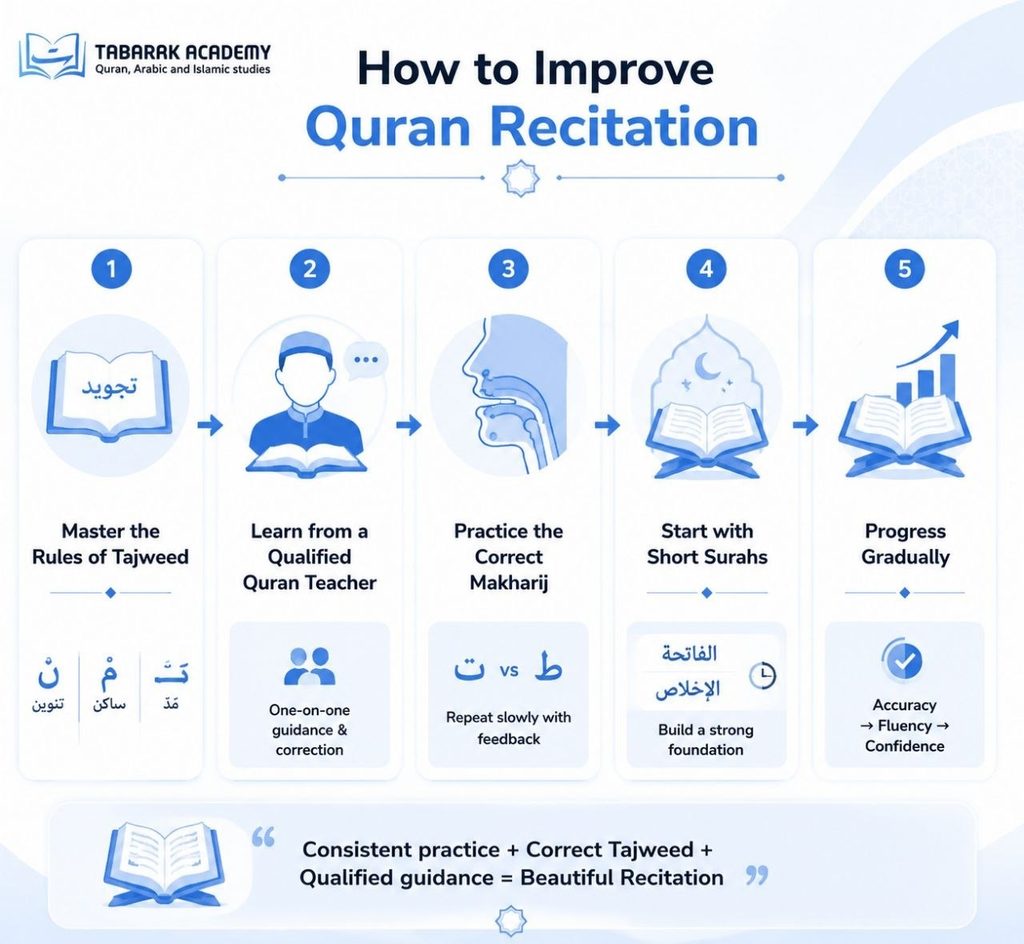
1. Learn the Essential Tajweed Rules and Apply Them During Recitation
Improving Quran recitation begins with Tajweed because correct recitation depends on more than recognizing Arabic letters. You need to know how each letter should be pronounced and what happens to its sound when it appears in different Quranic combinations.
Rather than trying to memorize every Tajweed rule at once, build your knowledge in stages.
Start with essential rules such as:
- Noon Sakinah and Tanween: learn Idhar, Idgham, Iqlab, and Ikhfa and recognize when each applies.
- Meem Sakinah: distinguish between Ikhfa Shafawi, Idgham Shafawi, and Idhar Shafawi.
- Ghunnah: learn when nasalization occurs and how long it should be maintained.
- Madd: distinguish natural elongation from the different forms of extended Madd.
- Qalqalah: practice producing the required echo without adding an extra vowel.
- Waqf and Ibtida’: learn where to stop and restart without disrupting the meaning or structure of an Ayah.
The goal is not simply to be able to name these rules. You should eventually recognize and apply them automatically while reciting.
A practical way to do this is to focus on one rule at a time. For example, take a short Surah, identify every occurrence of Noon Sakinah and Tanween, and recite those words slowly until you can apply the relevant rule without stopping to think about it.
Once that skill becomes stable, move to the next rule.
2. Recite Regularly to a Qualified Quran Teacher for Direct Correction
One of the biggest limitations of practicing Quran recitation alone is that you may not hear your own mistakes.
A learner can repeat the same incorrect pronunciation hundreds of times because it sounds normal to their own ear. This is especially common with subtle errors involving Makharij, vowel length, Ghunnah, Tafkheem, Tarqeeq, and similar Arabic sounds.
This is why Talaqqi — learning through direct listening and recitation with a qualified teacher — is so valuable.

During a live recitation session, a teacher can:
- stop you exactly where an error occurs;
- identify whether the problem comes from Makhraj, Sifaat, or a Tajweed rule;
- demonstrate the correct pronunciation;
- ask you to repeat the word or Ayah immediately;
- identify recurring mistakes across different Surahs;
- confirm when the corrected pronunciation has become consistent.
Do not simply note a correction and continue reading. When your teacher corrects a word, repeat it several times correctly and then recite the entire Ayah again. This helps connect the correction to actual Quran recitation rather than leaving it as an isolated exercise.
Experience Our Interactive Learning
Curious about how we teach? Watch these brief video clips from our recent live sessions to see our structured curriculum, advanced learning platform, and dynamic student-teacher interactions firsthand.
3. Correct Your Makharij Before Trying to Increase Your Recitation Speed
If individual letters are not being produced correctly, reading faster usually reinforces the problem rather than solving it.
Makharij are the specific articulation points from which Arabic letters are produced. These include areas of the throat, tongue, lips, nasal passage, and oral cavity.
For non-Arabic speakers, some of the most useful practice involves separating letters that initially sound similar.
For example, practice distinguishing between:
- ت and ط
- س and ص
- د and ض
- ذ and ظ
- ح and ه
- ع and أ
- ق and ك
Do not practice difficult letters only in isolation.
Use a three-stage exercise:
Letter → Word → Ayah
First, pronounce the individual letter correctly. Then practice it inside several Quranic words. Finally, recite an Ayah containing that letter while trying to maintain exactly the same articulation.
A mirror can help with letters involving visible tongue or lip positioning, while recording yourself can reveal differences you may not notice while actively reciting.
The goal is to reach a point where correct articulation remains stable during continuous recitation, not only when you stop and concentrate on one letter.
4. Master Short Surahs Before Moving to Longer Quran Passages
Trying to improve everything across several pages of Quran at once can make it difficult to identify whether you are actually progressing. Instead, choose a manageable passage and make it accurate before making it longer.
Surahs such as Al-Fatihah, Al-Ikhlas, Al-Falaq, and An-Nas are useful starting points because their shorter length allows you to concentrate closely on pronunciation and Tajweed.
Take one Surah and work through it in stages:
- Listen carefully to an accurate recitation.
- Follow the Mushaf while listening.
- Mark or identify the Tajweed rules you are practicing.
- Recite one Ayah slowly.
- Correct difficult words individually.
- Repeat the complete Ayah without stopping.
- Connect it to the following Ayah.
- Recite the complete Surah to your teacher for feedback.
Do not measure progress only by how many Surahs you have completed.
A better question is:
Can I recite this Surah accurately, fluently, and consistently without repeating the same corrections?
Once the answer is yes, move to a slightly longer passage.
This gradual approach creates a stronger foundation because every completed Surah becomes practical training in Makharij, Tajweed, fluency, and controlled recitation rather than simply another chapter you have read.
The Best Way to Improve Quran Recitation Through Listening and Practice
Beyond structured lessons, the best way to improve Quran recitation often combines listening, repetition, and honest self-review.
These habits train the ear and the voice together, helping correct sounds become automatic rather than something you consciously think about.
1. Listen to Skilled Reciters Daily
Listening closely to reciters known for precise Tajweed, such as Sheikh Mahmoud Khalil Al-Hussary or Sheikh Abdul Basit Abdul Samad, trains the ear to recognize correct pronunciation patterns.
Regular listening, even just fifteen to twenty minutes a day, helps a learner internalize rhythm, pacing, and letter articulation naturally. Over time, this exposure makes it easier to imitate correct sounds without conscious effort.
2. Record Your Voice and Review It
Recording your own recitation and listening back to it is one of the fastest ways to catch mistakes you cannot hear in the moment.
Compare each recording to a model reciter or your teacher’s correction, noting specific words that need more work. This simple habit turns vague self-assessment into a precise, trackable improvement.
Read also: Simple Ways to Improve Your Quran Recitation Voice
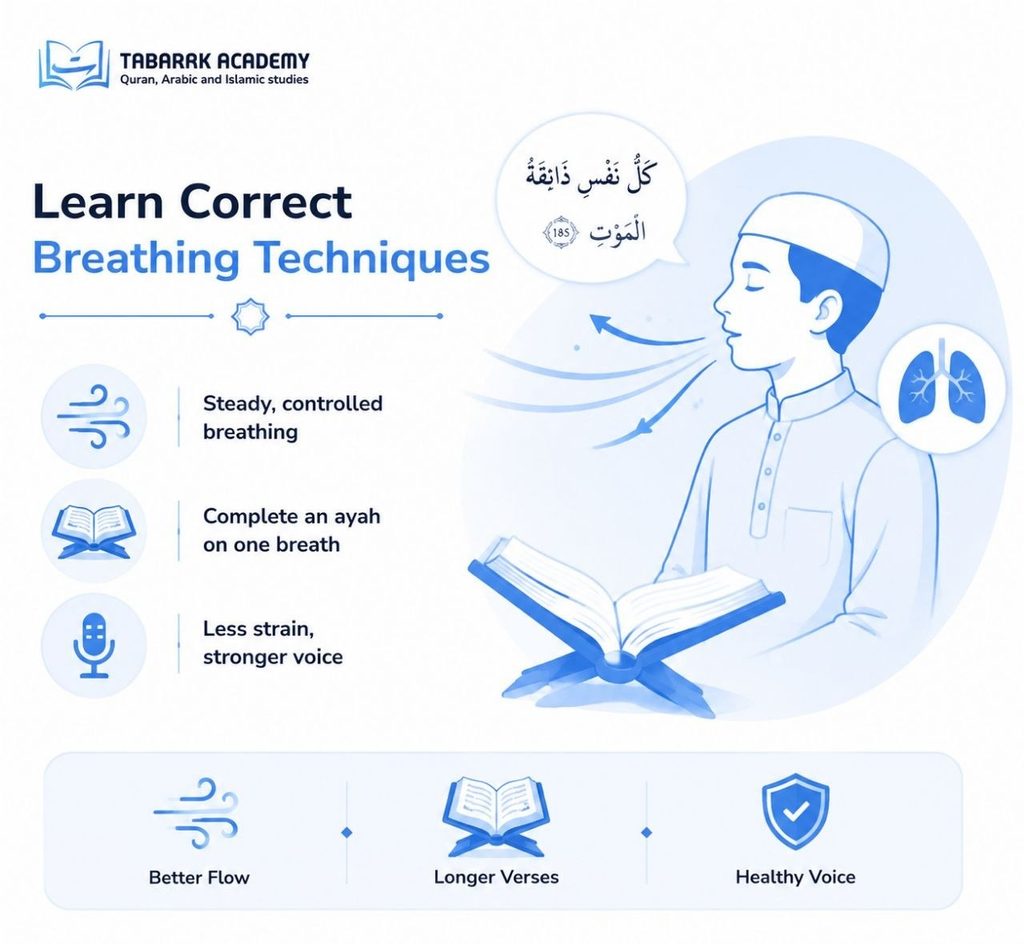
3. Learn Correct Breathing Techniques
Breath control directly affects how smoothly a reciter moves through long verses without pausing at incorrect points.
Practicing steady, controlled breathing allows a reciter to complete a full ayah, or a natural stopping point, on a single breath. This skill also reduces strain on the voice during longer recitation sessions.
Watch a real life at our academy:
Advanced Quran Recitation | Surah An-Nisa Correction
4. Understand Waqf and Ibtida (Pausing and Starting)
Waqf and ibtida are the rules that govern where a reciter may correctly pause and resume during Quran recitation.
Correct application of these rules preserves the intended meaning of a verse and prevents the confusion caused by stopping mid-phrase.
Allah commands in the Quran:
وَرَتِّلِ الْقُرْآنَ تَرْتِيلاً
“And recite the Quran with measured recitation.” (Surah Al-Muzzammil, 73:4)
This verse highlights the importance of pacing, clarity, and unhurried recitation the same qualities good Waqf and ibtida practice helps a reciter maintain.
Tabarak Academy’s live online sessions give students direct, real-time feedback on pacing, breathing, and Waqf rules the kind of correction that is difficult to achieve through self-study alone.

Practical Quran Recitation Tips You Can Apply Every Day
Consistent, small habits often produce more lasting improvement than occasional long study sessions. The improve Quran recitation tips below are designed to fit naturally into a busy daily schedule.
1. Set a Fixed Daily Quran Practice Time to Build Consistency
Reciting at the same time each day, such as shortly after Fajr prayer, helps turn practice into a stable habit rather than an occasional task.
Early morning hours are often quieter and mentally clearer, which supports better focus during Tajweed practice.
Consistency, even in short ten to fifteen minute sessions, produces more progress than irregular, longer sessions.
Read also: Practical Tips for a Beautiful and Correct Quran Recitation
2. Create a Quiet Quran Practice Space That Helps You Focus on Pronunciation
A calm, distraction-free space at home makes it easier to focus fully on correct pronunciation and meaning. Family encouragement, whether through shared practice time or simple words of support, plays a real role in a learner’s motivation to continue.
Removing background noise and setting aside a specific reading corner can noticeably improve concentration.
3. Use Quran Apps and Recordings to Review Tajweed Between Lessons
Quran apps, audio recordings, and online learning tools can make daily practice more effective when they are used as support for guided learning rather than a replacement for a qualified teacher.
Use technology intentionally to:
- listen repeatedly to the same Ayah from a reliable reciter;
- slow down difficult passages and focus on individual sounds;
- record your own recitation and listen for recurring mistakes;
- review corrections from previous lessons;
- compare your pronunciation with a model recitation;
- repeat difficult words before returning to the complete Ayah.

4. Join a Quran Study Circle or Online Course to Stay Accountable
Learning alongside others, whether in a mosque study circle or an online Quran course, adds accountability and shared motivation to the learning process.
Group settings also expose learners to different questions and corrections that may not come up in one-on-one sessions. Many learners find that a mix of individual lessons and group review keeps recitation practice consistent over the long term.
Step Inside Our Virtual Classrooms
See our engaging teaching methods in action! watch real snippets of our live classes and discover how our expert instructors make learning interactive, memorable, and inspiring for every student.
Book Your Free Trial Class Today
If you’re ready to put these steps into practice with expert guidance, Tabarak Academy offers online Quran and Tajweed classes for children, adults, and families worldwide, taught by qualified instructors in one-on-one and group settings.
Book Your Free Trial Class today and start your own personalized recitation plan, built around your current level and goals.
Our Tajweed Courses
- Online Tajweed Classes
- Tajweed Course for Beginners
- Tajweed Course for Kids
- Tajweed Course for Adults
- Tajweed Course for Sisters
- Advanced Tajweed Course
- Amali (Practical) Tajweed Course
- Learn Quran with Tajweed
- Learn Quran with Tajweed for Kids
- Learn Quran with Tajweed for Sisters

Summary: Key Steps to Improve Your Quran Recitation
Improving Quran recitation is a gradual process built on correct Tajweed knowledge, consistent listening, honest self-review, and guidance from a qualified teacher. The most effective results come from combining short daily practice sessions with direct feedback, rather than relying on any single method alone.
Keep the essentials in mind: start with short surahs, master your makharij, listen daily to skilled reciters, and record your own voice to track real progress.
Whether you are a complete beginner or refining an already solid recitation, applying these improve Quran recitation tips consistently, ideally with structured support such as the classes offered by Tabarak Academy, will help you recite the Quran with greater confidence, accuracy, and khushu, or heartfelt presence.

Frequently Asked Questions
How long does it take to improve Quran recitation?
Most beginners notice a clear improvement in pronunciation and confidence within eight to twelve weeks of consistent daily practice combined with regular teacher feedback.
Progress speed depends on practice frequency, prior familiarity with Arabic sounds, and access to correction from a qualified reciter. Short daily sessions tend to produce steadier results than infrequent long sessions.
Can I improve Quran recitation without knowing Arabic?
Yes, non-Arabic speakers can improve Quran recitation by focusing on correct Tajweed rules and letter articulation rather than full language fluency.
Many successful reciters worldwide learned pronunciation and Tajweed step by step, without first mastering Arabic grammar or vocabulary. A qualified teacher can guide pronunciation practice regardless of a student’s Arabic language background.
What is the best way to improve Quran recitation as a beginner?
The best way to improve Quran recitation as a beginner is to start with short surahs, learn basic Tajweed rules, and receive regular correction from a qualified teacher.
Combining this with daily listening to skilled reciters helps train the ear alongside the voice. Structured, guided classes tend to produce faster progress than self-study alone.
Do I need a teacher to improve my Quran recitation?
A teacher is not strictly required to begin, but working with one significantly speeds up correction of pronunciation errors that are difficult to detect independently.
Self-study through listening and recording is valuable, though a qualified instructor can identify subtle articulation mistakes a learner may not notice alone. Many students combine both self-practice and teacher-led sessions for the best results.
How can I make my Quran recitation sound more beautiful?
A more beautiful recitation comes from correct Tajweed application, steady breath control, and thoughtful pacing, rather than trying to imitate a particular vocal style.
The Prophet Muhammad (peace be upon him) is reported to have encouraged beautifying recitation, saying, “Beautify the Quran with your voices.” Practicing Waqf, ibtida, and elongation rules consistently naturally improves the sound of recitation over time.