

How to Improve Your Quran Recitation Voice – 7 Practical Ways
Have you ever listened to a skilled Quran reciter and wondered why their Tilawah sounds clear, controlled, and moving while your own voice feels flat, strained, or inconsistent?
Improving your Quran recitation voice does not mean copying someone else’s natural voice or trying to sound like a famous Qari. A better recitation begins with correct Tajweed and Makharij, then develops through careful listening, breath control, vocal stability, appropriate pacing, and regular feedback.
Natural vocal qualities differ from one person to another, but every learner can work on making their recitation clearer, steadier, and more pleasant to listen to.
The seven methods below focus on improving the quality of your voice without allowing melody or vocal performance to interfere with correct Quran recitation.
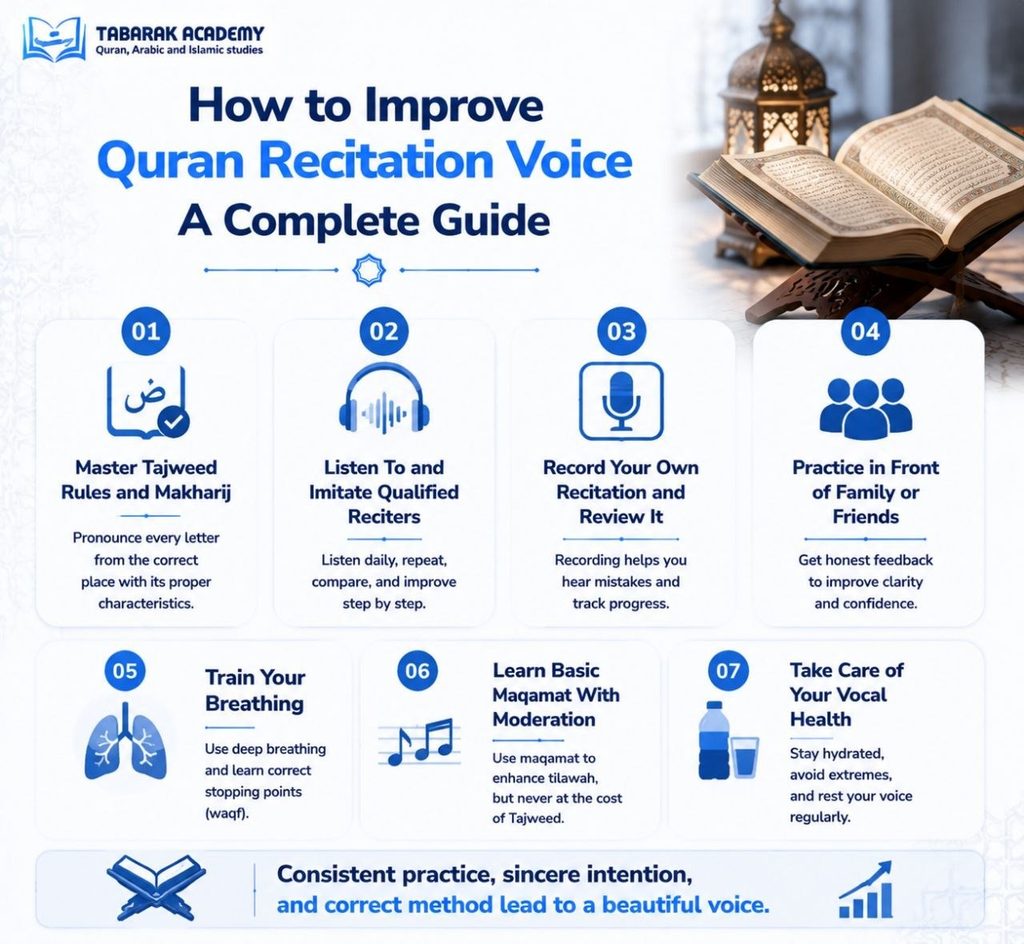
1. Build a Clearer Recitation Voice by Correcting Tajweed and Makharij First
Before working on melody, pitch, or vocal style, make sure the foundation of your recitation is accurate.
Tajweed governs how Quranic letters are articulated and how their characteristics are preserved during recitation. If a letter comes from the wrong Makhraj, a Madd is shortened, or Tafkheem and Tarqeeq are confused, making the voice more melodic will not correct the underlying problem.
Start by identifying the pronunciation errors that affect the clarity of your voice most often. Pay particular attention to letters that learners commonly confuse, such as:
- س and ص
- ت and ط
- د and ض
- ك and ق
- ه and ح
- ء and ع
Then work on qualities such as Tafkheem, Tarqeeq, Ghunnah, Qalqalah, and Madd.
A useful rule is:
Accuracy first → fluency second → vocal beauty third.
Once correct pronunciation becomes more natural, you can work on beautifying the voice without sacrificing the words or Tajweed rules.
Read also:How to Improve Your Quran Recitation Fast and Easily?
2. Listen to Skilled Quran Reciters and Practice One Short Passage at a Time
Listening develops your ear for controlled Quran recitation. However, passive listening alone is not enough. Turn it into an active practice exercise.
Choose a qualified reciter whose pace and vocal range are comfortable for you. Instead of switching constantly between different reciters, use one reciter for a period of focused practice so you can become familiar with their pronunciation, pacing, and stopping patterns.
Then use a simple listen-and-repeat method:
- Select one short Ayah or phrase.
- Listen without reciting.
- Listen again while following the Mushaf.
- Notice the Makharij, Madd, Ghunnah, pauses, and changes in vocal intensity.
- Pause the recording.
- Recite the same passage yourself.
- Listen again and compare.
- Repeat until the passage becomes more controlled.
Do not try to reproduce a reciter’s exact pitch if it sits outside your comfortable vocal range. The goal is to learn from their clarity, control, Tajweed, rhythm, and phrasing, not to imitate a voice your body does not naturally have.
3. Record Your Quran Recitation to Identify Problems in Tone, Pace, and Pronunciation
Your voice sounds different to you while you are speaking than it does on a recording. This makes recording one of the simplest tools for evaluating your recitation more objectively.
Choose a short passage and record it without stopping every time you make a minor mistake. Then listen to the complete recording and evaluate specific areas.
Ask yourself:
- Are individual letters clear?
- Am I rushing certain words?
- Are my Madd lengths controlled?
- Does my voice become strained on higher notes?
- Is my volume consistent?
- Are my pauses natural and correctly placed?
- Do I lose Tajweed when trying to beautify the voice?
- Does the recitation sound calm or forced?
Avoid judging the recording only by asking, “Do I like my voice?”
A much more useful question is:
“What is the single most noticeable weakness I can improve in my next recording?”
Work on that weakness, record the same passage again, and compare the two versions. This turns recording into a measurable practice method rather than simple self-criticism.
4. Recite to a Teacher or Trusted Listener to Get Feedback You Cannot Hear Yourself
Self-review is valuable, but it has limitations. Some pronunciation habits become so familiar that you may no longer recognize them as mistakes.
Regularly reciting to a qualified Quran teacher provides an outside ear that can distinguish between a Tajweed problem, articulation problem, breath problem, and unnecessary vocal strain.
When receiving feedback, ask for specific corrections rather than a general opinion about whether your voice sounds good.
For example:
- Which letters lose clarity when I recite faster?
- Where am I using unnecessary vocal pressure?
- Are my stopping points appropriate?
- Does my tone interfere with Tajweed?
- Which recurring mistake should I prioritize this week?
You can also recite occasionally in front of supportive family members or fellow learners to become more comfortable using your normal recitation voice around others.
However, technical Tajweed and Makharij corrections should come from someone qualified to evaluate Quran recitation.
Experience Our Interactive Learning
Curious about how we teach? Watch these brief video clips from our recent live sessions to see our structured curriculum, advanced learning platform, and dynamic student-teacher interactions firsthand.
5. Improve Breath Control to Recite Longer Ayahs Without Rushing or Straining
Poor breath management can make even accurate recitation sound unstable.
When learners begin running out of air, they often speed up, lower their voice suddenly, swallow the final letters of words, or stop at an unsuitable place simply because they cannot continue.
Instead of trying to hold your breath for as long as possible, learn to manage the breath you already have.
Practice by:
- taking a comfortable breath before beginning;
- relaxing the shoulders, throat, and jaw;
- starting at a sustainable volume rather than using too much air immediately;
- keeping the pace steady;
- identifying suitable Waqf points before attempting a long Ayah;
- stopping correctly when necessary instead of forcing yourself to reach the end.
Breath control and Waqf and Ibtida’ should work together.
The goal is not to prove that you can recite an entire long Ayah in one breath. The goal is to maintain accurate, controlled recitation while stopping in appropriate places that preserve the meaning.
6. Use Melody and Maqamat Without Allowing Them to Override Tajweed
Once your pronunciation, Tajweed, and breath control are stable, you may begin paying more attention to the melodic qualities of your recitation.
Some reciters study or naturally use Arabic Maqamat, such as Bayati, Rast, and Saba, to understand different melodic patterns.
However, melody should remain secondary to correct recitation.
A common mistake is choosing a melody first and then stretching, shortening, or changing sounds to make the Ayah fit it. This reverses the proper priority.
Instead:
Let the Quranic words and Tajweed rules control the recitation; let the melody follow naturally.
If maintaining a particular tone causes you to distort a letter, extend a sound incorrectly, force your voice, or ignore an appropriate stopping point, abandon the melody and return to comfortable recitation.
You do not need advanced knowledge of Maqamat to develop a pleasant Quran recitation voice. Good Tajweed, controlled breathing, natural vocal variation, and thoughtful pacing can already make a significant difference.
7. Protect Your Voice So You Can Recite Clearly Without Vocal Strain
Your voice is a physical instrument, and excessive tension or overuse can affect the quality of your recitation.
Start with a comfortable vocal range rather than immediately attempting very high or low notes. Keep your jaw, neck, and shoulders relaxed, especially during longer practice sessions.
Useful habits include:
- staying adequately hydrated.
- taking breaks during long recitation sessions.
- avoiding shouting or forcing your voice before practice.
- beginning gently rather than immediately reciting at maximum volume.
- stopping when your throat becomes painful or unusually strained.
- choosing a pitch that allows you to finish phrases comfortably.
Pay particular attention to vocal strain.
A beautiful recitation should not require you to squeeze your throat to imitate another Qari. If a particular pitch repeatedly causes tension, lower or adjust it until you can recite comfortably while maintaining Tajweed.
Your goal is not to discover the most impressive voice you can produce for a few minutes. It is to develop a clear, sustainable recitation voice you can maintain consistently.
A Simple Daily Routine to Improve Your Quran Recitation Voice
You can combine all seven methods into one focused practice routine:
- Warm up gently with a comfortable short Surah.
- Review one Tajweed or Makhraj weakness you are currently correcting.
- Listen to one short passage from a qualified reciter.
- Repeat the passage while matching its accurate pronunciation and pacing.
- Practice your breathing and stopping points within the same passage.
- Record yourself reciting it independently.
- Compare the recording and identify one specific issue to improve.
- Recite the passage to your teacher during your next lesson for professional correction.
This approach is more effective than trying to improve “your voice” as one vague skill.
Each practice session has a specific target: pronunciation, Tajweed, breath, pacing, tone, or consistency. As these individual skills improve, the overall quality of your Tilawah improves with them.
Read also :How to Improve Your Quran Recitation With Easy Tips
How to Know Your Quran Recitation Voice Is Actually Improving
Do not measure progress by whether you suddenly sound like your favorite reciter.
Look for more meaningful signs:
- your letters sound clearer.
- you make fewer recurring Tajweed mistakes.
- your pace remains controlled during longer passages
- you can complete phrases without rushing for breath.
- your voice feels less strained.
- your pitch stays within a comfortable range.
- your stopping points become more deliberate.
- your recordings sound more consistent from beginning to end.
- you can add natural vocal beauty without sacrificing Tajweed.
The strongest sign of improvement is greater control.
When pronunciation, breath, pace, and tone remain stable without constant conscious effort, your recitation voice is becoming more developed and reliable.
The Best Way to Beautify Your Quran Recitation Voice While Preserving Tajweed
Beyond technique, understanding the spiritual and scholarly context behind a beautiful recitation voice helps learners pursue this goal with the right intention.
1. Beautifying Your Quran Recitation Voice Is Recommended When Tajweed Remains Correct
Beautifying the voice while reciting the Quran, known as tahsin al-sawt, is considered mustahabb (recommended) by the consensus of Muslim scholars, as reported by Imam an-Nawawi from the companions and the scholars who followed them.
The Prophet Muhammad (peace be upon him) said:
زَيِّنُوا الْقُرْآنَ بِأَصْوَاتِكُمْ
“Beautify the Quran with your voices.”
Sunan Abi Dawud, Sunan an-Nasa’i, Sunan Ibn Majah, Musnad Ahmad
He (peace be upon him) also said:
مَا أَذِنَ اللَّهُ لِشَيْءٍ مَا أَذِنَ لِنَبِيٍّ يَتَغَنَّى بِالْقُرْآنِ
“Allah does not listen to anything as He listens to a Prophet reciting the Quran aloud in a beautiful voice.”
Sahih al-Bukhari and Sahih Muslim
Scholars are clear that this recommendation applies only within the boundaries of correct Tajweed, and it does not permit stretching or altering the recitation in a way that changes its meaning or resembles secular singing.
2. Taghanni bil-Quran Means Beautifying the Voice Without Turning Recitation Into Singing
Taghanni bil-Quran refers to reciting the Quran with a beautiful, moving voice, not singing it in the entertainment sense.
Imam ash-Shafi’i and most scholars explained it as improving the voice during recitation, while others, including al-Layth ibn Sa’d, described it as reciting with humility (khushu’) and reflection on the meanings.
Read also: Best Quran Hifz Schools for Online Quran Memorization
3. Follow the Prophet’s Example of Clear, Measured Tarteel Instead of Rushing the Quran
The Prophet (peace be upon him) recited with tarteel, meaning slow, clear, letter-by-letter recitation rather than rushing through the verses. Allah commands this directly in the Quran:
وَرَتِّلِ الْقُرْآنَ تَرْتِيلًا
“And recite the Qur’an with measured recitation.”
He (peace be upon him) also paused between each ayah rather than running them together, and he began every recitation by seeking refuge in Allah from Satan.
Watch a real life at our academy:
Title: Surah Al-Fath Recitation | Student Test

Tips to Improve Your Quran Recitation Voice and Build Consistency
Improving your Quran recitation voice depends more on consistent, focused practice than occasional intensive sessions. A simple routine gives your voice time to develop while reinforcing correct Tajweed, Makharij, breath control, and pacing.
The following habits can help you turn what you learn into skills that remain stable during everyday recitation.

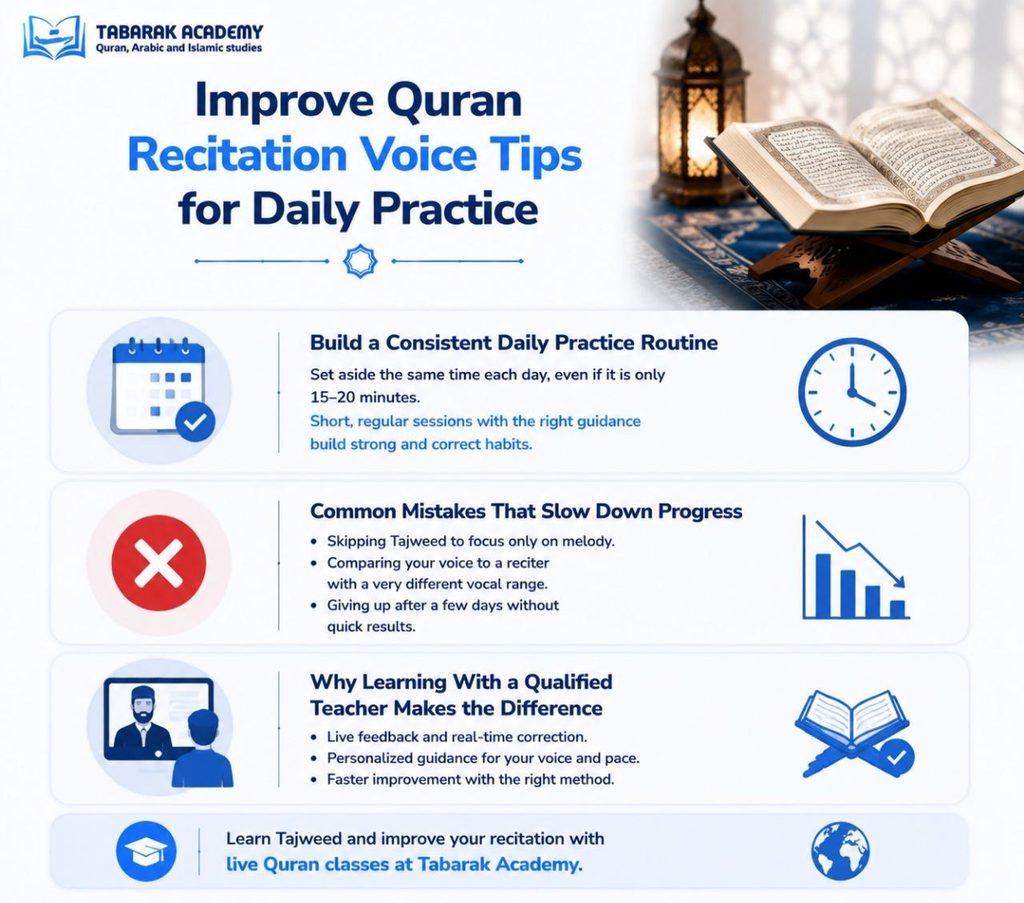
1. Follow a Short Daily Quran Recitation Routine Instead of Practicing Irregularly
Choose a consistent time each day for focused recitation practice. The session does not need to be long; what matters is that you practice deliberately rather than simply reading without a specific goal.
Divide your practice between different skills. For example, you might spend part of the session correcting a difficult Makhraj, then practice one short passage for Tajweed, breath control, and vocal stability.
A simple routine could include:
- Listen: Hear a short passage from a qualified reciter.
- Repeat: Recite the same passage slowly while focusing on Tajweed.
- Record: Record yourself without stopping after every small mistake.
- Review: Compare your recitation with the model and identify one weakness.
- Correct: Repeat the difficult word or Ayah until the correction becomes more natural.
Avoid trying to improve every aspect of your voice in one session. One day you might focus on breath control, while another session targets Madd, Makharij, or pacing.
2. Avoid These Common Mistakes That Can Slow Your Recitation Voice Improvement
Practicing regularly is useful only when you are reinforcing the right habits. Some approaches can make your recitation sound more expressive while leaving fundamental weaknesses unresolved.
Common mistakes include:
- Prioritizing melody before Tajweed: A pleasant tone cannot compensate for incorrect letters, Madd, Ghunnah, or other Tajweed errors.
- Forcing your voice outside its natural range: Trying to copy a reciter with a much higher or lower voice can create tension and make breath control more difficult.
- Imitating sound without studying pronunciation: Copying the melody while missing the reciter’s Makharij and Tajweed defeats the purpose of the exercise.
- Changing reciters constantly: Practicing with one suitable reciter for a period can make it easier to study their pacing, pronunciation, and stopping patterns consistently.
- Practicing mistakes repeatedly: Repetition builds habits whether the pronunciation is correct or incorrect. Seek correction when you are unsure.
- Expecting immediate results: Vocal control, Tajweed, breathing, and fluency are separate skills that develop gradually through consistent practice.
- Comparing your natural voice with someone else’s: Your goal is not to reproduce another Qari’s voice exactly, but to make your own recitation clearer, more controlled, and more beautiful.
Read: 7 Types of Qirat in the Quran
3. Recite Regularly to a Qualified Quran Teacher for Personalized Voice and Tajweed Correction
Recordings and self-review can help you recognize obvious weaknesses, but they cannot always tell you why a pronunciation or vocal problem is happening.
A qualified Quran teacher can listen to your recitation and determine whether the problem comes from your Makhraj, Tajweed, breath management, pacing, vocal tension, or another recurring habit.
For example, if you struggle to complete an Ayah smoothly, the solution may not be taking a larger breath. You may be using too much air at the beginning, reciting at an unsuitable pitch, rushing certain words, or missing an appropriate Waqf point.
A teacher can identify the actual cause and give you a targeted exercise instead of leaving you to experiment blindly.
Regular teacher-guided recitation also creates an important correction cycle:
Recite → Receive correction → Repeat correctly → Practice independently → Recite again for verification.
This prevents incorrect pronunciation from becoming deeply established through repetition.
Step Inside Our Virtual Classrooms
See our engaging teaching methods in action! watch real snippets of our live classes and discover how our expert instructors make learning interactive, memorable, and inspiring for every student.
Book Your Free Trial Class Today
Get matched with a certified Quran teacher, receive live feedback on your Tajweed and recitation voice, and follow a learning plan built around your schedule and level. Book Your Free Trial Class and take the first step toward a clearer, more confident recitation.
Our Tajweed Courses
- Online Tajweed Classes
- Tajweed Course for Beginners
- Tajweed Course for Kids
- Tajweed Course for Adults
- Tajweed Course for Sisters
- Advanced Tajweed Course
- Amali (Practical) Tajweed Course
- Learn Quran with Tajweed
- Learn Quran with Tajweed for Kids
- Learn Quran with Tajweed for Sisters

Conclusion
Improving your Quran recitation voice combines correct Tajweed, regular listening and imitation, honest self-review through recordings, and consistent daily practice, all built on the understanding that a beautiful voice is a recommended act of worship when kept within its proper limits.
Whether you are just starting out or refining an existing recitation, the best way to improve Quran recitation voice is to pair steady practice with feedback from someone who can correct you as you go, which is exactly the guidance Tabarak Academy provides to learners around the world.
Frequently Asked Questions
How long does it take to improve Quran recitation voice?
Most learners notice a clear improvement within four to eight weeks of daily practice, though the exact timeline depends on how consistently they practice Tajweed, listening, and recording review each day.
Can I improve my recitation voice without a naturally beautiful voice?
Yes, correct Tajweed, breath control, and regular practice improve clarity and pleasantness for almost any voice, since accurate articulation always sounds better than untrained pronunciation, regardless of natural tone.
Is it necessary to learn maqamat to recite the Quran beautifully?
No, maqamat are optional vocal scales that some reciters use for melodic variation, but correct Tajweed and clear pronunciation remain the foundation of an acceptable and beautiful recitation on their own.
What is the difference between taghanni bil-Quran and singing?
Taghanni bil-Quran means reciting with a beautiful, humble voice within the rules of Tajweed, while singing in the entertainment sense involves rhythms and styles unrelated to Quranic recitation and is not what the Prophet encouraged.
Do I need a teacher to improve my Quran recitation voice?
A teacher is not strictly required, but live feedback from a qualified instructor corrects mistakes far faster than self-study alone, which is why structured classes, such as those at Tabarak Academy, are recommended for steady, reliable progress.