


How Long Does It Take To Memorize The Quran? A Realistic Roadmap
Most people who want to memorize the Quran ask the same question: how long does it take to memorize the Quran? first and most receive an answer that is either vague or discouragingly extreme.
The honest answer is that the time to memorize the Quran ranges from under a year for a full-time student to a decade or more for someone juggling a demanding life, Both are valid.
What determines where you land is not talent or background alone. It is eight specific factors that shape every learner’s timeline, and most students have never had them clearly explained.
This guide lays each factor out one by one, alongside honest timelines based on daily page amounts and real student outcomes, so you can plan your hifz with clarity rather than guesswork.
Explore our Free Tajweed Quran Course at Tabark Academy

How Long Does It Take To Memorize The Quran?
For most learners, memorizing the entire Quran takes about 2 to 5 years, depending on their daily pace, Arabic reading ability, consistency, and review routine. A disciplined student memorizing one page a day may finish in around 2–2.5 years, while half a page daily typically takes 3.5–5 years.
The goal should not be to finish as quickly as possible, but to build strong, lasting Hifz. Consistent daily memorization, regular muraja’a (review), and guidance from a qualified teacher can prevent forgotten portions and costly relearning.
Your ideal timeline is the pace you can maintain consistently without sacrificing retention.
1. A Daily Memorization Pace That Fits Your Schedule
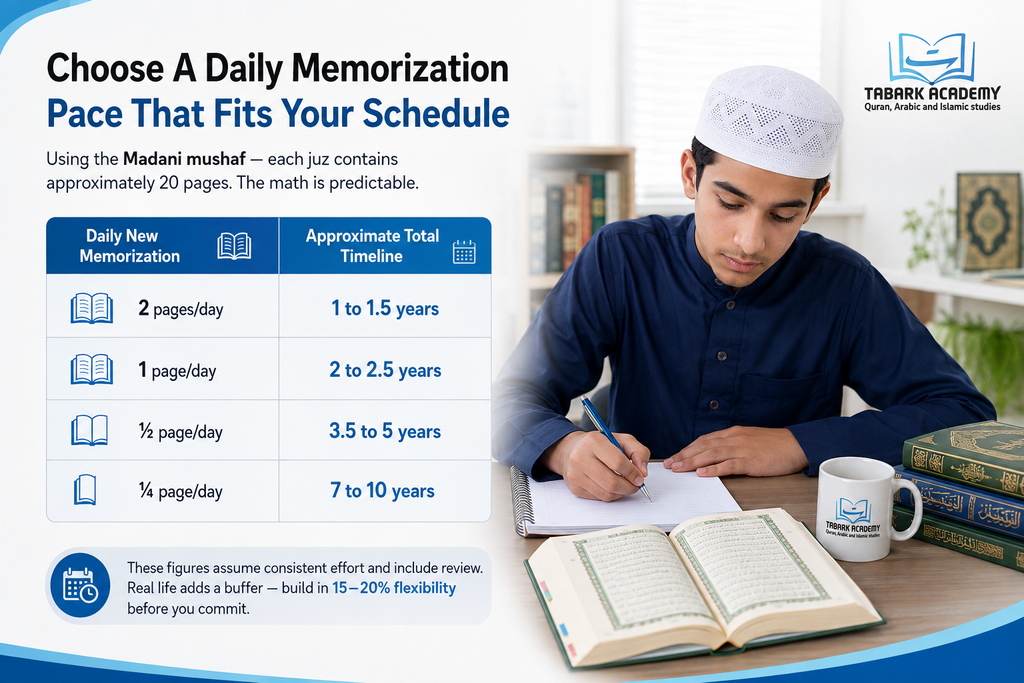
The most controllable factor is the simplest: how many pages per day? Using the Madani mushaf — the standard edition used in most hifz programs globally — each juz contains approximately 20 pages. The math is predictable.
| Daily New Memorization | Approximate Total Timeline |
| 2 pages/day | 1 to 1.5 years |
| 1 page/day | 2 to 2.5 years |
| ½ page/day | 3.5 to 5 years |
| ¼ page/day | 7 to 10 years |
These figures assume consistent, uninterrupted effort and include time for review. Real life — exams, travel, illness — always adds a buffer. Any honest plan should build in 15–20% flexibility before you commit to it.
2. Your Arabic Foundation Before Day One
Fluent Arabic reading removes a persistent obstacle from every memorization session.
A student still working through unfamiliar letter forms or uncertain vowel marks divides mental resources between decoding and memorizing — and memory consolidation suffers when attention is split between two tasks.
Spending even four to six weeks strengthening Arabic reading before beginning formal hifz is an investment that consistently shortens the overall timeline.
Understanding the facts about the Arabic language — its structure, its patterns, and how its script works — removes friction from every page you memorize.
For students who find it daunting, looking at 3 reasons why Arabic is difficult gives a realistic picture alongside practical responses that make the challenge far more manageable.
Join Tabarak Academy’s Arabic Course for Beginners

3. The Age Of The Memorizer Shapes The Pace Of Memorization
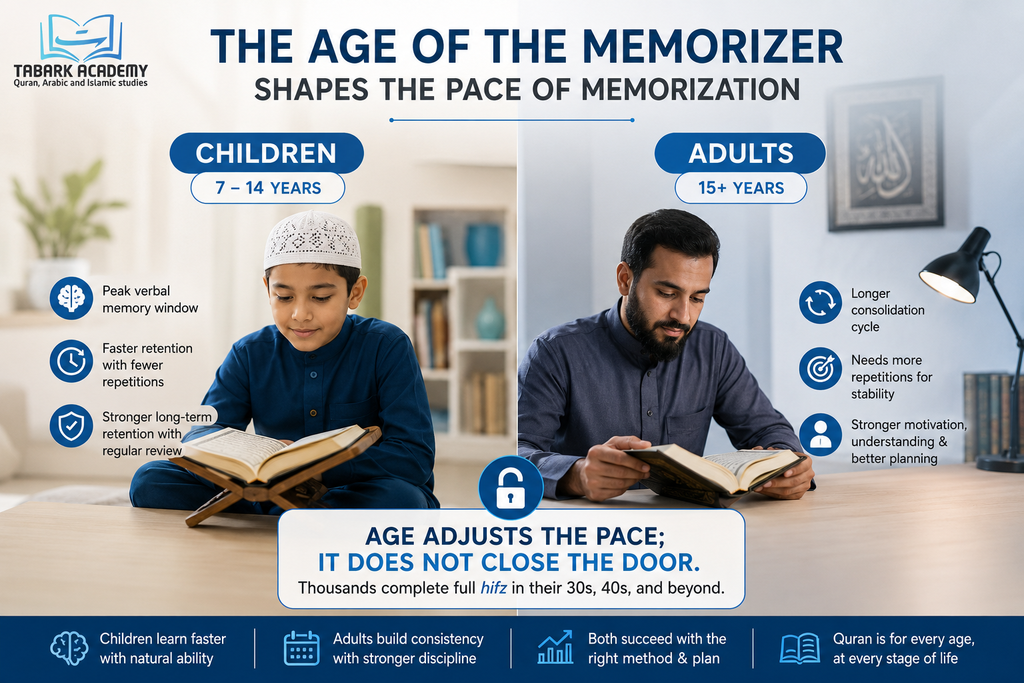
Children between roughly 7 and 14 sit inside a developmental window where verbal memory is at its peak. New pathways form quickly, and retention is stronger with fewer repetitions per page.
A child who memorizes a passage today and reviews it three days later can often hold it for months with minimal additional effort.
Adults face a longer consolidation cycle and typically need more repetitions to achieve the same stability.
The compensating advantage — stronger motivation, clearer understanding of meaning, and greater ability to organize a schedule deliberately — often offsets that gap.
Thousands of students complete full hifz in their 30s, 40s, and beyond. Age adjusts the pace; it does not close the door.
4. The Method You Choose Can Cut Your Timeline In Half
There is a meaningful difference between reading a page until it feels familiar and truly encoding it in retrievable, durable memory.
Effective hifz technique combines four steps: reading the target section aloud 7–10 times before attempting memorization, breaking it into clusters of 3–4 verses, linking each cluster to the next before closing the page, and reciting the entire section from memory with the mushaf closed at the session’s end.
Students who plan to study the types of Qirat in the Quran after completing their memorization should focus entirely on one recitation — typically Hafs ‘an ‘Asim — until hifz is complete. Tracking multiple narrations during active memorization fragments both timelines without strengthening either.
Experience Our Interactive Learning
Curious about how we teach? Watch these brief video clips from our recent live sessions to see our structured curriculum, advanced learning platform, and dynamic student-teacher interactions firsthand.
5. Consistency Beats Intensity Of Memorization Portion Every Single Time
A student who memorizes ten pages on Saturday and rests for a week has not memorized ten pages in any durable sense. Memory consolidation is a biological process that unfolds continuously between sessions — during rest, during sleep, during ordinary activity. It cannot be compressed into a single long session.
The most effective hifz students share one observable habit: a fixed, non-negotiable daily window. Thirty focused minutes at Fajr, five to six days per week, outperforms sporadic three-hour bursts.
The Prophet ﷺ said, “The most beloved deed to Allah is the most regular and constant, even if it is little.” That hadith is, among other things, the most practical memorization advice ever recorded.
Enroll in Tabarak Academy’s Online Hifz Program Free Trial

6. Your Life Circumstances Shape An Honest, Sustainable Plan
A 10-year-old in a full-time Islamic school and a 38-year-old parent of three are both capable of completing hifz. Their realistic timelines are simply different — and pretending otherwise is one of the primary reasons motivated adults abandon the goal mid-journey.
The Prophet ﷺ’s own life offers a perspective worth holding here. Understanding what can we learn from the life of prophet Muhammad shows that his engagement with revelation was a sustained, gradual orientation built over years — not a race. Set your timeline based on your actual life, not the most impressive story you have heard.
Book Your Free Trial Session Today →

7. A Qualified Teacher Is Not Optional
Students who memorize without a teacher consistently take longer and accumulate pronunciation errors that grow progressively harder to correct. Every time a student recites a mispronounced verse, that incorrect version is reinforced. Correcting an entrenched error costs far more time than learning it correctly from the start.
A certified teacher does three things no recording or app replicates: catches errors in real time before they set, provides structured review of previous material in every session, and adjusts the daily target based on the student’s actual retention — not a generic plan.
This is also why the process of how to get Ijazah — the formal certification of Quran recitation — requires transmission through a living teacher connected to an unbroken chain. The teacher’s role is not supplementary; it is the spine of the entire system.
If you have been hesitating over where to start, Tabarak Academy offers a free trial session with a certified teacher who assesses your current level and builds your plan from there — no generic curriculum, no guesswork.
8. Balance New Memorization With Regular Review For Stronger Hifz
This is where most hifz journeys quietly collapse. A student memorizes five pages, then ten, then twenty — and somewhere around page thirty, the first five have completely disappeared. The cause is almost never a poor memory. It is a broken review structure.
Sustainable hifz allocates roughly twice as much time to muraja’a (review) as to new memorization. A productive daily session looks like this:
- Review of the past 7–10 days of material: 15–20 minutes.
- Review of older sections: 10–15 minutes.
- New memorization: 20–30 minutes.
Students who skip both review layers and only add new pages build a structure with no foundation. When the review ratio is maintained, total hifz time actually decreases — because solidly retained pages do not need to be re-memorized from scratch.

How Long Does It Take To Memorise The Quran In Practice?
Once you understand the eight variables, estimating how long does it takes to memorize Quran becomes a practical exercise rather than a guess.
The three timelines below reflect genuine student outcomes across a range of daily commitments.
A. Completing Hifz In One Year
This timeline is achievable but demands either full-time study or exceptionally disciplined part-time effort.
The math: 604 pages across roughly 300 effective study days requires approximately 2 pages of new material per day, with remaining days dedicated entirely to review.
The structure that makes this work: memorize 2 pages on 5 days per week, dedicate one full day each week to reviewing the week’s 10 new pages, and keep one day for deep review of older sections. Monthly, revisit all memorized material from the beginning of that month.
This plan requires strong pre-existing Arabic reading ability and a teacher who can catch errors before they accumulate — one day of uncorrected mistakes on a 1-year plan creates a problem that takes weeks to fix.
Read also:The best way to memorize quran
B. Completing Hifz In Two To Three Years
This is the most commonly achieved timeline among motivated adult learners who approach the journey with structure. Memorizing 1 page daily, 5–6 days per week, with a consistent review schedule brings the new-material phase to roughly 24 months.
Add review time, real-life disruptions, and the occasional period of slower progress, and the realistic completion point sits at 2–2.5 years for most disciplined students.
A three-year plan — built around half a page daily — often produces stronger long-term retention than faster approaches, because the review load stays manageable and the memorized material has more time to consolidate.
Read also:How to memorize quran without forgetting?
C. Completing Hifz In Five Years Or More
This is not a lesser achievement. Umar ibn al-Khattab (may Allah be pleased with him) famously devoted years to Surah al-Baqarah alone, his practice being to act upon each verse before advancing to the next.
A quarter-page daily — 5 to 7 minutes of new material — maintains genuine forward movement through even the most demanding adult schedule.
The rule at any pace: some daily contact with the Quran outperforms any ambitious target that collapses under the pressure of real life. A small, consistent commitment outlasts a heroic one every time.
Read also: Understanding Hifz Burnout: A Complete Guide
Three Mistakes That Quietly Add Years To The Memorization Journey
Most hifz delays trace to the same predictable errors. Knowing them before they happen is the most efficient form of progress available.
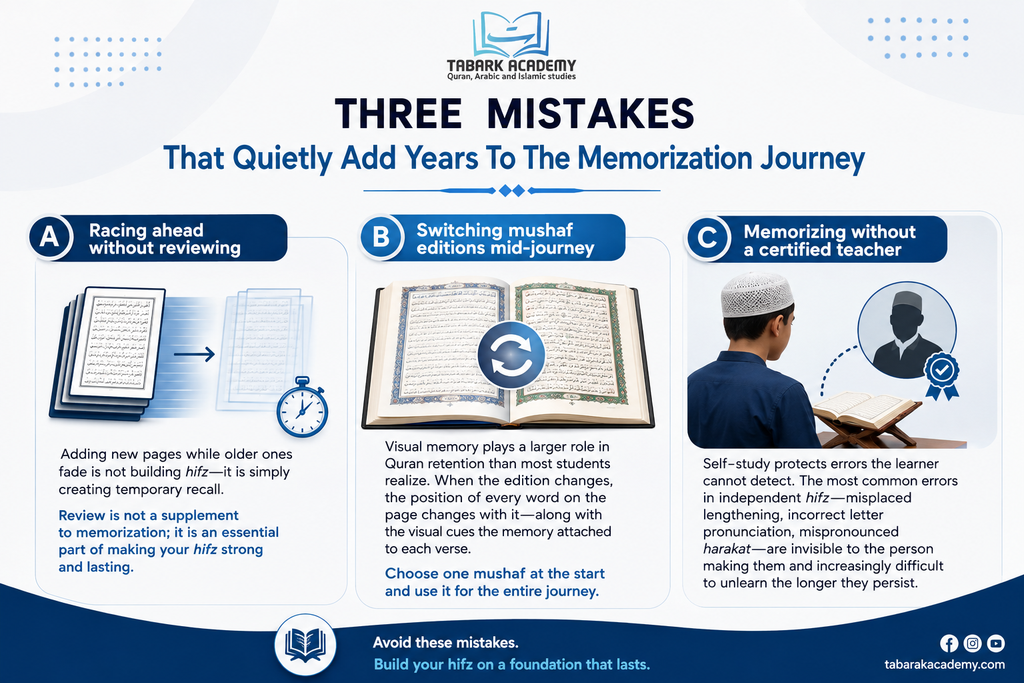
A. Racing Ahead Without Reviewing
Adding new pages while older ones fade is not building hifz—it is simply creating temporary recall. Without regular review, even well-memorized verses can become weak over time.
Review is not a supplement to memorization; it is an essential part of making your hifz strong and lasting.
Read also:Teaching Quran Memorization to Five-Year-Olds
B. Switching Mushaf Editions Mid-Journey
Visual memory plays a larger role in Quran retention than most students realize.
When the edition changes, the position of every word on the page changes with it — along with the visual cues the memory attached to each verse. Choose one mushaf at the start and use it for the entire journey.
C. Memorizing Without A Certified Teacher
Self-study protects errors the learner cannot detect. The most common errors in independent hifz — misplaced lengthening, incorrect letter pronunciation, mispronounced harakat — are invisible to the person making them and increasingly difficult to unlearn the longer they persist.
Step Inside Our Virtual Classrooms
See our engaging teaching methods in action! watch real snippets of our live classes and discover how our expert instructors make learning interactive, memorable, and inspiring for every student.
Begin Your Hifz The Right Way With A Teacher Who Stays The Course With You
Every student who completed the Quran did so one page at a time, guided by someone who had already walked the road before them. The correction, accountability, and structured review a qualified teacher provides are not available anywhere else.
At Tabarak Academy, every student is matched with an ijazah-certified teacher from the first session. Classes are live, one-to-one, and held entirely online — so students across the world access qualified instruction from wherever they are.
The curriculum covers memorization, tajweed, Quranic Arabic, and Islamic studies, each structured to support the others.
Whether you are beginning from the very first page or resuming a hifz that stalled years ago, Tabarak Academy builds a plan around your actual timeline.
Our Quran Memorization / Hifz Courses
- Online Hifz Program
- Juz 30 Memorization
- Hifz for Kids
- Hifz for Adults
- Hifz for Sisters
- Short Surah Memorization Course
- Hifz Ijazah Course
Start Your Hifz Journey with Tabarak Academy Today

Conclusion
Completing the Quran by heart is one of the most significant things a Muslim can do — and it is achievable for anyone who approaches the journey with honesty about their timeline and discipline in their daily routine. The exact time it takes to memorize the Quran matters far less than the habits that carry you through it.
A learner who memorizes half a page daily with full review is making more genuine progress than someone who memorizes two pages once a week and lets most of it slip.
The patience, self-discipline, and moral steadiness that hifz requires are among the Important Reasons why morals are important in Islamic development — qualities that grow through the sustained effort of returning to the same pages, day after day, until they are truly yours.
Set your timeline honestly. Protect your daily session. Maintain your review ratio. Work with a qualified teacher.
Tabarak Academy‘s graduates include children who completed hifz in under two years and adults who arrived with no prior Arabic and finished in five.
What they share is not exceptional ability — it is the decision to begin, the structure to continue, and a teacher who walked the road alongside them.
Frequently Asked Questions
How long does it take to memorize the Quran for a complete beginner?
A complete beginner with no Arabic reading ability typically needs three to six months of foundational preparation before beginning formal memorization.
From that point, the full hifz journey commonly takes three to five years at a sustainable daily pace. Students who begin with existing Arabic reading fluency often reach completion in two to three years.
Can adults memorize the Quran as effectively as children?
Adults memorize more slowly on average because verbal memory is less plastic after adolescence.
They compensate with stronger motivation, deeper comprehension of meaning, and better self-organization. Thousands of adults complete full hifz every year. The journey takes longer but produces results that are equally solid when review is maintained consistently throughout.
How many pages should I memorize per day to finish the Quran?
The right amount depends on your Arabic reading level, available daily time, and ability to sustain consistent review.
Half a page per day is a common and manageable starting point for adult beginners — enough to complete the Quran in roughly four to five years while keeping the review load under control. Once retention feels stable, the daily target can increase gradually.
What is the best time of day to memorize Quran?
Most scholars and experienced hifz teachers recommend the period immediately following Fajr prayer. The mind is clear, the house is typically quiet, and neural consolidation from the previous night’s sleep makes new material more likely to settle.
A short review session before sleep reinforces what was memorized earlier in the day.
Does understanding Arabic help memorize the Quran faster?
Yes, measurably so. Students with even basic comprehension retain verses more reliably because meaning provides an additional memory layer beyond phonetic repetition.
This is one reason many teachers recommend studying Arabic alongside hifz rather than treating them as separate, sequential goals.
How do I stop forgetting what I have already memorized?
The answer is a structured review routine, not more new memorization. Dedicate more of your daily session to reviewing previously memorized material than to new content.
Review the last week of material daily, and older sections at least once per week. The most common cause of hifz dropout is not weak memory — it is skipping review sessions in order to race ahead with new pages.