


The Complete Revision Plan For Someone Who Has Memorized 10 Juz
You made it here. Ten juz of the Quran, roughly 200 pages of divine speech, are stored in your memory, earned through years of early mornings, repeated recitation, and genuine sacrifice. What you have built is remarkable.
The Prophet ﷺ warned us directly: “Maintain the Quran, for by the One in Whose hand is my soul, it slips away faster than a camel from its rope.”
Without a consistent structure, even the most disciplined hafiz can watch months of hard work quietly erode in a matter of weeks.
This guide is built specifically for American Muslims constructing a revision plan for someone who has memorized 10 juz, often without a local hifz circle, without daily teacher check-ins, and in the middle of a full and demanding life.
What You Will Learn In This Article
- The daily wird structure that protects 10 juz without consuming your entire day.
- How the 10-day cycle keeps every page in rotation automatically.
- Why the five daily prayers are the most underused revision tool a hafiz has.
- How to review similar verses together to permanently resolve confusion.
- The three-tier system that ensures old material never silently goes cold.
- A realistic weekly and monthly plan built for American schedules.
- What to do when you miss several days and how to recover without unraveling.
What Do Students Gain From Quran Memorization Online at Tabarak Academy?

Why A Revision Plan For Someone Who Has Memorized 10 Juz Cannot Be Left To Chance?
Memorizing and maintaining are two different disciplines. The techniques that built your hifz will not automatically protect it, protection requires a separate, deliberate system running daily regardless of motivation.
For American Muslims, this challenge runs deeper than forgetting. There is no mudarris checking in each morning, no peer group reciting together at Fajr, and no structured schedule keeping the habit alive by default.
A revision plan for someone who has memorised 10 juz must therefore be self-contained, or supported through an online program that provides that external accountability.
Understanding how to memorize the quran is the first half of the hafiz’s journey. Protecting it is the second half — and the second plan tends to receive far less attention despite being the more permanent commitment.
8 Field-Tested Steps That Build A Revision Plan Strong Enough To Last A Lifetime
Each step below targets a specific failure point that derails self-directed hifz. Together they form a complete system, not a collection of random tips. No single step here overlaps with another; each solves a distinct problem in the revision process.
Work through them in order before deciding which needs the most emphasis in your personal plan.
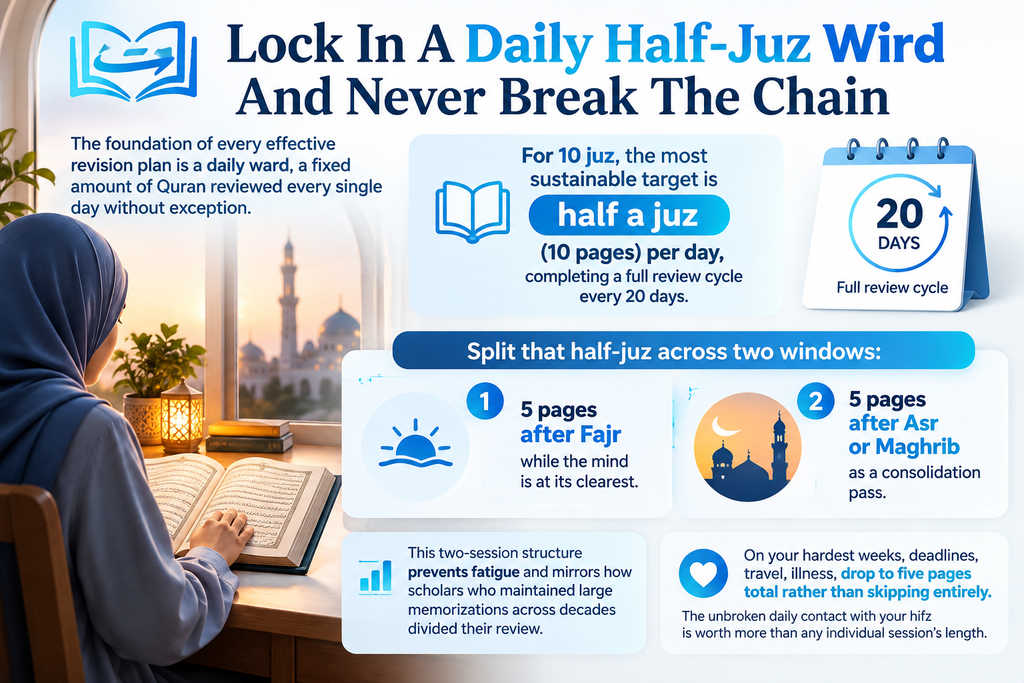
1. Lock In A Daily Half-Juz Wird And Never Break The Chain
The foundation of every effective revision plan is a daily wird, a fixed amount of Quran reviewed every single day without exception. For 10 juz, the most sustainable target is half a juz (10 pages) per day, completing a full review cycle every 20 days.
Split that half-juz across two windows: five pages after Fajr while the mind is at its clearest, and five pages after Asr or Maghrib as a consolidation pass.
This two-session structure prevents fatigue and mirrors how scholars who maintained large memorizations across decades divided their review.
On your hardest weeks, deadlines, travel, illness, drop to five pages total rather than skipping entirely. The unbroken daily contact with your hifz is worth more than any individual session’s length.
2. Run The 10-Day Cycle So Every Juz Stays In Rotation
Assign one complete juz to each calendar day: juz 1 on day 1, juz 2 on day 2, through juz 10 on day 10. On day 11, begin again from juz 1. No juz goes unreviewed for longer than 10 days, short enough to prevent compounding forgetting.
The cycle also eliminates a quiet killer of revision habits: the daily question of “what should I review today?” Decision fatigue causes more revision plans to collapse than lack of time ever does. The 10-day cycle answers that question automatically, permanently.
After two or three full cycles, patterns emerge. Some juz will consistently feel solid. Others will feel shaky in the same places every time.
That consistency is reliable diagnostic data, it tells you exactly where to concentrate extra effort without wasting time on what is already strong.
3. Use The Five Daily Prayers As Your Personal Revision Engine
Most hafizeen treat the five daily prayers as entirely separate from their revision schedule. That is a significant missed opportunity. Prayer offers the most focused, spiritually heightened state available to a human being, and for a hafiz, it is a built-in revision session five times a day at no additional cost to the schedule.
The key shift is intentional selection. Rather than defaulting to short surahs memorized years ago, read from the juz you are currently reviewing.
This single change multiplies daily contact with your hifz meaningfully without adding a single minute to your day.
A. Fajr Is Your Sharpest Window
The Fajr window, from the prayer itself through the Ishraq time, is the sharpest cognitive period of the day.
The mind has had a full night of consolidation, the world has not yet generated competing noise, and the spiritual environment of that hour amplifies both focus and retention in ways that are difficult to replicate later.
Recite from your revision juz in the sunnah and fard rak’ahs of Fajr. Even three to four pages read slowly and attentively at this hour tend to stick significantly better than ten pages rushed through after dinner.

B. Asr And Maghrib Turn Morning Impressions Into Lasting Memory
By Asr, your brain has had several hours to process what you reviewed at Fajr. Reciting the same pages again, in the prayer itself or immediately after, converts a first impression into a consolidated memory trace.
Pay close attention to where you hesitate. Hesitation during Asr review is your feedback system: it marks exactly which verses need focused attention in your next dedicated sitting session.
C. Qiyam Al-Layl Seals What Daylight Sessions Begin
For American Muslims who pray qiyam al-layl even two or three nights per week, this is an exceptional revision opportunity. Long passages recited standing, slow, attentive, in the stillness before dawn, create depth of retention that daytime sessions rarely produce.
For students working independently without a local hifz community, qiyam becomes a private, powerful session requiring no teacher, no partner, and no scheduling coordination. The greatest Quran reciters in history maintained their hifz through night prayer not through desk-based drills alone.
Experience Our Interactive Learning
Curious about how we teach? Watch these brief video clips from our recent live sessions to see our structured curriculum, advanced learning platform, and dynamic student-teacher interactions firsthand.
4. Find A Revision Buddy And Turn Mutual Accountability Into Momentum
Solo revision has a structural blind spot: your brain automatically fills in missing words without flagging the gap. You believe you recited correctly because internally, you completed the verse, even when your lips actually skipped or merged something.
A revision partner eliminates that blind spot. They hear what you cannot, catch the merged verse you did not notice, and hold you accountable even on weeks when self-discipline alone is not enough.
Forty minutes twice a week, meeting in person or via video call, is enough to produce meaningful results. Alternate roles: one recites while the other follows in the Mushaf, then switches.
For sisters looking for structured revision communities, quran hifz classes for sisters offer peer-based programs where this mutual accountability is already built into the design.
Begin Your Hifz for Sisters Journey With Tabarak Academy Now

5. Listen Your Way Through Days When Sitting Down Is Not An Option
American life does not always leave quiet desk time for revision. Work shifts, long commutes, childcare, and household responsibilities can fill every sitting window on a given day.
On those days, active listening is the maintenance layer that keeps the cycle intact. Queue up your current revision juz recited by a sheikh whose voice sustains your attention, Mishary Rashid, Maher Al Muaiqly, or whoever keeps you fully present, and play it during your commute, workout, or while cooking.
This method surfaces something specific: when you hear a verse that sounds unfamiliar despite being in your memorized juz, that is a real signal.
That verse needs extra attention in your next sitting session. Listening works as a supplementary layer and simultaneously as a diagnostic tool, two functions for the price of none.
6. Take On Your Similar Verses Head-On And Break The Pattern Of Confusion
The most persistent and frustrating memorization error is confusing verses that look or sound nearly identical. Two verses in Al-Baqarah that open with the same phrase, passages in two different juz sharing nearly identical wording, chronic confusion at these points erodes confidence and slows every review session.
The solution is direct comparison, not isolation. Pull all the confused verses up side by side in your next session and alternate between them, one, then the other, then back, until the distinction is reflexive rather than reasoned.
Understanding the importance of the Arabic language makes this process significantly more effective.
When you know even the basic meaning of the words that differ between two similar verses, your brain creates a separate semantic anchor for each one, far more durable than distinguishing them by sound alone. Even beginning Arabic vocabulary reduces mutashabihat confusion dramatically.
Why Advanced Learners Choose Tabarak Academy’s Online Qirat Course?

7. Use The Three-Tier System To Make Sure Old Material Never Goes Cold
Not all 10 juz need the same amount of attention every week. The three-tier system organizes your memorization based on recency and current strength, directing your limited time where it matters most.
The table below shows how to assign and review each tier. One or two cycles of honest self-testing is enough to slot every juz accurately.
| Tier | Time Since Last Review | Suggested Frequency | Priority Level |
| Tier 1 — Recent | 0–7 days | Daily or every other day | Highest |
| Tier 2 — Intermediate | 8–30 days | Every 3–4 days | Medium |
| Tier 3 — Older | 30+ days | Weekly or biweekly | Steady maintenance |
Most hafizeen unconsciously pour all their energy into Tier 1 while Tiers 2 and 3 silently decay. Discovering that old juz have gone cold is entirely preventable with this system.
Reassign juz between tiers as their condition changes, which typically clarifies after two or three review cycles.
8. Hold The Line No New Material Until Every Existing Juz Is Solid
This is the most commonly broken rule in self-directed hifz, broken for understandable reasons. The impulse to keep moving forwird, to add juz 11 while juz 3 is still shaky, feels like ambition. But adding new material to an unstable foundation does not build a larger hifz; it builds a fragile one.
Anyone who has researched how long does it take to memorize quran knows the timeline varies widely across students. The single largest variable is whether students protected existing memorization responsibly before advancing.
Those who moved slowly and stabilized what they had consistently finished stronger than those who raced forwird on shaky ground.
The standard is concrete: can you recite any of your 10 juz, from any starting point, without hesitation, without error, reliably across multiple sessions? If the answer is no for even one juz, that is where your focus belongs before anything new is introduced.

Build A Weekly Schedule That Holds Even When Life Does Not Cooperate
A great revision strategy that cannot survive a hard week is not a great strategy, it is a good-weather plan. American life has hard weeks, demanding seasons, and months that go sideways. Building a structure that bends without breaking requires intentional design, not willpower.
The framework below works with the natural rhythm of an American week rather than against it.
A. The Monday–Friday Weekday Plan
On weekdays, keep sessions short, targeted, and non-negotiable. Review one-quarter to one-half juz during the Fajr window, or during the commute via listening if a dedicated session is genuinely unavailable that morning.
Weekday sessions are maintenance sessions: you are making contact with the material to prevent decay, not doing deep diagnostics on weak spots. Save the deeper work for the weekend.
For practical strategies on fitting hifz into a packed weekday schedule, 3 effective ways for time management in Islam offers frameworks that have helped many American Muslims find revision time they did not know they had.
Start Weekend Quran Classes With a Free Trial Now

B. The Weekend Deep-Review Session
Set aside 60–90 minutes on Saturday or Sunday morning, ideally starting at or just after Fajr, for your weekly deep review. This is the session where you test yourself from memory rather than reading from the Mushaf.
Recite without looking and track every hesitation point. Update your three-tier system assignments based on what you discovered. Plan the coming week’s daily sessions around the juz that surfaced as weakest.
C. The Monthly Reset When To Start Over From The Beginning
At the end of each month, run one complete sequential review of all 10 juz in order — from juz 1 through juz 10, over a 10 to 20 day stretch. This replaces rather than supplements your normal cycle for that period.
The monthly reset functions as both an audit and a confidence builder. You finish it knowing exactly which juz are strong and which need concentrated work. Over months of consistent resets, the cycle gets measurably faster, which is how you know your hifz is genuinely consolidating.
At Tabarak Academy, we work with hafizeen at exactly this stage, students who have built significant memorization and need structured support to protect and strengthen what they have.
Our certified instructors design flexible online revision tracks, provide weekly accountability sessions, and build personalized plans around real American schedules.
Whether you are searching for a best online hifz program with live teacher access or a self-paced maintenance track, Tabarak Academy has a path built for you.
What To Do When Life Interrupts Your Revision Plan?
Gaps happen. A demanding project at work, a family emergency, illness, a week of travel, any of these can knock a dedicated hafiz off schedule for days or longer. The question is not how to avoid gaps entirely; it is how to return from them cleanly.
Those who worry it is too late to memorize quran — or that too much has been lost to recover, consistently discover the same truth: previously memorized material returns far faster than it was originally learned.
Re-learning after a gap is categorically different from first-time memorization. The pathways are already formed; they need reactivation, not rebuilding. When you return after a gap, resume your normal daily wird rather than trying to compensate with double sessions.
Let the 10-day cycle rebuild natural contact with each juz over the following two to three weeks. Trust the structure to do what it was designed to do.
Start Quran Classes for Brothers With a Free Trial Now

Make Your 10 Juz The Launchpad For Something Greater
Having a concrete long-term goal transforms revision from a maintenance chore into a purposeful pursuit.
For many hafizeen, the most meaningful goal beyond completed memorization is earning an ijazah, a formal certification that your recitation meets the authenticated standard of a chain of transmission connected back to the Prophet ﷺ.
Ijazah in the Quran is not reserved for full-time scholars or students at traditional institutions. It is achievable for anyone whose recitation meets the required standard through verified examination.
If you want to understand the timeline, how long does it take to get an Ijazah? depends almost entirely on the consistency of your revision, which means the plan you build today is simultaneously the preparation you need for that goal.
A target like this gives every revision session purpose beyond routine and gives your teacher a concrete milestone around which to build your curriculum and pace your progress.
Enroll in the Online Ijazah Course Now

Set The Stage For Your Children Too
For American Muslim parents reading this, the daily revision discipline you build does something your children will absorb before they consciously register it happening.
A parent who returns to the Quran consistently, without drama, without skipping, gives children a living model that no lecture about Islamic identity can replicate.
If you are thinking about how to make quran memorization fun for kids or wondering how to teach a 5 year old to memorize quran, your own daily hifz habit is the most powerful environmental factor available to you.
A home where hifz is actively maintained, not just historically completed, naturally draws children toward participation.
For parents thinking carefully about how to raise children in Islamic way in the United States, visible daily Quranic engagement is one of the most effective anchors of Islamic identity your household can carry, especially in an environment where that identity faces real cultural pressure.

Step Inside Our Virtual Classrooms
See our engaging teaching methods in action! watch real snippets of our live classes and discover how our expert instructors make learning interactive, memorable, and inspiring for every student.
Start Your Revision Journey With Tabarak Academy’s Expert Instructors Today
Your 10 juz deserve expert support, not solo guesswork and self-doubt. Tabarak Academy‘s certified instructors work with hafizeen across the United States, providing structured revision tracks, weekly progress reviews, and personalized plans that fit around real American careers, school schedules, and family commitments.
Whether your goal is securing your current 10 juz, advancing toward a complete hifz, or earning a formal ijazah, your dedicated instructor is ready.
Thousands of students have protected and strengthened their Quranic memorization with Tabarak Academy, from their living rooms, lunch breaks, and Fajr windows.
Our Quran Memorization / Hifz Courses
- Online Hifz Program
- Juz 30 Memorization Course
- Hifz for Kids Course
- Hifz for Adults Course
- Hifz for Sisters Course
- Short Surah Memorization Course
- Hifz Ijazah Course
Begin Your Personalized Revision Plan With Tabarak Academy with a Free Trial

Conclusion
A revision plan for someone who has memorized 10 juz is not a supplementary activity, it is the practice that determines whether your hifz belongs to you for life or only for now.
The eight steps in this guide address every major failure point: daily consistency through a fixed wird, full coverage through the 10-day cycle, prayer-integrated review, partner accountability, audio maintenance on busy days, direct similar-verse comparison, tiered protection of older material, and the discipline to stabilize before advancing.
The core insight from this entire guide is that the revision plan for someone who has memorised 10 juz works best when it is simple enough to survive your hardest week.
An ambitious system that collapses under pressure is worth far less than a modest one that endures. Build for consistency over intensity. Let the structure do what motivation alone cannot sustain.
Your 10 juz took years to build. They are worth protecting with the same intention that built them.
Frequently Asked Questions
How Many Pages A Day Should I Review When I Have 10 Juz Memorized?
Ten pages per day, half a juz, is the standard recommendation. This completes a full review cycle every 20 days, keeping every page in recent enough memory to prevent significant fading.
On high-demand days, five pages with a compensatory weekend session maintains the overall cycle without breaking it.
Is It Normal To Forget Parts Of A Juz Even While Reviewing Regularly?
Yes. The Prophet ﷺ specifically described the Quran as slipping away faster than other memorized content. Regular review dramatically reduces fading but does not eliminate soft spots entirely.
Occasional gaps and weaker passages are a normal and expected part of the lifelong hifz commitment not a sign that something is wrong with your memory.
What Should I Do After Missing An Entire Week Of Revision?
Resume from wherever you are in the cycle do not attempt to compensate by doubling daily sessions. Previously memorized material returns faster than it was initially learned.
A week’s gap typically recovers within two to three normal review sessions per affected juz once consistent contact resumes.
How Do I Know Which Of My 10 Juz Needs The Most Concentrated Work?
Track your hesitations systematically. Every time you stumble, pause, or feel uncertain during review, note which juz and approximately where the difficulty appeared.
After two full 10-day cycles, a clear and reliable pattern will emerge. Those consistently shaky juz are where your weekend deep-review sessions should focus.
Can I Begin Adding New Juz While Maintaining My Existing 10?
Only after you can recite all 10 existing juz from any starting point, without hesitation or error, consistently across multiple sessions.
That threshold is the signal that the foundation can bear additional weight. Adding new material before reaching it weakens both the old and the new simultaneously.
How Does Tajweed Fit Into A Daily Revision Session?
Tajweed applies in every recitation context, including private review. Recite with conscious attention to the rules governing the verses you are covering in each session.
Flag any applications you are uncertain about and bring them to a teacher or class for correction. Revision sessions are ideal for tajweed refinement precisely because you are not learning new content at the same time.