

How to Read the Quran in Arabic for Beginners
Learning how to read the Quran in Arabic for beginners may seem challenging at first, especially if you do not speak Arabic. However, you can build this skill step by step by learning the Arabic letters, understanding Harakat (vowel marks), and practicing how letters form Quranic words.
In this guide, you’ll discover the best way to read the Quran in Arabic for beginners, along with practical tips to help you improve your reading and pronunciation.
The easiest way to learn how to read the Quran in Arabic for beginners is to build your skills in a clear order. You do not need to speak Arabic fluently to begin reading the Quran.
Start with the Arabic alphabet, learn the basic vowel marks (Harakat), understand how letters connect, and then practice reading simple Quranic words.
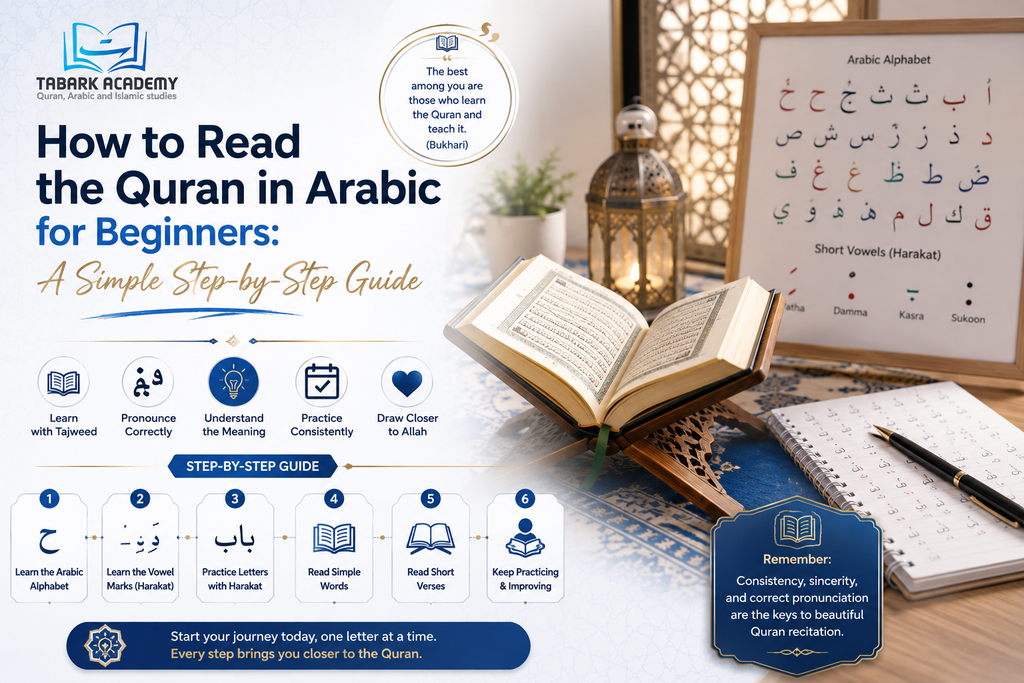
Step 1: Learn the 28 Arabic Letters and Recognize Their Shapes and Sounds
The first step in learning how to read the Quran in Arabic for beginners is becoming familiar with the 28 letters of the Arabic alphabet.
At this stage, focus on three things for each letter: its name, written shape, and basic sound. You do not need to memorize every letter perfectly in one session. Learn a small group at a time and review them regularly.
Pay particular attention to letters that have similar shapes but are distinguished by dots, such as:
- ب، ت، ث
- ج، ح، خ
- د، ذ
- ر، ز
- س، ش
- ص، ض
- ط، ظ
Recognizing these differences early helps prevent confusion when you begin reading Quranic words.
It is also important to hear the correct pronunciation of each letter, because some Arabic sounds do not have an exact equivalent in English. Learning them accurately from the beginning makes later Tajweed and pronunciation practice much easier.
Step 2: Master Harakat to Read the Short Vowel Sounds Correctly
Once you can recognize the Arabic letters, the next step is learning Harakat, the short vowel marks that tell you how each letter should be pronounced.
The three basic Harakat are:
- Fatha (َ) produces a short “a” sound.
- Kasra (ِ) produces a short “i” sound.
- Damma (ُ) produces a short “u” sound.
For example, the letter ب changes depending on the Harakah placed on it:
بَ = ba
بِ = bi
بُ = bu
Practice combining each Arabic letter with these three vowel marks until you can recognize the sound without stopping to think.
As you progress, you will also need to recognize other important Quranic signs, including:
- Sukoon (ْ): indicates that the letter has no short vowel.
- Shaddah (ّ): indicates that the consonant sound is doubled.
- Tanween: produces an ending sound such as -an, -in, or -un.
Learning these marks is essential because Quranic Arabic is written with pronunciation signs that guide the reader through each word.
Step 3: Learn How Arabic Letters Join and Change Shape Inside Words
Arabic is written from right to left, and most letters connect to the letters around them. Because of this, the shape of a letter may change depending on whether it appears at the beginning, middle, or end of a word.
Understanding these connected forms is an important part of learning how to read the Quran in Arabic for beginners.
For example, the letter ب (Baa) may appear as:
- ب — isolated
- بـ — at the beginning
- ـبـ — in the middle
- ـب — at the end
Although these forms may appear different at first, they all represent the same letter.
Instead of memorizing each shape as a completely new symbol, practice identifying the main features of the letter wherever it appears.
Learn the Six Arabic Letters That Do Not Connect to the Next Letter
There are six important letters that do not connect to the letter that follows them:
ا – د – ذ – ر – ز – و
When one of these letters appears inside a word, you will see a visual break before the next letter.
Learning these six letters early can make connected Arabic words much easier to understand.
Experience Our Interactive Learning
Curious about how we teach? Watch these brief video clips from our recent live sessions to see our structured curriculum, advanced learning platform, and dynamic student-teacher interactions firsthand.
Step 4: Use the Scan–Apply–Blend Method to Read Quranic Words
Once you know the alphabet, Harakat, and connected letter forms, you can begin sounding out simple Quranic words.
A useful method for beginners is Scan – Apply – Blend.
1. Scan the Letters From Right to Left
First, look at the word and identify each Arabic letter.
For example:
خَلَقَ
The letters are:
- خ — Khaa
- ل — Laam
- ق — Qaaf
Do not rush to pronounce the entire word. Start by recognizing each letter correctly.
2. Apply the Harakat to Each Letter
Next, look at the vowel mark attached to each letter.
In خَلَقَ, all three letters carry a Fatha:
خَ = kha
لَ = la
قَ = qa
This step helps you convert written letters into individual sounds.
3. Blend the Sounds Into One Smooth Word
Once you can pronounce each part, combine the sounds without long pauses:
kha + la + qa = khalaqa
At first, you may need to read each syllable separately. With repetition, you will begin recognizing the complete word more quickly and reading it more smoothly.
Read also: Difference Between Qaf and Kaf Pronunciation in Arabic
Step 5: Practice Short Surahs to Build Fluency and Confidence
After learning the alphabet, Harakat, connected letters, and basic word blending, begin applying these skills to short Quranic passages.
Starting with short Surahs is one of the most effective Quran reading tips for beginners because the verses are manageable and can be repeated frequently.
Choose a short Surah and work through it slowly. Focus first on accurate reading rather than speed.
A simple practice method is to:
- Read one verse slowly.
- Identify any letters or vowel marks that cause difficulty.
- Listen to a reliable recitation of the same verse.
- Repeat the verse several times.
- Move to the next verse only when you can read the first one more comfortably.
- Return to the full Surah and practice connecting the verses smoothly.
Surahs such as Al-Fatihah, Al-Ikhlas, Al-Falaq, and An-Nas are often useful starting points because they are short and commonly recited.
The goal at this stage is not to read quickly. Focus on recognition, pronunciation, and consistency. Fluency develops naturally as your eyes become more familiar with Quranic script and your tongue becomes more comfortable producing Arabic sounds.
What Is the Best Way to Read the Quran in Arabic for Beginners?
The best way to read the Quran in Arabic for beginners is to follow a gradual learning process rather than trying to read full pages immediately. Build your skills from the basics and practice them consistently. A simple approach is:
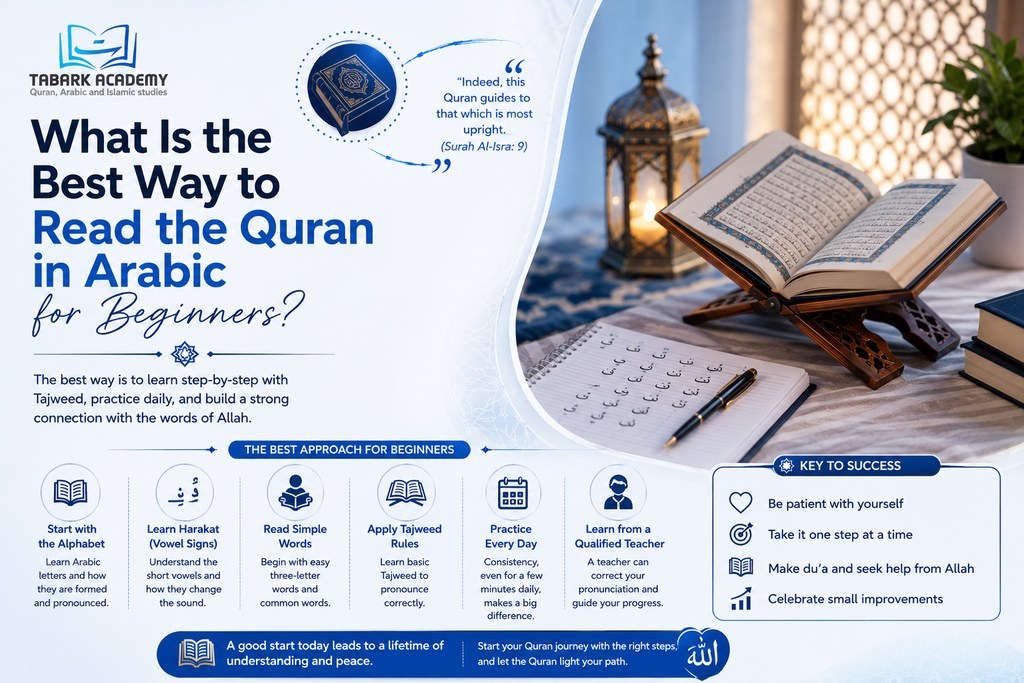
- Learn the Arabic alphabet and practice each letter’s pronunciation.
- Master Harakat such as Fatha, Kasra, and Damma.
- Understand connected letters and learn the six non-connecting letters.
- Practice sounding out simple Quranic words from right to left.
- Start with short Surahs that are easier to practice and repeat.
- Listen to qualified reciters and repeat after them to improve pronunciation.
- Practice daily, even if you only have 15–20 minutes.
- Learn basic Tajweed gradually as your reading foundation becomes stronger.
- Work with a qualified Quran teacher when possible to receive feedback and correct pronunciation mistakes.
The key is to focus on accuracy before speed. With regular practice, familiar letters, sounds, and words will become easier to recognize, helping you read the Quran more confidently over time.
Tips for Better Progress In Reading The Quran in Arabic for Beginners
If you are learning how to read the Quran in Arabic for beginners, progress usually comes from consistent, focused practice rather than trying to learn too much at once. The goal is to gradually make Arabic letters, vowel marks, and Quranic words easier to recognize and pronounce.
Use these practical habits to strengthen your reading skills and build confidence over time.
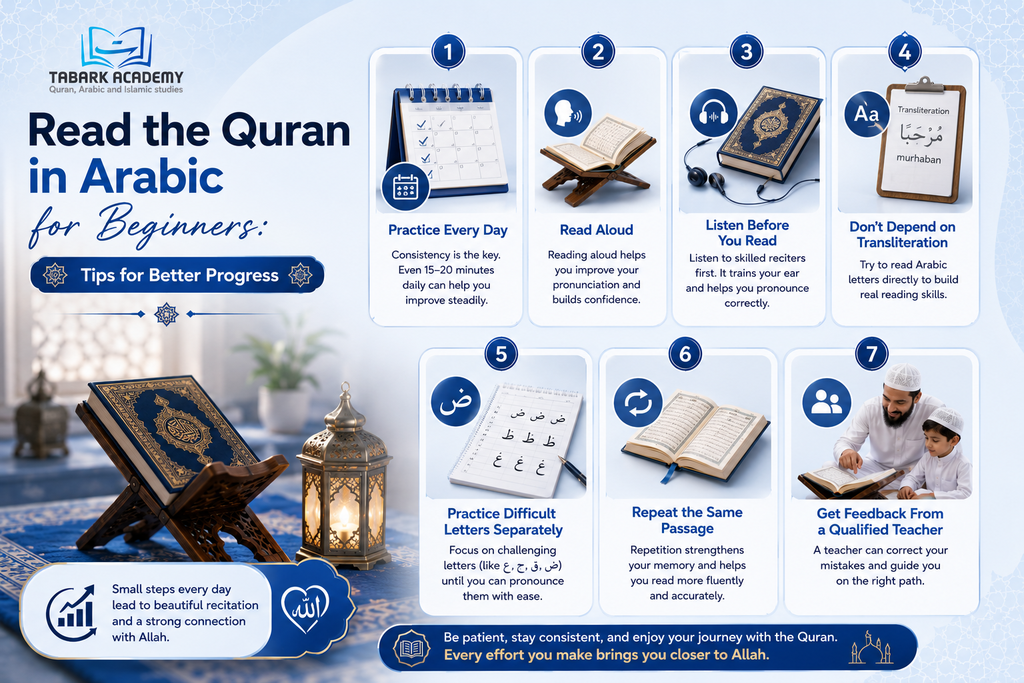
1. Practice Quran Reading for 15–20 Minutes Every Day
Short, regular practice is usually more effective than studying for a long period only once or twice a week.
Set aside 15–20 minutes each day to review letters, Harakat, Quranic words, or a short passage. Daily exposure helps your eyes become more familiar with Arabic script and reduces the amount of time you need to recognize individual letters.
If 20 minutes feels difficult to maintain, begin with 5–10 minutes. A routine you can follow consistently is more valuable than an ambitious schedule you quickly abandon.
2. Read the Quran Aloud to Improve Pronunciation and Fluency
Reading silently may help with letter recognition, but reading aloud allows you to hear how you are actually pronouncing Arabic sounds.
Recite slowly enough to pronounce each letter clearly. If you struggle with a word, break it into smaller sounds, pronounce each part separately, and then blend them together again.
Do not worry about reading quickly. For beginners, accuracy should come before speed. Fluency develops naturally as letter and word recognition becomes more automatic.
3. Listen to Correct Quran Recitation Before Reading the Passage Yourself
Listening can help connect the Arabic text you see with the sounds you are expected to produce.
Choose a short verse and follow the Arabic text while listening to a clear, reliable Quran reciter. Pay attention to the pronunciation of individual letters, vowel sounds, elongations, and pauses.
Working with one or two verses at a time makes it easier to concentrate on pronunciation instead of trying to keep up with a long recitation.
4. Gradually Stop Relying on Transliteration and Read Directly From Arabic
Transliteration may seem helpful at the very beginning, but depending on it for too long can slow your ability to recognize Arabic letters and words independently.
It also cannot represent every Arabic sound with complete accuracy, particularly letters that have no direct English equivalent.
Whenever possible, look at the Arabic text first. Try to identify the letters and Harakat yourself before checking any additional support.
Your long-term goal should be to see a Quranic word and read it directly from Arabic without converting it into English letters first.
5. Isolate Difficult Arabic Letters and Practice Their Makharij
Some Arabic sounds can be particularly challenging for beginners, especially when those sounds do not exist in their first language.
Instead of repeatedly mispronouncing a difficult letter while reading complete verses, isolate it and practice it separately.
For example, you may need additional work on letters such as:
ع – ح – خ – غ – ق – ص – ض – ط – ظ
Listen carefully to how the letter is pronounced, learn its correct Makhraj (articulation point), and practice it with different Harakat.
This allows you to correct the underlying pronunciation problem before returning to normal reading.
6. Repeat the Same Quranic Passage Until Reading Becomes Easier
Constantly moving to new verses may give you more material to practice, but repetition is what helps many beginner reading skills become automatic.
Choose a short passage and read it several times. During the first attempt, you may need to identify almost every letter individually. After several repetitions, you should begin recognizing familiar combinations and words more quickly.
Each repetition can have a different focus:
- First reading: Identify the letters and Harakat accurately.
- Second reading: Focus on correct pronunciation.
- Third reading: Reduce unnecessary pauses between letters and words.
- Fourth reading: Pay attention to basic Tajweed and elongation.
- Final reading: Try to read the passage smoothly from beginning to end.
Do not measure progress only by how many pages you complete. Being able to read a short passage more accurately and independently than before is meaningful progress.
7. Use a Beginner Quran Reading Book or Noorani Qaida for Structured Practice
If reading directly from the Mushaf still feels overwhelming, a structured beginner resource such as Noorani Qaida can help bridge the gap between recognizing individual letters and reading complete Quranic verses.
These resources typically introduce skills progressively, moving from individual letters to Harakat, connected letters, Sukoon, Shaddah, Madd, and increasingly complex combinations.
Follow the lessons in order rather than skipping ahead. Each stage prepares you for the reading pattern introduced in the next one.
8. Ask a Qualified Quran Teacher to Correct Mistakes Early
Some Quran reading mistakes are difficult to identify on your own. You may believe you are pronouncing a letter correctly because the sound seems close, even though its Makhraj or characteristics need correction.
A qualified Quran teacher can listen to your reading and identify issues with letter pronunciation, Harakat, Madd, Tajweed, and fluency before those mistakes become established habits.
This is particularly valuable for beginners because receiving correction early gives you a more accurate foundation to build on.
9. Track Your Progress by Skills, Not Just Pages Completed
Reading more pages does not always mean that your Quran reading is improving. Instead of measuring progress only by quantity, track the specific skills you can now perform independently.
For example, ask yourself:
- Can I recognize all 28 Arabic letters?
- Can I distinguish similar-looking letters?
- Can I read Fatha, Kasra, and Damma confidently?
- Can I recognize Sukoon and Shaddah?
- Can I identify connected forms of letters?
- Can I sound out an unfamiliar Quranic word?
- Can I read a short verse without relying on transliteration?
These small milestones make progress easier to see and show you exactly what you should practice next.
10. Be Patient and Focus on Accuracy Before Reading Speed
Beginners often compare their reading speed with fluent Quran readers and feel that they are progressing too slowly. However, speed should not be your main goal during the early stages.
Read slowly enough to identify letters, pronounce them correctly, and apply the signs you have learned. Avoid guessing words simply because they look familiar.
As recognition becomes automatic, your reading speed will gradually increase without sacrificing accuracy.
The most important thing is to practice consistently, correct mistakes, and keep moving forward one skill at a time. With regular practice and proper guidance, Quranic Arabic that initially looks unfamiliar can gradually become much easier to recognize, pronounce, and read confidently.
How Long Does It Take to Learn to Read the Quran in Arabic?
Some beginners progress quickly, while others need more time, depending on their previous experience with Arabic, practice routine, pronunciation, and access to a qualified teacher. If you practice consistently, you may gradually progress through these stages:
- First stage: Recognizing the Arabic letters and their sounds.
- Second stage: Reading letters with Harakat and simple combinations.
- Third stage: Sounding out complete Quranic words.
- Fourth stage: Reading short Surahs with greater confidence.
- Fifth stage: Improving fluency and pronunciation while learning Tajweed.
The most important factor is consistent practice rather than speed. Even 15-20 minutes of focused practice each day can help you make steady progress.
Step Inside Our Virtual Classrooms
See our engaging teaching methods in action! watch real snippets of our live classes and discover how our expert instructors make learning interactive, memorable, and inspiring for every student.
Learn to Read the Quran in Arabic With Tabarak Academy
If you’re ready to move beyond practicing on your own, Tabarak Academy can help you build your Quran reading skills through structured online lessons taught by qualified teachers. Whether you’re starting with the Arabic letters or working on your pronunciation, guided learning can give you the support and feedback you need to progress with confidence. With Tabarak Academy, learners can work on:
- Reading the Quran in Arabic from the basics.
- Correct pronunciation of Arabic and Quranic letters.
- Quran reading fluency through regular practice.
- Tajweed fundamentals as their skills develop.
- Personalized guidance from experienced Quran teachers.
- Flexible online Quran learning for learners of all ages and levels.
Instead of struggling with difficult letters or pronunciation on your own, you can learn step by step with a teacher who can identify mistakes and help you improve.
Our Quran Memorization / Hifz Courses
- Online Hifz Program
- Juz 30 Memorization
- Hifz for Kids
- Hifz for Adults
- Hifz for Sisters
- Short Surah Memorization Course
- Hifz Ijazah Course
Conclusion
Learning to read the Quran in Arabic does not require you to become fluent in Arabic before you begin.
What matters most is building the right skills in the right order: recognize the Arabic letters, master Harakat, understand how letters connect, practice blending sounds into words, and gradually move into short Surahs and complete Quranic passages.
Do not rush to read quickly. For a beginner, accurate letter recognition and pronunciation are more important than the number of pages completed.
Practice for a short period every day, repeat difficult words and passages, listen to correct recitation, and work specifically on letters or Makharij that continue to cause difficulty.
As these individual skills become more automatic, you can gradually introduce basic Tajweed and focus more on fluency.
Most importantly, seek correction from a qualified Quran teacher whenever possible so that pronunciation mistakes can be identified before they become established habits.
Ready to take the next step? Join Tabarak Academy and start learning to read the Quran in Arabic with structured guidance and qualified teachers.
FAQs
Do I need to learn Arabic grammar to read the Quran?
No. You can learn to read the Quranic Arabic script without first studying Arabic grammar. Grammar becomes useful when you want to understand the language and meaning more deeply.
Should I learn Tajweed before reading the Quran?
You can begin reading before mastering Tajweed. However, learning basic Tajweed and pronunciation with a qualified teacher can help you develop accurate recitation habits.
What Surah should a beginner start with?
Short Surahs such as Al-Ikhlas, Al-Falaq, An-Nas, Al-Asr, and Al-Kawthar are practical choices because they are relatively short and provide manageable reading practice.
Is transliteration enough to learn Quran reading?
Transliteration can provide temporary support, but it shouldn’t replace learning the original Arabic script. The goal should be to gradually recognize and read the Quran directly in Arabic.
Can I learn Quran reading online?
Yes. Online Quran classes can provide structured lessons and direct feedback from a teacher, making them a convenient option for beginners who want guided learning from home.