


How to Improve Arabic Skills: 9 Practical Steps to Speak with Confidence
You may already read and write Arabic reasonably well, yet freeze the moment a real conversation begins. If you struggle to find the right words or worry about making mistakes, you are not alone.
Learning how to improve Arabic skills, especially speaking, is the single most common goal among Arabic learners, and it is also the skill that demands the most deliberate, structured practice.
Learning Arabic is a deeply rewarding journey. It connects you to a rich culture, a long literary history, and hundreds of millions of speakers around the world. Many students study grammar diligently and memorize long vocabulary lists, yet still hit the same frustrating wall: an inability to speak with confidence and fluency.
The gap between knowing Arabic and using Arabic is exactly what this guide is designed to close.
The good news is that conversational fluency is an achievable goal. It requires the right strategies, consistent effort, and a supportive learning environment.
This guide walks you through nine practical, field-tested steps to improve Arabic skills, explains why speaking feels so difficult in the first place, and shows how Tabarak Academy, an academy built around Quran and Arabic instruction, gives learners a direct path to speaking confidently through guided, one-on-one online lessons.
1. Train Your Ear Through Active Listening and Shadowing
Before you can speak Arabic with confidence, you first need to learn to listen to it accurately. Active listening means focusing not only on individual words but on how native speakers actually communicate their rhythm, their intonation, the pauses they take, and the way words blend together in natural, connected speech.
Many learners rush into speaking before their ear is properly trained, which creates pronunciation habits that are much harder to correct later.
Set aside your first few weeks for intensive, focused listening to native Arabic speakers through podcasts, YouTube channels, and language apps that concentrate on Modern Standard Arabic or the dialect you are targeting.
Expose yourself daily to authentic Arabic through podcasts, news broadcasts, interviews, and songs. Instead of listening passively, focus on context and try to identify recurring phrases and patterns. To accelerate progress, use the shadowing technique: play a short clip of a native speaker, and repeat what you hear almost simultaneously, lagging behind by a fraction of a second.
This method trains your mouth, ear, and brain to work together, helping you develop a more natural accent, smoother speech, and greater self-confidence.
Pay close attention to how the correct pronunciation points of letters, known as makharij, shape the sound of the language — a subject covered in detail in The Seventeen Makharij of Arabic Letters.
Understanding exactly where each letter is produced in the mouth and throat prepares your speech muscles to reproduce accurate sounds once you begin active speaking practice.
2. Speak Every Day — Even If You Are Alone
When it comes to speaking, consistency matters far more than long, occasional study sessions. Make Arabic part of your daily routine, even if you only practice for five minutes.
Short, daily exposure builds durable speech habits far more effectively than a three-hour session once a week, because your brain needs repeated, low-pressure contact with the language to move vocabulary from passive recognition into active, spoken recall.
One effective method is narrating your day. Describe your actions out loud using simple sentences, such as “ana ashrabu al-qahwa” (I am drinking coffee) or “ana dhahibun ila al-‘amal” (I am going to work).
This turns everyday moments into speaking practice and strengthens your ability to think directly in Arabic rather than translating in your head first.
Another effective habit is reading aloud. Choose short Arabic texts, dialogues, or even social media posts, and read them out loud. This improves pronunciation, reinforces vocabulary, and trains your mouth to produce Arabic sounds more naturally over time.
3. Record Yourself and Review Your Speech
Although it can feel strange at first, recording yourself is one of the fastest ways to improve your Arabic. Choose a short passage to read, or answer a simple question in Arabic, then listen back to the recording carefully.
This single habit, repeated over weeks, often produces faster gains than any other self-study technique because it forces you to hear your own Arabic the way a listener would.
Compare your pronunciation, rhythm, and clarity to that of a native speaker. This process helps you notice mistakes you may not catch while speaking in the moment, such as mispronounced letters, incorrect stress, or unnatural pauses, and gives you the chance to correct them deliberately rather than repeating them indefinitely.
Step Inside Our Virtual Classrooms
See our engaging teaching methods in action. Watch this real snippet from one of our live classes and discover how our expert instructors make learning interactive, memorable, and inspiring for every student: Watch: Step Inside Our Virtual Classrooms.
4. Prioritize Communication Over Perfection
The primary goal of learning Arabic is communication, not flawless fluency. Fear of making mistakes often prevents learners from speaking at all, which slows their progress far more than the mistakes themselves ever would. Perfectionism is, in practice, one of the biggest hidden obstacles to fluency.
It is perfectly fine to speak imperfectly. A sentence with minor grammatical errors is far more valuable than silence. Native speakers are usually patient and appreciative of your effort, and most real communication succeeds even with small mistakes.
Your accuracy will naturally improve as you gain more experience and receive constructive feedback along the way.
5. Practice With a Language Partner or a Specialized Tutor
While self-study methods are important, nothing replaces direct conversation with a native speaker. A conversation partner or a specialized tutor can correct your mistakes, model natural expressions, and help you speak with greater fluency than solo practice alone.
This is exactly where a structured learning environment, such as the online courses and regular teaching sessions offered by Tabarak Academy, becomes valuable personalized feedback, guided conversation practice, and consistent interaction all contribute significantly to building speaking confidence and improving fluency.
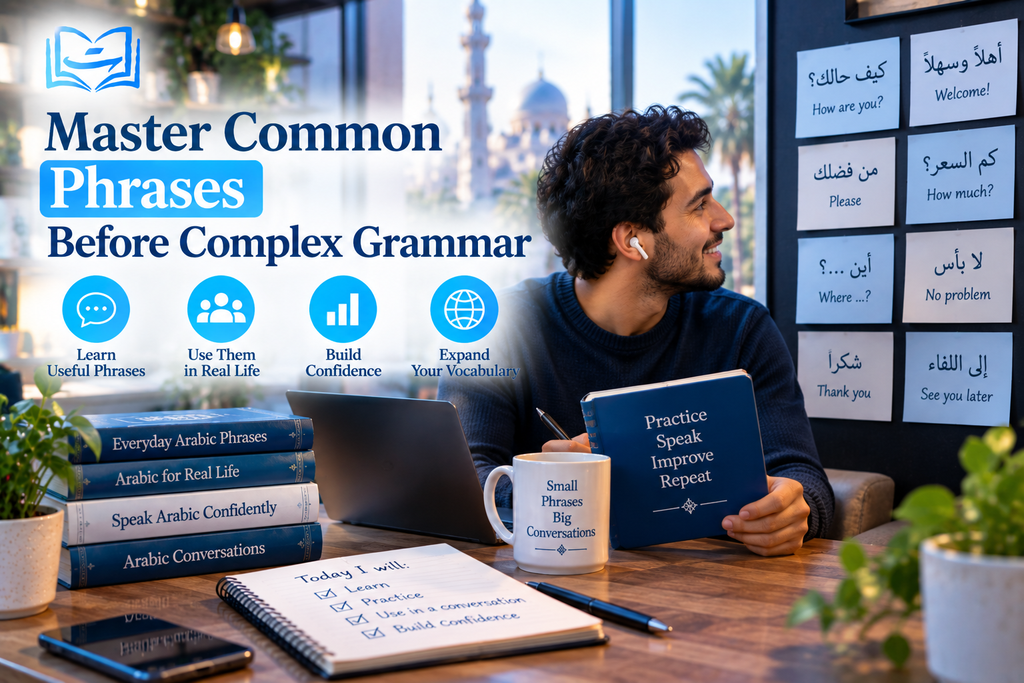
6. Master Common Phrases Before Complex Grammar
Studying grammar without practical application causes hesitation during real conversation. Instead, memorize complete, commonly used phrases that native speakers rely on constantly.
These ready-made phrases allow for immediate communication while your grammar knowledge develops separately and gradually catches up.
Prioritize these core categories of Arabic phrases: greetings and responses (kayfa haluk? — how are you?, al-hamdu lillah — thank God, tasharrafna — pleased to meet you); common questions (ayna…? — where…?, kam…? — how much/many…?, mata…? — when…?); and everyday expressions (la ba’s — no problem, bi-dhabt — exactly, mumkin — may I / is it possible).
These phrases function as building blocks. Once you can produce them automatically, you can expand them gradually: “ayna al-mat’am?” (where is the restaurant?) becomes “ayna aqrab mat’am min huna?” (where is the nearest restaurant from here?), giving you far more expressive range from the same core vocabulary.
Experience Our Interactive Learning
Curious about how we teach? Watch these brief video clips from our recent live sessions to see our structured curriculum, advanced learning platform, and dynamic student-teacher interactions firsthand.
7. Join Structured Conversation Practice Sessions
Good conversation practice requires structure. Random chatting without clear goals produces only limited improvement.
Design fifteen-minute conversation sessions with clear objectives: practice using past-tense verbs, talk about your family members, describe your neighborhood, or explain your daily routine. Structure turns scattered practice time into measurable, compounding progress.
Before each session, prepare five to seven key phrases you want to use. During the conversation, try to naturally incorporate these phrases. After the session, note which phrases you felt comfortable using and which ones need more practice.
This targeted approach systematically develops specific speaking skills instead of leaving your progress to chance.
Structured conversation drills tailored to your proficiency level ensure that every session builds directly on your previous progress instead of covering random, disconnected topics.
8. Expand Your Comfort Zone by Diversifying Topics
Speaking confidently about familiar topics while struggling with new ones is a sign of limited vocabulary range.
Systematically expand your speaking range by dedicating two weeks to each new domain: health and medicine, travel and transportation, technology, education, business, current events, and culture and traditions.
For each topic, learn twenty to thirty core vocabulary words and ten to fifteen common phrases. Practice describing situations, asking relevant questions, and expressing opinions within that domain.
This deliberate expansion ensures you develop broad conversational ability rather than becoming narrowly specialized in a single field.

Build topic-specific flashcards that contain phrases rather than isolated words. Instead of memorizing “mustashfa” (hospital) alone, learn “ahtaju an adh-haba ila al-mustashfa” (I need to go to the hospital).
This phrase-based approach prepares you for genuine, real-world communication right away.
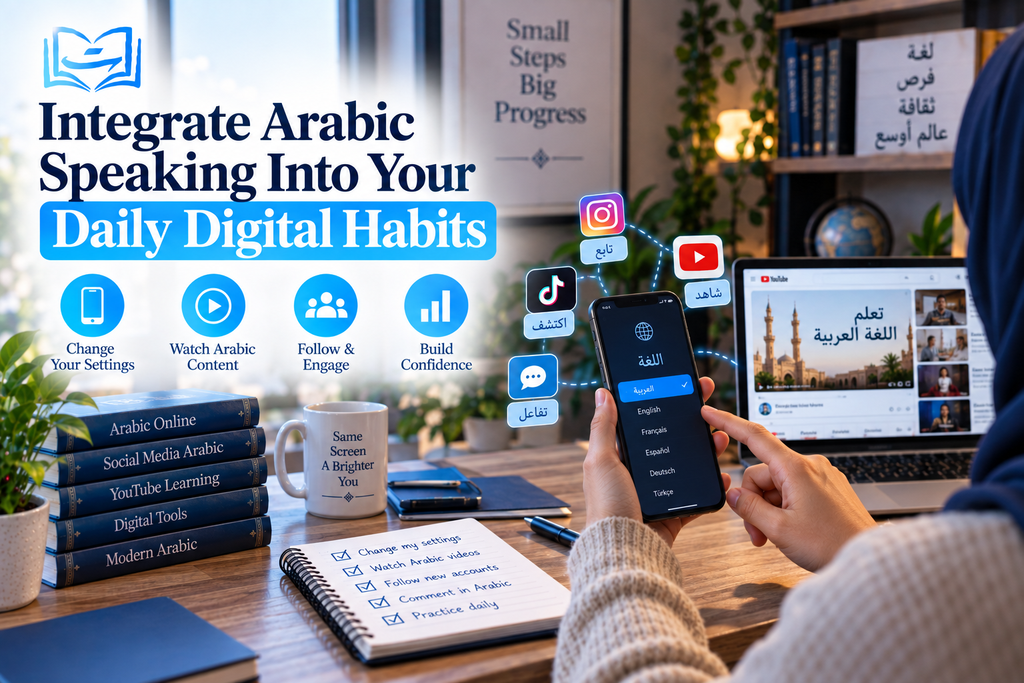
9. Integrate Arabic Speaking Into Your Daily Digital Habits
Turn your passive screen time into active Arabic exposure. Change your phone’s language to Arabic.
Follow Arabic social media accounts that match your interests. Watch Arabic YouTube channels with Arabic subtitles rather than English ones. This constant, low-effort exposure gradually embeds Arabic more deeply in your thinking.
Start with content that is only slightly below your current level. Watching material that is far too advanced causes frustration rather than learning.
As your comprehension improves, gradually increase the difficulty of the content. This progressive challenge keeps you motivated while steadily developing your abilities.
Comment on Arabic social media posts in Arabic, even briefly. Write “shukran ‘ala al-ma’lumat” (thank you for the information) or “video ra’i'” (great video).
These low-pressure written interactions build confidence in spoken communication while maintaining consistent Arabic production.
Why Improving Your Arabic Also Deepens Your Connection to the Quran
For many learners, the motivation to improve Arabic skills goes beyond everyday conversation; it is also about understanding the Quran in its original language.
Strengthening your spoken and listening Arabic naturally supports Quran memorization and recitation, since familiarity with root words, sentence rhythm, and pronunciation carries over directly into how confidently you recite.
If this is part of your goal, Best Method to Memorize Quran and Best Online Hifz Program outline practical, structured approaches that pair naturally with the speaking techniques described above.
Why Is Speaking Arabic So Difficult for Learners?
Speaking is harder than reading or writing because it happens in real time, with no time to pause and check a dictionary or a grammar rule.
Many learners spend years absorbing Arabic passively through textbooks, apps, or courses without ever training the specific muscles that live conversation requires: quick recall, natural pronunciation, and the confidence to respond without over-thinking every sentence.
This mismatch between passive knowledge and active use is precisely why so many students who understand written Arabic well still feel stuck the moment someone asks them a question out loud.
If this sounds familiar, you may also want to read Is Arabic a Difficult Language to Learn? for a broader look at where the real challenges lie and how learners typically overcome them.
Experience Our Interactive Learning
Curious about how we teach? Watch this brief video clip from one of our recent live sessions to see our structured curriculum, advanced learning platform, and dynamic student-teacher interactions firsthand: Watch: Experience Our Interactive Learning.
Step Inside Our Virtual Classrooms
See our engaging teaching methods in action! watch real snippets of our live classes and discover how our expert instructors make learning interactive, memorable, and inspiring for every student.
Start Learning Arabic with Tabarak Academy
Ready to build your Arabic skills with confidence? Join Tabarak Academy for engaging online Arabic classes designed for beginners, children, and learners at different levels.
Learn Arabic step by step with experienced teachers, flexible online lessons, and practical guidance that helps you read, write, understand, speak, and use Arabic in everyday situations, including dedicated support for Arabic writing.
Start your Arabic learning journey with Tabarak Academy today!
| Enroll in Tabarak Academy’s Arabic ProgramStructured lessons, expert native tutors, and a clear learning path — start speaking, reading, and writing Arabic with real confidence.▶ Book Your Free Trial Lesson Now |
Our Arabic Language Courses
- Online Arabic Classes
- Arabic Course for Beginners
- Arabic Alphabet Learning Course
- Online Arabic Classes for Kids
- Arabic Classes for Adults
- Arabic Grammar Course
- Intermediate Arabic Course
- Arabic Speaking Course
- Arabic Reading Course
- Learn Arabic Writing Course
- Classical Arabic Course
- Modern Standard Arabic (MSA) Course
- Advanced Arabic Course
- Intensive Arabic Course
- Madinah Arabic Course
Conclusion
Improving your Arabic speaking skills is a gradual, achievable process built on consistent daily practice rather than occasional, intensive study.
The nine steps above form a complete roadmap — from training your ear and speaking daily, to working with a tutor and integrating Arabic into your digital life. Apply even a few of them consistently and the results will follow.
Applying even a few of these steps consistently will move you noticeably closer to speaking Arabic with real confidence.
If you would like personalized guidance along the way, Tabarak Academy offers structured, one-on-one online lessons with expert native Egyptian tutors designed to help you reach exactly that goal.
Frequently Asked Questions
How long does it take to improve Arabic speaking skills?
It depends on your starting level and how consistently you practice, but most learners notice a meaningful improvement in confidence and fluency within a few months of daily, focused speaking practice combined with regular feedback from a tutor or conversation partner.
Do I need to learn Modern Standard Arabic or a dialect first?
This depends on your goal: Modern Standard Arabic is used in formal media, writing, and religious texts, while dialects are used in everyday conversation in specific regions. Many learners study both together, using Modern Standard Arabic as a foundation.
Can I improve my Arabic speaking without a tutor?
Yes, self-study methods like shadowing, recording yourself, and daily narration can produce real progress.
However, working with a tutor or native speaker accelerates the process by providing direct correction and natural conversation practice that self-study cannot fully replicate.
What is the biggest mistake learners make when trying to speak Arabic?
The most common mistake is avoiding speaking altogether out of fear of making errors. Waiting until you feel “ready” delays progress significantly; speaking imperfectly and learning from corrections is far more effective than staying silent.
How does improving Arabic speaking help with Quran recitation?
Stronger spoken Arabic builds familiarity with pronunciation, root words, and natural rhythm, all of which make Quran recitation and memorization noticeably smoother and more confident over time.