

Want to finish Quran memorization before Ramadan, but the days are slipping away? Every year, it happens the same way. Ramadan feels far off in the fall. Then winter comes, and one morning you look at the calendar and feel your heart drop.
The month is close, and your hifz (learning the Quran by heart) is not where you hoped it would be.
If that is you right now, take a breath. You are not behind for good. You can still reach your goal, or at least get much closer than you think. The best way to finish Quran memorization before Ramadan is to plan by lines, not by pages, and to be honest about how much time you have.
Ramadan 1448 AH is expected to start around February 8, 2027. The exact day depends on the moon. If you start in early November, you have about 90 days. That is three months of mornings, commutes, and quiet nights. It is enough time to do real work.
But here is the problem. Most advice online mixes up two goals. It tells you to read one juz a day and calls that a plan to “finish the Quran.” That works for reading. It does not work for memorizing. If you follow it for hifz, you will feel like you failed, when the plan was wrong from the start.
So this guide does it differently. It starts with what you really want, then gives you a plan you can keep on busy days and tired days, not just good ones.
Step 1: Know What It Means To Finish Quran Memorization Before Ramadan
People use “finish the Quran” for two very different goals. Some mean reading the whole Quran. Others mean learning it by heart. Your plan depends on which one you mean, so start here.
Finishing By Reading Means Reciting All 30 Juz
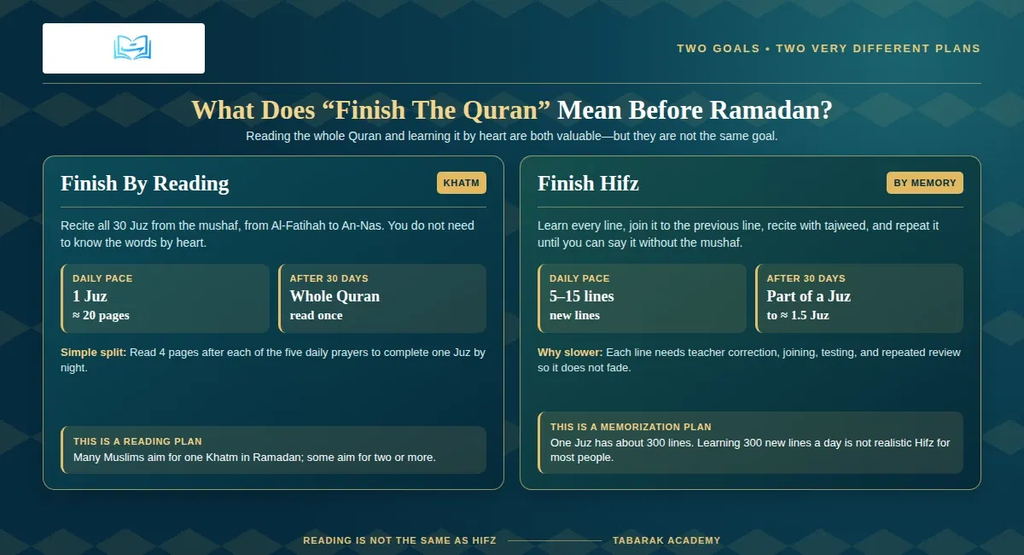
Finishing by reading is called a khatm. You read the whole Quran from the mushaf (the printed Quran), from Al-Fatihah to An-Nas. You do not need to know it by heart.
The Quran has 30 parts. Each part is called a juz. In the standard Madinah Mushaf, one juz is about 20 pages. If you read one juz a day, you finish in 30 days.
That pace is easy to split up. Read 4 pages after each of the five daily prayers. By the end of the day, you have read a full juz without one long sitting.
Many Muslims aim for one khatm in Ramadan. Some aim for two or more. This is a great goal, and most adults can reach it with a steady daily habit.
But reading is not the same as hifz. When an article tells you to finish the Quran in a month with one juz a day, it is giving you a reading plan. Keep that in mind when you read other advice online.
Finishing Hifz Means Reciting From Memory
Hifz means you know the Quran by heart. You can recite it without looking at the mushaf. You also recite it with tajweed, the rules for how each letter should sound.
Hifz is much slower than reading. Each new line must be learned, then joined to the line before it. A teacher should check it. Then you must go over it again and again, or it fades.
Here is a simple way to see the gap. The table below shows the daily pace and the 30-day result for each goal.
| Goal | Daily pace | Result after 30 days |
| Finish by reading | 1 juz (about 20 pages) | The whole Quran read once |
| Finish hifz | 5 to 15 lines | Part of a juz to about 1.5 juz learned by heart |
One juz has about 300 lines. Learning 300 new lines a day is not real hifz for most people. If a plan promises that, it is a reading plan with a new name.
Step 2: Set A Hifz Goal You Can Reach Before Ramadan
Now you know you are working on hifz. The next step is to pick a goal that fits your life. A goal that is too big makes most people quit in the first few weeks.
Measure How Many Lines You Can Memorize In A Day
Before you set a goal, find your real pace. Do not guess. Guessing is the main reason hifz plans fall apart.
Take one week to test yourself. Each day, pick 5 new lines. Time how long it takes to go from first reading to saying them by heart with no mistakes.
At the end of the week, look at your numbers. If 5 lines took 20 minutes, you know about how much time 10 lines will need. Now you can plan with facts, not hopes.
Most people who do hifz next to work or school land between 3 and 15 new lines a day. Beginners start near the low end. People who have done hifz before often move faster, because they already know the method.
If you are new to hifz, start small and be kind to yourself. Our guide on how to memorize Quran as an adult beginner walks you through those first weeks.
Match Your Goal To The Days You Have Left
Once you know your pace, you can see what fits before Ramadan. A juz in the 15-line mushaf has about 300 lines, so the math is simple.
The table below shows what most students can reach. It only counts the days you learn new lines, because the last week or two are saved for review (see Step 3).
| Time before Ramadan | New lines per day | What you can reach |
| 30 days | 3 to 5 | A few surahs (about a quarter to a third of a juz) |
| 30 days | 13 to 15 | 1 juz, if you have done hifz before |
| 60 days | 6 to 10 | 1 to 1.5 juz |
| 90 days | 7 to 15 | About 2 to 4 juz (3 juz is a good middle goal) |
If you start in November, you are in the 90-day row. If you start in January, you are in the 30-day row. Pick the row that matches today, not the day you wish you had started.
For more help with your number, read how to set a realistic hifz goal. It covers eight steps that keep your goal steady.
When Finishing Full Hifz Before Ramadan Is Possible
Can you finish the whole Quran by heart before Ramadan? Yes, but only if you already know most of it.
The honest line is about 25 juz. If you have 25 juz, you have 5 left. That is about 1,500 lines. A 90-day plan gives you about 75 days for new lines, so it works out to about 20 to 25 new lines a day.
That pace is hard, but it can be done by someone who already has a strong habit. You also need time each day to go over the 25 juz you already know.
If you have less than 25 juz, full hifz before Ramadan is not a fair goal. That is fine. A better aim is to finish one more juz and make all your hifz strong.
Strong hifz means you can recite it in prayer without stopping. That is worth more than racing to the last page with weak lines.
Picking the right goal is easier with a teacher who knows your level. In Tabarak Academy’s Online Hifz Program, your first free class includes a level check, and every lesson after that is built around your own pace and goals.

What Happens In A Tabarak Academy Class?
Watch short videos from real lessons with real students. You’ll see how our teachers guide, correct, and encourage learners of every age
Start Your Quran Learning Journey
Join Tabark Academy today for structured online lessons with qualified tutors, customized to fit your goals.
Book Your Free Trial LessonStep 3: Split Your Time Into Three Phases
A long plan works better when it has clear stages. We call this the 3-Phase Countdown. Each phase has one job, so you always know what today’s work is for.
Phase 1: Start Slow For The First Few Days
At the start of your plan, use about two thirds of your daily target. If your goal is 9 lines a day, start with 6. On a 90-day plan, keep this up for the first two weeks. On a 30-day plan, the first 4 or 5 days are enough.
This slow start has a purpose. It lets you build the habit before the load gets heavy. You learn when your best time is. You see how your mind feels after a few days in a row.
Use this time to fix the small things. Choose your spot to sit. Pick your time slot. Tell your family, so they know not to interrupt you.
At the end of this phase, check your pace again. If 6 lines feel easy, move up to your full target. If 6 lines feel hard, lower your goal now.
Changing the goal early is not failure. It is smart planning. A small change now saves you from quitting halfway through.
Even if you have done hifz before, keep this slow start. Old skills come back faster when you give them a few easy days first.
Phase 2: Hold A Steady Daily Pace
This is the longest phase. In a 90-day plan, it runs from about day 15 to day 76. Your job is simple: hit your daily target every day.
Keep the number the same. On days you feel strong, do not add extra lines. Many students make this mistake. They learn 20 lines on a good Monday, then feel worn out and skip until Thursday.
If you have extra energy, spend it on review instead. Your new lines will be safer, and your old lines will grow stronger.
The Prophet ﷺ said the deeds Allah loves most are the ones done often, even if they are small (Sahih al-Bukhari 6464). A steady 7 lines a day will take you further than big bursts with gaps in between.
Track each day on a simple chart. A tick mark for each finished day helps you see your progress. On hard days, that row of ticks reminds you how far you have come.
Phase 3: Stop New Lines In The Final Days Before Ramadan
In the last 10 to 14 days of a 90-day plan, stop learning new lines. On a 30-day plan, use the last 5 to 7 days. This is the step most plans skip.
Lines you learn in the final week have no time to settle. They are the first to slip when you stand in Taraweeh, the long night prayers of Ramadan. So use this time to make your hifz solid instead.
Recite your newest pages in your prayers. Ask a friend or family member to pick a random line, then go on from there. Find the spots where you pause between pages and fix them.
Do not start a new juz in this phase, even if you reach your goal early. Use the extra time to make what you have even stronger.
When Ramadan begins, you will stand in prayer with lines you trust. That calm feeling is the real reward of this phase.
Mark the date you will stop new lines on your calendar from day one. That way, this phase does not sneak up on you.
Step 4: Follow A Simple Daily Hifz Routine
A good plan needs a daily routine. Of all the tips to finish Quran memorization before Ramadan, this one helps the most, because you stop wasting energy deciding what to do next. Here is a routine that fits around most work and school days.
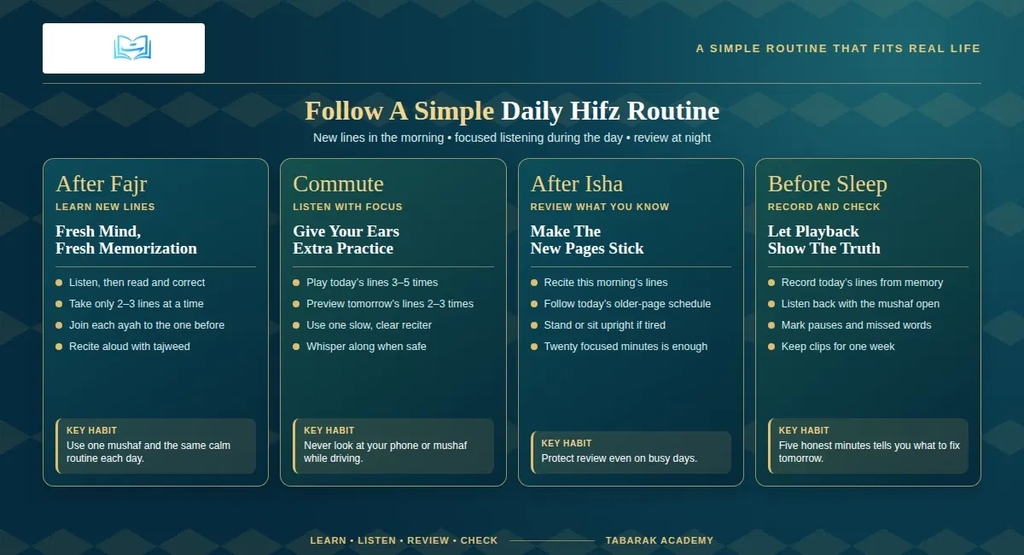
After Fajr: Memorize Your New Lines
After Fajr, the house is quiet and your mind is fresh. This is the best time for new lines. Follow the same steps every day:
- Listen to the new lines from your teacher or a skilled reciter first.
- Read them yourself and fix any word you are not sure about.
- Learn one ayah at a time. Never take more than 2 or 3 lines at once.
- Join each new ayah to the one before it.
- Say the full portion by heart, then check it against the mushaf.
Say the words out loud in a calm voice. Reading with your eyes alone does not work. Your tongue, ears, and eyes need to work together.
Read slowly with tajweed. Allah tells us to recite the Quran in a slow, clear way (Surah Al-Muzzammil 73:4).
Use only one mushaf, like the 15-line Madinah Mushaf. Your eyes will remember where each ayah sits on the page.
Here is the clearer version. I changed the heading so readers know exactly what to listen to, and I rewrote the section as simple, concrete steps.
On Your Commute: Listen To The Lines You Are Memorizing
Your commute is a good time to hear the lines you are working on. You are not learning new lines here. You are giving your ears extra practice with the lines you learned after Fajr.
Here is what to play, in this order:
- This morning’s new lines. Play them 3 to 5 times. This helps them settle while they are still fresh.
- Tomorrow’s new lines. Play them 2 or 3 times. When you sit down to learn them tomorrow, they will already sound familiar.
Do not just let the audio play in the background. Listen with focus. If you are on a bus or train, whisper along with the reciter. Try pausing before the next ayah and saying it yourself, then press play to check.
Use one reciter every time. A slow teaching recitation, like the one by Sheikh Mahmoud Khalil Al-Husary, works well. Each reciter stops and pauses in different places, so sticking with one helps your ear learn one steady pattern.
To make this easy, use an app that can repeat an ayah or a set of ayat, like the Quran.com app. Set it up the night before so you can just press play.
If you drive, keep your eyes on the road and listen only. Do not look at the mushaf or your phone. If you do not have a commute, use another daily task instead, like walking, cooking, or folding laundry.
After Isha: Review What You Know
After Isha, your work or school day is usually over. Use this time for review.
First, say this morning’s new lines by heart one more time. This second pass, hours after Fajr, helps them stick.
Next, go over the older portions on today’s schedule. You will learn how to build that schedule in Step 5.
If you feel tired, sit up straight and recite out loud. Reciting while lying down often ends with falling asleep halfway through a page.
Many working adults find that a set evening class keeps this review on track. Our article on evening Quran classes for working professionals shows how to fit a teacher into the hours after work.
This session can be shorter than your morning one. Twenty focused minutes after Isha does more than an hour of half-awake reading.
Before Sleep: Record And Check Yourself
Before you sleep, record yourself on your phone. Recite today’s new lines by heart, with no mushaf in front of you.
Then play the recording back. Follow along in the mushaf as you listen. Mark every place you paused, skipped a word, or said a vowel wrong.
This takes only about five minutes. But it shows you exactly which lines need work tomorrow.
A recording is honest. In the moment, you may think your recitation was perfect. On playback, small mistakes become easy to hear.
Keep your recordings for a week. Listening to Monday’s clip on Sunday shows how much you have grown, and that gives you a boost to keep going.
If you feel shy hearing your own voice, that is normal. Most people do at first, and the feeling fades after a few nights.
Step 5: Give Revision Most Of Your Time
Revision means going over what you already know, so it stays strong. New lines feel exciting, but revision is what keeps them. The Prophet ﷺ said the Quran slips from memory faster than a camel escapes its rope (Sahih al-Bukhari 5033).
Use The 70/30 Rule Every Day
The 70/30 rule is a guide many Quran teachers use. Spend about 70 percent of your Quran time on review. Spend about 30 percent on new lines.
Here is what that looks like. If you have 60 minutes a day, spend about 42 minutes on review and 18 minutes on new lines.
This may feel backward at first. Most people want more time for new pages. But new lines built on weak old lines will fall apart within weeks.
The rule has one part you should never break. Do not skip review to add new lines. If time is short, cut the new lines first.
Think of review as guarding your savings. New lines are like new income. Both matter, but losing what you saved hurts much more.
As your hifz grows, the review part will feel bigger. That is a good sign. It means you have more to protect.
Review The Last 7 Days Every Week
Once a week, sit down and recite everything you learned in the past seven days. Do it by heart, in one sitting.
This weekly check catches weak spots early. A line that slips in week one is easy to fix. The same line, left alone for a month, may need to be learned again.
Pick a set day for this check, like Friday or Sunday. A set day turns it into a habit, not a task you forget.
If a page from the past week still needs the mushaf, pause new lines for one day. Spend that day fixing the weak page.
This one-day pause does not slow you down. It saves you from building on a cracked base.
Some students like to recite this weekly review to a friend or family member. A listener keeps you honest and makes the habit more fun.
Write down any line where you paused. Next week, start your review with those lines first.
Go Over Everything You Know On A Fixed Cycle
Beyond the past week, you also need to go over all of your hifz on a cycle. How often depends on how much you know.
If you know less than ten juz, a classic rule is to never let 15 days pass without going over all of it once.
If you know more, you can review about one juz a day inside your prayers. Recite your portions in sunnah prayers, in the four rak’ahs before Asr, and in night prayer. Our guide on which surahs to recite in salah can help you plan this.
Huffaz who know the whole Quran sometimes use the “Fami bi Shawq” method. It splits the Quran into seven days. Each day starts at a set surah: Al-Fatihah, Al-Ma’idah, Yunus, Al-Isra (also called Bani Isra’il), Ash-Shu’ara, As-Saffat, and Qaf. The first letters of these surahs spell the Arabic phrase, which is how the method got its name.
If an old juz has slipped badly, do not panic. Read how long it takes to re-memorize a juz to plan your comeback.
Keeping this balance alone is hard. Tabarak Academy’s tutors hold Al-Azhar ijazah, a certified license to teach the Quran. In private lessons, they hear your old pages as well as your new ones, so weak spots get fixed before they grow.

Step 6: Get Back On Track After A Missed Day
Every long plan has missed days. You may get sick, travel, or face a busy week at work. What matters is how you come back, because the wrong move turns one missed day into a lost week.
Do Not Double Up The Next Day
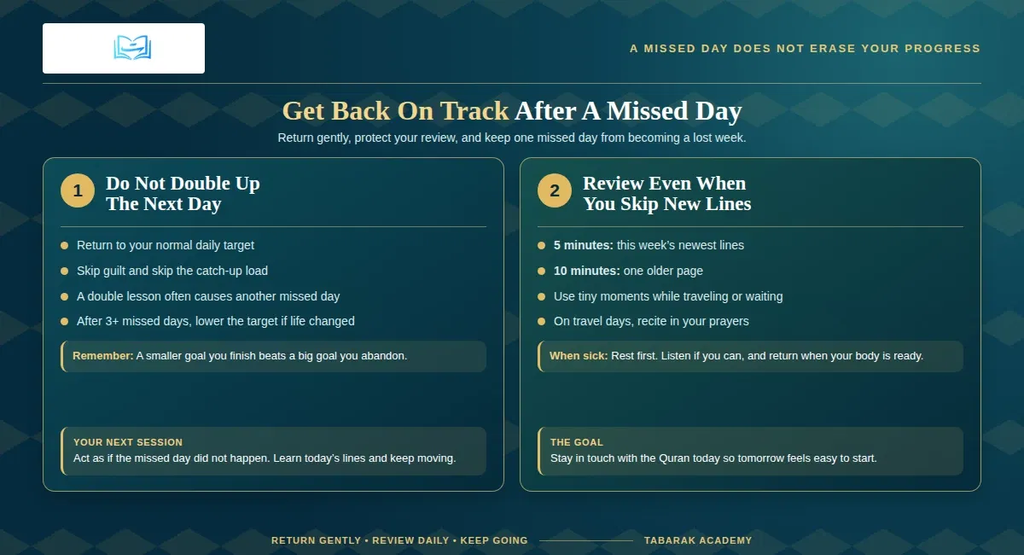
After a missed day, many students try to catch up. They learn double the lines the next day. This feels responsible, but it often backfires.
A double load makes the session long and tiring. Your mind holds fewer of the lines. And the heavy day often leads to a second missed day, then a third.
Instead, go back to your normal target the next day. Act as if the missed day did not happen. No guilt, no catch-up plan, just today’s lines.
Your goal table in Step 2 already leaves room for a few lost days. That is why you planned with a buffer. Trust it and keep moving.
If you miss three or more days in a row, take an honest look at your goal. Life may have changed. A new job, a sick child, or exams can shrink your free time. In that case, lower your daily target a little.
A smaller goal that you finish is far better than a big one you give up on. Ramadan will still come, and you will still meet it with real progress.
Keep Revising Even When You Skip New Lines
Some days, you will have only 15 minutes. That is not enough for new lines. But it is plenty for a short review, and that is how you keep a missed day from becoming a missed week.
Here is a simple plan for short days. Spend five minutes on this week’s newest lines. Spend ten minutes on one older page. That is it. You stay in touch with the Quran, and tomorrow feels easy to start.
You can also break review into tiny pieces. Recite one page while the kettle boils. Recite another in the car before you walk inside. Small moments count.
On travel days, use your prayers. Recite your newest surahs in each rak’ah. Even a short prayer keeps your hifz awake.
When you are sick, rest first. Listen to your portion if you can, and recite only when you feel up to it. Your plan can wait a few days while your body heals.
Step 7: Keep Going If Ramadan Comes Before You Finish
Sometimes Ramadan arrives before you reach your goal. That is okay. The work you did still counts, and you can keep building in Ramadan.
Continue Your Plan Instead Of Starting Over
Some people think they must start fresh when Ramadan begins. That is not needed.
The scholars at Islamweb were asked about this for reading the Quran. In their fatwa, they said there is no text telling you to start over when Ramadan comes. They advised you to keep going until you finish, then begin again.
They also said finishing in Ramadan is better, but it is not required. So there is no blame on you if the month comes first.
The same idea fits hifz well. Do not throw away your plan because the calendar changed. Pick up from the exact line where you stopped, and keep your daily target the same.
Think of it this way. Your plan is a road, not a race with a finish line on the first night of Ramadan. Each line you learn is a step on that road, and it stays yours.
Allah made the Quran easy to remember for anyone who wants to remember it (Surah Al-Qamar 54:17). Keep going, and trust that your effort is seen.
Turn Ramadan Into Your Revision Month
Ramadan is the month the Quran was sent down (Surah Al-Baqarah 2:185). It is also a perfect month for review.
The Prophet ﷺ met Jibril every night of Ramadan to go over the Quran (Sahih al-Bukhari 6). You can follow that example by going over your hifz each night.
Cut back on new lines during the month. Recite your portions in Taraweeh and night prayer. If you lead prayer at home, recite from your own pages.
Before Ramadan ends, write down your plan for after Eid. Set your new daily target and your start date.
This way, your hifz does not stop when the month ends. Ramadan becomes the strong middle of your plan, not the end of it.
After Eid, keep the same time slot you used before Ramadan. Your mind already knows that hour belongs to the Quran, so starting again feels natural.
See A Real Class Before You Join
Curious what a lesson feels like? Watch real moments from our live classes and see how our teachers keep each student focused, confident, and moving forward.
Start Your Quran Learning Journey
Join Tabark Academy today for structured online lessons with qualified tutors, customized to fit your goals.
Book Your Free Trial LessonBook Your Free Hifz Trial Class With Tabarak Academy Today
You now have the plan. The hard part is sticking to it for 90 days with no one checking your lines. That is where Tabarak Academy helps you finish strong before Ramadan.
Here is what you get with Tabarak Academy:
- 25 years of experience teaching Quran online
- Tutors with verified Al-Azhar ijazah (a certified license to teach the Quran)
- Private 1-on-1 live lessons, never group classes
- Female tutors for sisters and girls, at no extra cost
- Morning, evening, and weekend times in your time zone, from the US to the UK and Australia
- Monthly progress reports, so you always know where you stand
- Lessons built around your level, your pace, and your Ramadan goal
Whether you call it memorization or Quran memorisation, the goal is the same: firm hifz by the first night of Ramadan. Your first class is free. Book today, and the team will confirm your slot within 24 hours. No card, no payment, and no pressure to sign up.
Book Your Free Trial Class Now

Our Quran courses:
Start your Quran memorization journey, browse our courses and click free Trial.
- Quran Reading Course
- Quran Recitation Course
- Online Ijazah Course
- Online Qirat Course
- Quran for Toddlers / Young Children
- Weekend Quran Classes
- Intensive Quran Course
- Al-Azhar Quran Course
- Zoom Quran Classes
Conclusion
To finish Quran memorization before Ramadan, start by knowing your goal. Reading one juz a day finishes a khatm in a month. Hifz moves at 5 to 15 lines a day, so it needs its own plan.
Next, measure your real pace and match it to the days you have left. Most students can reach one to three juz before Ramadan. Full hifz is a fair goal only if you already know about 25 juz.
Then follow the 3-Phase Countdown. Start slow, hold a steady pace, and stop new lines in the final days before Ramadan. Your daily routine keeps it simple: new lines after Fajr, listening on your commute, review after Isha, and a short recording before sleep.
Give review most of your time. When you miss a day, do not double up. Just come back to your normal target. If Ramadan comes first, keep going and use the month to make your hifz strong.
The goal is not to reach the last page in a rush. The goal is to stand in prayer this Ramadan with lines you know and trust. With a clear plan and a teacher by your side, that goal is well within reach.
FAQs
Many students have the same questions as Ramadan gets closer. Here are short, clear answers to the ones we hear most.
Can I Memorize One Juz A Day Before Ramadan?
Learning one juz a day is not a real hifz pace for most people. One juz has about 300 lines, so one juz a day is a reading pace.
How Much Quran Can I Memorize In 30 Days?
In 30 days, most students can learn a few surahs at 3 to 5 lines a day. If you have done hifz before and can hold 13 to 15 lines a day, you can finish one juz.
Can I Finish My Full Hifz Before Ramadan?
You can finish full hifz before Ramadan if you already know about 25 juz. The last 5 juz need about 20 to 25 new lines a day on a 90-day plan, plus daily review.
Should I Review Or Memorize New Lines Before Ramadan?
Review should come first before Ramadan. Spend about 70 percent of your time on review, and stop new lines in the final days before Ramadan begins.
What Should I Do If I Miss A Day Of Hifz?
If you miss a day of hifz, go back to your normal target the next day. Do not double up, and use any short time you have for review.
What Is The Best Time Of Day To Memorize Quran?
The best time to memorize Quran is after Fajr for most people. Your mind is fresh, and the house is quiet before the day gets busy.
Can I Memorize Quran Without A Teacher?
You can start alone, but a teacher is strongly advised. A teacher hears your tajweed mistakes and fixes them before they stick.
Is It Better To Finish The Quran By Reading Or Memorizing In Ramadan?
Both bring great reward, and they are different goals. Reading one juz a day gives you a full khatm, while hifz students often use Ramadan to review in prayer.




0 Comments