

How To Learn Arabic In 10 Steps?
Arabic is not just a language, it is the key to over 400 million people, the Quran, and one of the world’s oldest living civilizations.
Whether you’re an American Muslim trying to understand your faith at a deeper level, a professional working with Arab clients, or someone drawn to this ancient tongue, knowing how to learn Arabic deserves a real, honest answer.
This article gives you exactly that, not a vague “start with basics” post, but a concrete 10-step framework built from how successful learners actually reach fluency, from the first letter to real conversation.
These steps are not a wish list, they are a sequential system in which each step builds on the one before it. Skip a step and you will feel the gap later. Follow the sequence, and what seemed impossible begins to feel inevitable.

1. Master The Arabic Alphabet As A First Step Of How To Learn Arabic
Learn all 28 letters in both isolated and connected forms before anything else. Arabic is written right to left, and most letters change shape depending on their position — beginning, middle, or end of a word.
Spend the first one to two weeks doing nothing but recognizing and handwriting letters. Use a physical notebook rather than a screen alone — the motor memory of writing reinforces recognition faster than passive digital study.
Understanding the 17 makharij of Arabic letters, the precise articulation points for each sound, is one of the most underrated moves a beginner can make. It eliminates pronunciation errors before they classify into habits.
Why Families Choose Tabarak Academy for Arabic Alphabet Learning?

2. Train Your Ear To Hear Arabic
Listen to Arabic audio for at least 15 minutes every day, starting on day one, even before you understand a single word.
The human brain does not learn languages by reading about them, it learns by absorbing patterns of sound over time. Consistent listening builds an internal phonetic map that makes speaking and reading dramatically easier when those stages arrive.
Use Arabic children’s programs, Islamic lectures in clear Fusha, or beginner-level podcasts. Fifteen deliberate minutes daily beats two passive hours on weekends, every time.
3. Study Arabic Grammar Progressively
Introduce grammar as a tool to explain patterns you have already heard, never as a starting point.
Arabic grammar (النحو) is famously detailed, but beginners only need a fraction of it to begin communicating. Start with basic sentence structure, the masculine and feminine noun distinction, and the dual form. These three concepts alone unlock thousands of sentences.
Add one new grammar rule per week, applied immediately to real sentences rather than memorized in isolation. The learner who uses five rules in live speech outpaces the one who has memorized fifty rules but never spoken aloud.
4. Practice Speaking From Day One
Record yourself speaking Arabic for 60 seconds every day, even if it is just reading ten words aloud.
Hearing your own voice builds confidence and reveals pronunciation errors your eyes cannot catch on a page. Arabic has sounds that do not exist in English — the ع (ʿayn), the خ (kha), the غ (ghayn). These need muscle memory, not just mental knowledge.
Find a language partner, join a conversation group, or book a session with a native-speaking tutor. The sooner you hear a real response to your Arabic, the sooner your brain treats it as a living tool rather than an academic exercise.

5. Build Core Vocabulary With Spaced Repetition
Commit to learning 10 new Arabic words each day using a spaced repetition system such as Anki, or a structured set of physical flashcards.
Spaced repetition presents words right before your brain is about to forget them — which research consistently shows to be the most efficient memorization method available.
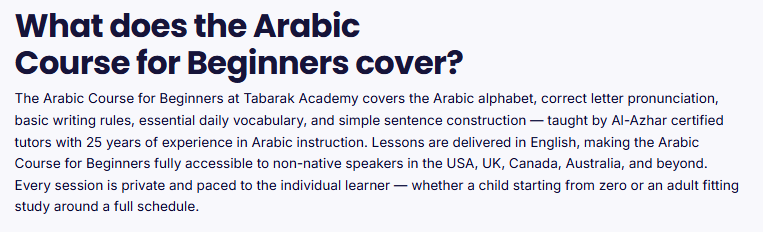
Starting with the 500 most common Arabic words gives you a usable vocabulary base faster than any other strategy.
Connect each new word to a visual or a short sentence in context. “بيت / bayt / house” is retained far longer when you picture your own front door than when it sits as an isolated item on a card.
6. Read Arabic Texts Out Loud Every Day
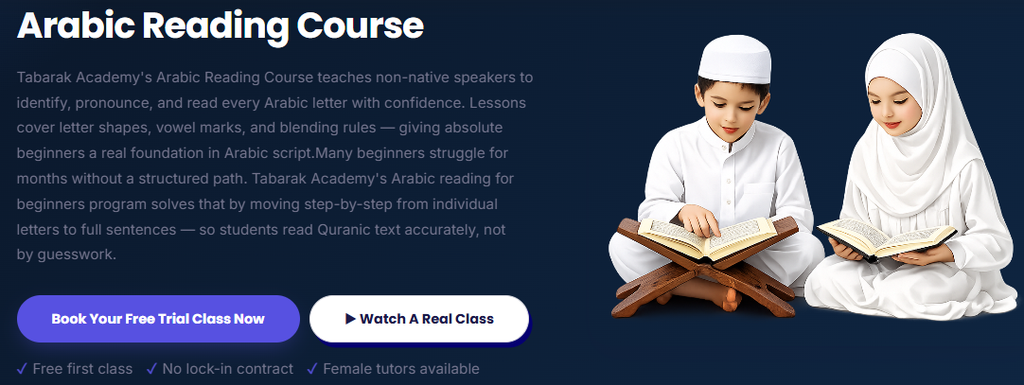
Select a short Arabic text, three to five sentences, and read it aloud at least twice daily, starting with fully vowelized texts.
Reading aloud simultaneously reinforces the connection between written letters and spoken sounds while building the kind of fluency that silent study alone never produces.
Texts from the Quran are ideal for this stage, they are vowelized, rhythmically consistent, and spiritually motivating for Muslim learners.
Those looking to improve your language skills with quran will find that daily Quran recitation, even of familiar surahs, dramatically accelerates reading fluency and pronunciation accuracy at the same time.
7. Write In Arabic Daily To Lock In What You Learn
Write five to ten Arabic sentences every day, a journal entry, a lesson summary, or a short description of your morning. Write by hand, not by keyboard.
Handwriting Arabic reinforces letter formation, the right-to-left direction, and the connected script system in ways that typing does not replicate.
Even simple sentences, “The weather is warm today. I studied for 30 minutes. I learned five new words”, forcing vocabulary and grammar to work together.
Save your written work and compare entries from week one to week eight. The progress visible on those pages is often the most powerful motivation to keep going.
8. Explore Quranic Arabic To Anchor Your Learning In Meaning
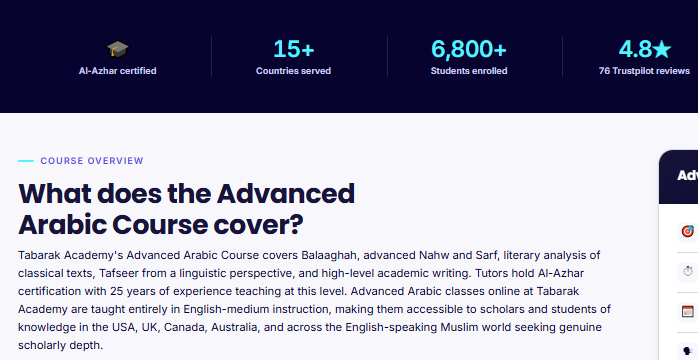
Devote at least two sessions per week specifically to Quranic Arabic, regardless of your primary Arabic track.
Quranic Arabic shares its roots with Modern Standard Arabic but carries its own vocabulary, rhetorical structures, and grammatical forms.
Understanding it does not require completing Fusha first, many learners find Quranic study actually accelerates broader Arabic comprehension because the Quran uses extraordinarily precise, high-frequency vocabulary.
For Muslim learners in the USA, this step often functions as a spiritual practice, which means motivation rarely runs dry. The learn Arabic language journey and the journey of understanding the Quran are, for millions of learners, the same road traveled together.
9. Find A Qualified Teacher
Book at least one live session per week with a qualified Arabic teacher, especially during your first six months.
A good teacher does three things no app can: catches pronunciation errors in real time, adapts every lesson to your specific gaps, and provides the social accountability that keeps learners from quitting.
The difference between students who plateau at intermediate and those who break through to fluency almost always comes down to whether they had a teacher.
At Tabarak Academy, certified Arabic teachers work with learners across all levels, from beginners who are still writing the alphabet to advanced students pursuing Quranic Arabic and Islamic sciences.
Experience Our Interactive Learning
Curious about how we teach? Watch these brief video clips from our recent live sessions to see our structured curriculum, advanced learning platform, and dynamic student-teacher interactions firsthand.
10. Stay Consistent In Practising Arabic
Commit to a minimum of 30 minutes of Arabic study every single day, even on days when motivation is nowhere to be found.
Consistency is the single variable that separates learners who reach conversational Arabic in 12 months from those still at beginner level after three years. The daily habit matters more than the length of any individual session.
Track your daily streak with a habit tracker or simple calendar. Celebrate small wins, the first Arabic sentence you understood without translating, the first time a native speaker smiled at your pronunciation.
These moments are not accidents. They are compound interests on every quiet day you showed up anyway.

The Three Types Of Arabic Every Learner Needs To Know
Before going deeper into methodology, there is a question that confuses nearly every beginner: which Arabic are you actually learning?
Getting this wrong costs months of misdirected effort and erodes motivation faster than any language difficulty ever could.
Arabic is not one monolithic language, it is a family of related varieties sharing a common grammar and script but differing meaningfully in vocabulary, usage, and context.
The table below gives you a quick reference. One to two sentences can explain a lot, but seeing it laid out plainly makes the choice far easier to act on.
| Variety | Primary Use | Best For |
| Modern Standard Arabic (Fusha) | Formal writing, media, education | Academic learners, professionals, cross-Arab communication |
| Quranic Arabic | Sacred text, Islamic study | Muslim learners, Quran comprehension, spiritual grounding |
| Colloquial Dialects | Daily spoken life | Travelers, social integration, Egyptian/Gulf contexts |
Each variety has a distinct role, and choosing the right starting point, or the right combination, is the first real decision every Arabic learner must make deliberately.

A. Modern Standard Arabic (Fusha)
Modern Standard Arabic, known as Fusha (الفصحى), is the formal written standard used across all 22 Arab nations. It is the language of newspapers, academic writing, official speeches, and Arabic television channels like Al Jazeera and BBC Arabic.
Fusha is taught in schools across the Arab world and is the most transferable form of the language, a learner who masters it can communicate in writing with any educated Arabic speaker, regardless of nationality.
For non-native learners, Fusha is the standard starting point for formal study. One important nuance: Fusha is rarely spoken in casual daily conversation.
Native speakers use their regional dialect at home and reserve Fusha for formal contexts, a distinction worth knowing from day one so learners are not surprised when their studied Arabic sounds different from what they hear in the street.
B. Quranic Arabic
Quranic Arabic is the classical form in which the Quran was revealed in the 7th century. It shares the grammatical framework of Fusha but contains vocabulary, rhetorical devices, and grammatical forms unique to the sacred text.
For Muslim learners, and especially for the growing Muslim American community, Quranic Arabic is often the most personally meaningful entry point into the language.
Understanding the Quran’s words directly, without a translation, transforms the prayer experience entirely.
The types of qirat in the quran are a related area of study that Quranic Arabic learners eventually encounter — the recognized recitation traditions that reflect the extraordinary breadth of the Quran’s oral transmission history.
C. Colloquial Arabic
Colloquial Arabic refers to the spoken dialects used in everyday life — Egyptian Arabic, Levantine Arabic, Gulf Arabic, Moroccan Darija, and several others. Each differs enough that speakers sometimes use Fusha to bridge the gap.
For learners in the USA who have Arab neighbors, colleagues, or family members, picking up one colloquial dialect alongside Fusha dramatically expands real-world communication.
Egyptian Arabic is generally recommended as the most universally understood dialect, largely due to the influence of Egyptian cinema and television.
If you’ve ever wondered about 3 reasons why Arabic is difficult, the coexistence of these multiple varieties — and the challenge of knowing which to study and when — is reliably near the top of that list.
The Silent Mistakes That Are Quietly Killing Your Arabic Progress
Most Arabic learners who plateau or quit did not lack dedication, they made structural mistakes that compounded over time.
Identifying these mistakes in advance is what separates learners who break through from those who remain permanently stuck.
Each mistake below is correctable. But it must be named before it can be addressed.
A. Skipping Pronunciation Work In The Early Stages
Arabic pronunciation is not an add-on, it is a foundation. Several Arabic sounds do not exist in English, and if they are not trained early, incorrect pronunciations classify into habits that require years to unlearn.
Learners who skip structured pronunciation work often reach a point where native speakers struggle to understand them, not because their vocabulary is weak, but because their sounds are wrong.
A mispronounced word in Arabic can change its meaning entirely. Spend the first month doing deliberate pronunciation practice with audio feedback from a teacher.
The facts about the Arabic language include the reality that Arabic covers a broader phonetic range than English, and every sound in that range deserves proper attention from day one.

B. Treating Grammar Like A Goal Instead Of A Tool
Arabic grammar is famously rich. It has attracted centuries of scholarly study and entire sciences dedicated to its analysis. For a beginner, this can become a trap — spending so much time studying rules that actual language use never begins.
Grammar should serve communication. A learner who knows five rules and applies them in real sentences every day outpaces one who has memorized fifty rules but has never spoken Arabic aloud.
The error is treating grammar mastery as a prerequisite to speaking, when in reality grammar develops alongside speaking through repeated use.
The practitioner’s rule: learn one grammar concept, then immediately use it in three original sentences. Move on. Return to it the following week when your listening practice has made it feel more natural.
C. Learning In Isolation Without Real Conversation
Arabic is a living spoken language with a fourteen-century history. It was never designed to be absorbed from a textbook in isolation.
Without real conversation, with a teacher, a tutor, or a native-speaking partner, learners develop what practitioners call “textbook Arabic”: grammatically correct sentences that no one actually says in natural speech.
Conversation forces word retrieval under pressure, repairs communication breakdowns in real time, and exposes the learner to authentic sentence rhythms that no study material can fully simulate.
Even one 30-minute conversation session per week produces measurable improvement in speaking confidence and listening comprehension.
For Muslim women in the USA seeking a structured and comfortable learning environment, Quran hifz classes for sisters and dedicated Arabic programs at Tabarak Academy.
Step Inside Our Virtual Classrooms
See our engaging teaching methods in action! watch real snippets of our live classes and discover how our expert instructors make learning interactive, memorable, and inspiring for every student.
Begin Your Arabic Journey With Tabarak Academy Today
Tabarak Academy has helped learners across the USA and the Arab world master Arabic and Quranic sciences through expert-led, structured online classes.
These classes fit around real life, including American time zones, working parents, full-time students, and everyone in between.
Whether you are starting from the very first letter or picking up where you left off years ago, Tabarak Academy‘s certified teachers bring the classroom directly to you, with methods built on decades of teaching experience and real, measurable results.
Our Courses:
- Online Quran & Arabic Classes | Foundation
- Online Quran Memorization Course
- Modern Standard Arabic Online Course (Fusha)
- Intensive Arabic Course
- Learn Arabic Writing Course
- Online Arabic Classes
- Noorani Qaida Course for Beginners
- Arabic and Quran Classes for Intermediate
- Arabic Speaking Course

Conclusion
Learning Arabic is one of the most rewarding decisions a person can make, and one of the most commonly mishandled.
The gap between learners who quit in month three and those who reach fluency is rarely raw talent. It is structure, sequence, and the discipline to show up on ordinary days.
The 10 steps in this article give you that structure. Start with the alphabet. Train your ear before you speak. Build vocabulary systematically with spaced repetition.
Use grammar as a support tool, not a destination. Speak early, read aloud, and write by hand daily. Anchor your learning in Quranic Arabic if your faith is your motivation. Find a teacher. And then return, every single day, even when it’s hard.
Arabic does not reveal itself to the impatient. It reveals itself, steadily and beautifully, to the learner who refuses to quit. That learner can be you — starting today.
Frequently Asked Questions
How Long Does It Take To Learn Arabic?
The timeline depends on your native language and daily study commitment. Native English speakers typically reach conversational proficiency in 18 to 24 months with 30 to 60 minutes of consistent daily practice.
Reading fluency in Quranic Arabic specifically can be achieved in 6 to 12 months with focused, structured instruction.
Can I Learn Arabic Without A Teacher?
Early progress with apps and textbooks is possible, but reaching genuine fluency without any live instruction is extremely rare.
A qualified teacher catches pronunciation errors in real time, adapts lessons to your specific weaknesses, and provides the accountability that self-study rarely sustains long-term.
What Is The Best Way To Start Learning Arabic From Scratch?
Begin with the Arabic alphabet — both reading and writing — before anything else. Pair this with daily listening practice from day one, even if you understand nothing yet.
Once letters are solid, introduce core vocabulary using spaced repetition. Add simple grammar only after you have a listening base in place, not before.
Is Arabic Difficult For English Speakers?
Arabic presents genuine challenges for English speakers — an unfamiliar script, distinct sounds, and a rich grammatical system. That said, difficulty is not the same as impossibility.
Millions of non-native learners reach fluency every year. The decisive factor is a structured approach that does not skip foundational stages.
What Is The Difference Between Quranic Arabic And Modern Standard Arabic?
Quranic Arabic is the classical form preserved in the Quran, with unique vocabulary and rhetorical structures. Modern Standard Arabic is the contemporary formal standard used in writing and media across all Arab nations.
Both share the same grammatical framework and alphabet, and progress in one supports the other, but each has vocabulary and usages specific to its domain.
At What Age Is It Best To Start Learning Arabic?
Arabic can be learned at any age. Children acquire it naturally through immersion.
Adults bring real advantages, stronger pattern recognition, clearer motivation, and more efficient study habits that often compensate for a slower phonetic acquisition pace. There is no age at which starting becomes a mistake.