

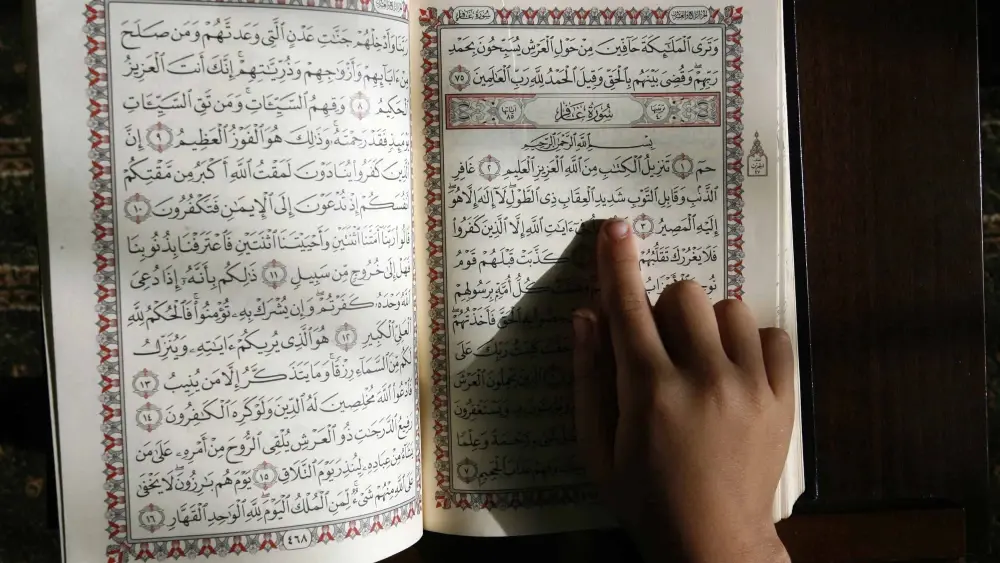
If I Learn Arabic, Will I Understand The Quran?
The short answer of “if I learn Arabic, will I understand the Quran” is Yes, if you learn Arabic, you will understand the Quran to a large degree.
But the honest answer depends on which Arabic you learn and how far you take it. Not all Arabic is equal.
Quranic vocabulary and grammar give you direct access to most verses. You will read words, recognize sentence structure, and grasp meaning without a translation. That access is real, and it grows with every week of consistent study.
Full understanding also needs tafsir and context; tools that even native Arabic speakers rely on throughout their lives. Language is the foundation, and scholarship builds on top of it. The two work together, not in place of each other.
What You Will Learn In This Article:
- Why the variety of Arabic you choose matters as much as learning it
- What Arabic gives you direct access to, and what language alone cannot provide
- The truth behind the widely repeated “300-word comprehension” claim
- A clear, stage-by-stage roadmap from the alphabet to tafsir-level reading
- The most common mistakes learners make, and exactly how to avoid them
Which Arabic Should You Learn to Understand the Quran?
The question “if I learn Arabic, will I understand the Quran” depends almost entirely on which Arabic you study. Egyptian Arabic, Modern Standard Arabic, and Quranic Arabic all share the same script.
But their impact on Quranic comprehension is dramatically different, and choosing the wrong one costs months of redirected effort.
Here is a direct comparison of the three varieties and one complete approach most learners encounter, ranked by how effectively each one serves Quranic reading.
| Arabic Variety | Connection To The Quran | Approximate Comprehension Access |
| Spoken Dialect (Egyptian, Gulf, Levantine) | Conversational only; separate grammar and vocabulary | Very low |
| Modern Standard Arabic (MSA) | Shares Quranic grammar; lacks classical vocabulary | Moderate |
| Quranic Arabic | The Quran’s own language; classical grammar and vocabulary | High with study |
| Quranic Arabic + Morphology + Tafsir | Full scholarly approach | Full access |
1. Dialects Versus Quranic Arabic
Spoken dialects developed from classical Arabic from classical Arabic over more than a thousand years. A learner fluent in Egyptian Arabic can hold a conversation but misses the Quran’s grammar, vocabulary, and rhetorical structures entirely.
Most American converts and beginners start with a dialect because it sounds more natural; this is the single most costly mistake a Quran-motivated learner can make.
Understanding the importance of the Arabic language in its classical form is the decision that shapes your entire study path. Quranic Arabic is not a dialect or a simplified variety. It is the original, precisely preserved language of revelation.
2. Modern Standard Arabic Versus Quranic Arabic
MSA is the formal written Arabic of news media, academic writing, and official documents. It shares Quranic grammar closely enough that an MSA learner can parse most sentences.
However, Quranic vocabulary is older and more specialized; MSA learners encounter words with no equivalent in modern usage regularly.
The deeper gap is rhetorical. Classical constructions unique to the Quran; such as fronting for emphasis (taqdim/ta’khir) and deliberate tense shifts to mark transitions in meaning, remain invisible without dedicated Quranic Arabic study.
What Learning Arabic Will (And Won’t) Give You
Arabic opens the Quran’s primary door. But not every room opens with the same key. Knowing what language gives you direct access to; and what it cannot give you alone; is the foundation of a realistic and productive study plan.
1. What You Can Understand With Arabic
With solid Quranic Arabic, you read most verses and grasp their direct meaning without a translation in hand. You begin noticing grammatical signals that English translations erase completely.
For example, Arabic uses two distinct conditional particles: “in” for hypothetical or uncertain conditions, and “idha” for expected or likely ones. Every English translation renders both as “if,” losing the original precision entirely.
You also begin seeing how the root system works. A single three-letter root generates dozens of related words.
Once you know roots, vocabulary expands much faster than in European languages; this efficiency is what makes dedicated Quranic Arabic study rewarding early in the process.
Tabarak Academy‘s online Quranic Arabic courses are built specifically to make this linguistic access real for English-speaking adults.
With certified teachers, structured lessons, and fully flexible online scheduling, learners across the USA begin building genuine comprehension from wherever they start.
2. What You Cannot Understand With Language Alone
Language gives you meaning; context gives you application. The Quran was revealed over 23 years in response to specific events (asbab al-nuzul, reasons for revelation).
Some verses were later clarified or superseded by others (nasikh and mansukh, abrogation). Arabic alone cannot tell you which verses fall into these categories; that requires tafsir and Quranic sciences.
Rhetoric (balagha) is another layer entirely. When a phrase is fronted in Arabic, it signals emphasis that a literal reading misses. When a verb tense shifts within a passage, it carries theological weight.
Classical scholars like Ibn al-Qayyim and Al-Zamakhshari wrote entire works devoted to these rhetorical signals. Arabic is the entry point; scholarship is the companion that opens the Quran’s depth.
Start The Arabic and Quran Classes for Elementary at Tabarak Academy
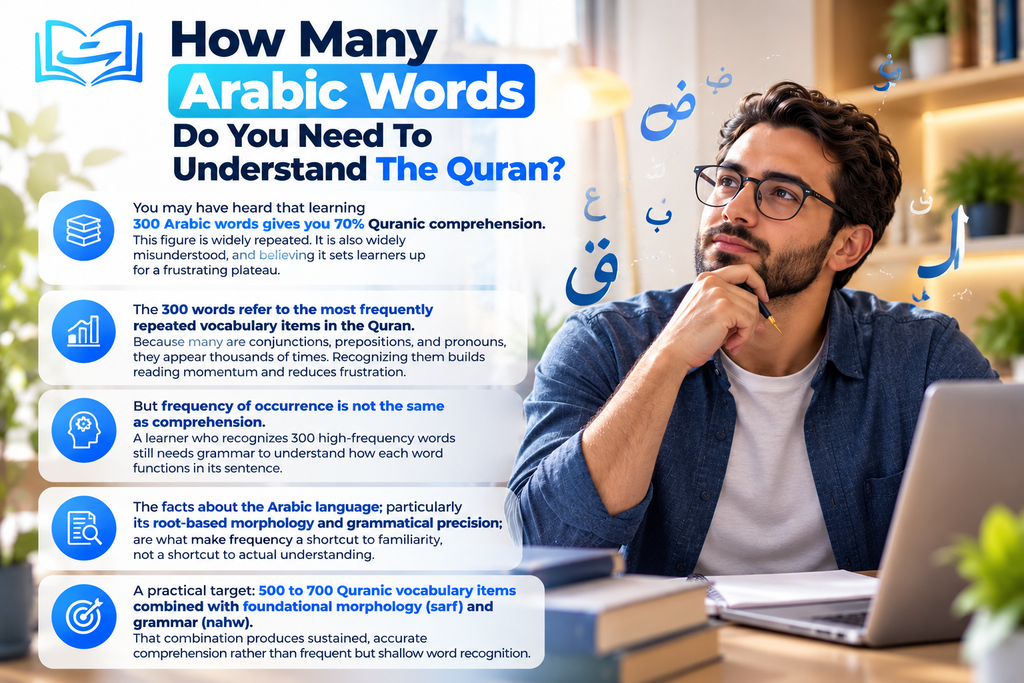
How Many Arabic Words Do You Need To Understand The Quran?
You may have heard that learning 300 Arabic words gives you 70% Quranic comprehension. This figure is widely repeated. It is also widely misunderstood, and believing it sets learners up for a frustrating plateau.
The 300 words refer to the most frequently repeated vocabulary items in the Quran. Because many are conjunctions, prepositions, and pronouns, they appear thousands of times.
Recognizing them builds reading momentum and reduces frustration; familiar forms appear constantly instead of unfamiliar text on every line.
But frequency of occurrence is not the same as comprehension. A learner who recognizes 300 high-frequency words still needs grammar to understand how each word functions in its sentence.
The Facts about the Arabic language; particularly its root-based morphology and grammatical precision; are what make frequency a shortcut to familiarity, not a shortcut to actual understanding.
A practical target: 500 to 700 Quranic vocabulary items combined with foundational morphology (sarf) and grammar (nahw). That combination produces sustained, accurate comprehension rather than frequent but shallow word recognition.
A Step-By-Step Roadmap To Understanding The Quran Through Arabic
Most learners want a clear path, not a list of abstract concepts. The roadmap below is built for adult English speakers starting from zero Arabic. Each stage builds directly on the one before it; skipping stages is the fastest way to stall.
1. Start With Arabic Letters And Sounds
Before vocabulary or grammar, you need the Arabic alphabet and its pronunciation.
Arabic letters change shape depending on their position in a word; most English speakers need two to four weeks of daily practice to internalize this. The goal at this stage is automatic letter recognition, not speed.
Learn to Read Quran as an Adult is an achievable milestone for any motivated beginner, regardless of age or prior language experience. Once you can read letters without stopping to think, you are ready to move forward.
2. Build Quranic Vocabulary And Morphology
Once reading is comfortable, spend three to six months on the 500 most frequent Quranic words.
Pair vocabulary with basic morphology: how roots work, what each verb form signals (active, passive, command, prohibition), and how nouns change by grammatical case. This is where the largest comprehension gains happen.
Tabarak Academy‘s Quranic Arabic Classes are structured specifically for this phase. The curriculum moves learners from letter recognition through vocabulary, morphology, and into connected Quranic reading; entirely online and designed around adult schedules.
3. Add Grammar, Then Read With Tafsir
Basic grammar (nahw) teaches how Arabic sentences are constructed: subject, verb, object, gender agreement, and case endings. With grammar in place, you can parse unfamiliar verses rather than guessing.
Start reading the Quran with a tafsir alongside; Tafsir Ibn Kathir in English is a widely recommended entry point for American learners.
Listening is an underused tool at this stage. Following Quran audio while tracking the Arabic text trains your ear to the language’s rhythm and reinforces vocabulary retention.
Thirty minutes of daily structured listening, paired with active reading, produces measurable gains within weeks.
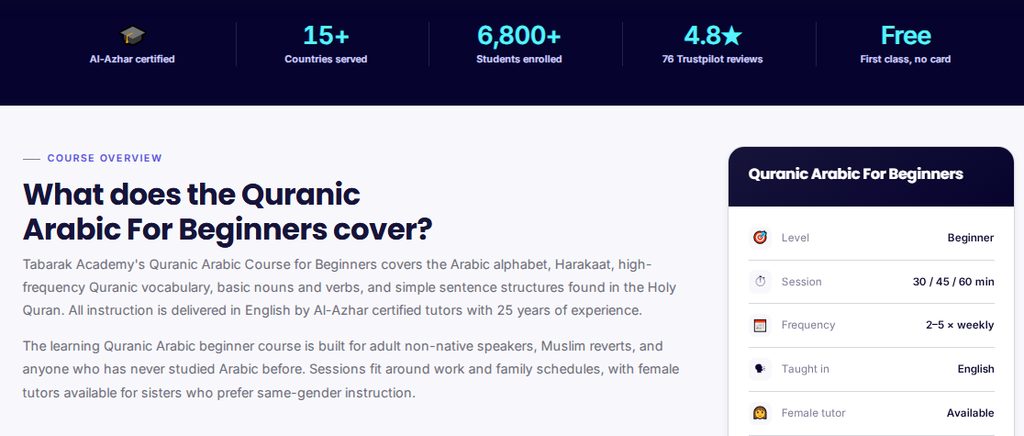
Discover What does the Quranic Arabic For Beginners cover?
How Long Does It Take To Understand The Quran In Arabic?
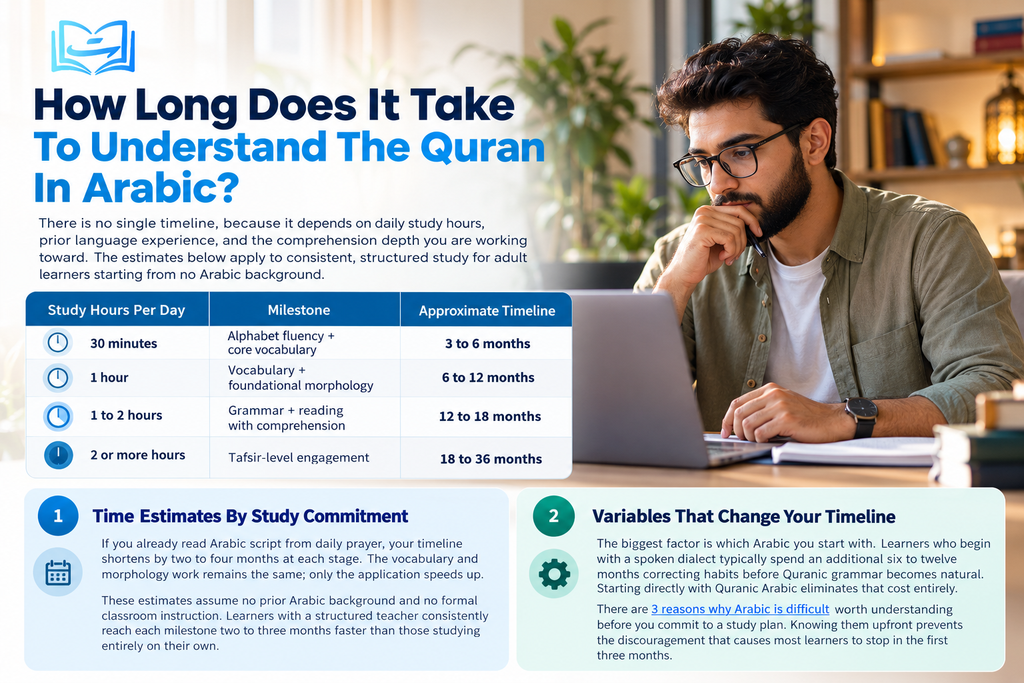
There is no single timeline, because it depends on daily study hours, prior language experience, and the comprehension depth you are working toward. The estimates below apply to consistent, structured study for adult learners starting from no Arabic background.
| Study Hours Per Day | Milestone | Approximate Timeline |
| 30 minutes | Alphabet fluency + core vocabulary | 3 to 6 months |
| 1 hour | Vocabulary + foundational morphology | 6 to 12 months |
| 1 to 2 hours | Grammar + reading with comprehension | 12 to 18 months |
| 2 or more hours | Tafsir-level engagement | 18 to 36 months |
1. Time Estimates By Study Commitment
If you already read Arabic script from daily prayer, your timeline shortens by two to four months at each stage. The vocabulary and morphology work remains the same; only the application speeds up.
These estimates assume no prior Arabic background and no formal classroom instruction. Learners with a structured teacher consistently reach each milestone two to three months faster than those studying entirely on their own.
The table above is a guide, not a ceiling. Some motivated learners reach grammar-level reading within ten months at one hour a day. What matters most is that your study sessions are daily, focused, and tied to actual Quranic text from the start.
Experience Our Interactive Learning
Curious about how we teach? Watch these brief video clips from our recent live sessions to see our structured curriculum, advanced learning platform, and dynamic student-teacher interactions firsthand.
2. Variables That Change Your Timeline
The biggest factor is which Arabic you start with. Learners who begin with a spoken dialect typically spend an additional six to twelve months correcting habits before Quranic grammar becomes natural. Starting directly with Quranic Arabic eliminates that cost entirely.
There are 3 reasons why Arabic is difficult worth understanding before you commit to a study plan. Knowing them upfront prevents the discouragement that causes most learners to stop in the first three months.
Consistency beats intensity for language learning. Thirty minutes every day produces better retention than three hours once a week. The brain consolidates language during sleep; short regular sessions use that process in a way that sporadic cramming cannot.
Do You Need Tajweed To Understand The Quran?
Tajweed and comprehension are separate skills. Confusing them is one of the most common misconceptions among new learners, especially in the USA where both are often introduced together in the same beginner classes.
Tajweed governs how you pronounce the Quran; its rules cover elongations (madd), nasal sounds (ghunna), articulation points (makharij), and proper stopping (waqf).
A full breakdown of the 17 Makharij of Arabic Letters explains why these points exist and how they preserve the Quran’s phonetic integrity across fourteen centuries of transmission.
Tajweed is about recitation excellence; comprehension is about language knowledge.
You do not need Tajweed to understand the Quran. You need Arabic. That said, Tajweed carries one indirect comprehension benefit: it slows your reading and forces word-by-word engagement, which helps vocabulary and morphology absorb faster than silent speed reading.
Tabarak Academy offers Online Tajweed Classes for Ladies for sisters who want to develop both recitation and comprehension in a structured, supportive online environment.
Correct Your Recitation With a Free Tajweed Trial Now

Common Mistakes American Learners Make
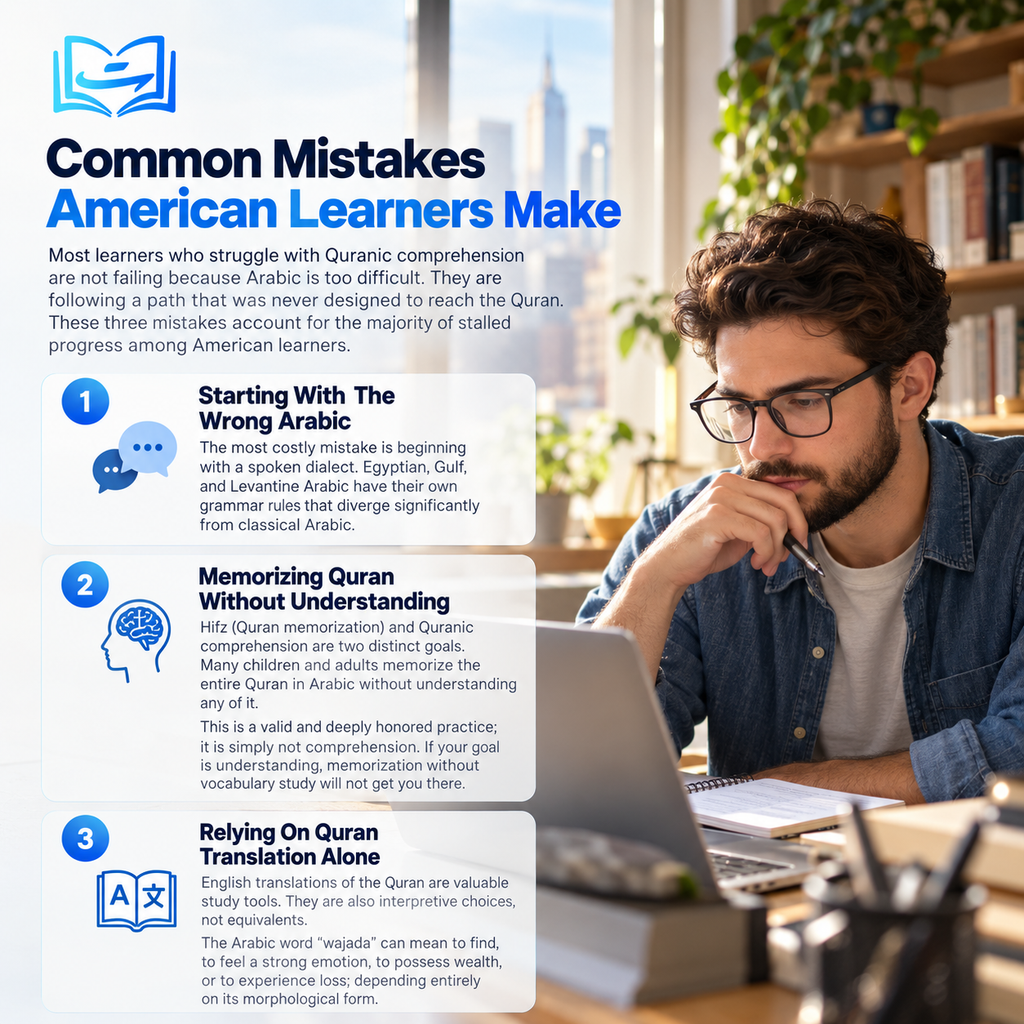
Most learners who struggle with Quranic comprehension are not failing because Arabic is too difficult. They are following a path that was never designed to reach the Quran. These three mistakes account for the majority of stalled progress among American learners.
1. Starting With The Wrong Arabic
The most costly mistake is beginning with a spoken dialect. Egyptian, Gulf, and Levantine Arabic have their own grammar rules that diverge significantly from classical Arabic.
A learner who spends a year on Egyptian Arabic is not a year closer to understanding the Quran; they are often further away, because Quranic structure now conflicts with entrenched habits.
A concrete example of what this costs: a learner trained only in dialect Arabic once encountered the word “imam” in a classical Quranic context and read it as the plural of “umm” (mother), producing a completely incorrect meaning.
Without classical Arabic training, that error is natural; it is also impossible to catch on your own.
2. Memorizing Quran Without Understanding
Hifz (Quran memorization) and Quranic comprehension are two distinct goals. Many children and adults memorize the entire Quran in Arabic without understanding any of it.
This is a valid and deeply honored practice; it is simply not comprehension. If your goal is understanding, memorization without vocabulary study will not get you there.
A practical solution: when you work on How To Memorize The Quran?, pair each passage with its direct meaning and morphological breakdown.
This serves both goals simultaneously and makes memorization more durable; meaning gives the sounds something to attach to.
3. Relying On Quran Translation Alone
English translations of the Quran are valuable study tools. They are also interpretive choices, not equivalents.
The Arabic word “wajada” can mean to find, to feel a strong emotion, to possess wealth, or to experience loss; depending entirely on its morphological form.
A translator selects one meaning per verse. Reading only the translation means receiving one scholar’s interpretive decision, not the text’s full range.
Translation also hides every structural signal visible only in Arabic: the verb-subject inversion that marks urgency, the repeated phrase that signals a legal ruling, the pronoun shift that signals a change of address.
These details are what make the Quran’s literary precision remarkable; and they are accessible only through the Arabic itself.
Step Inside Our Virtual Classrooms
See our engaging teaching methods in action! watch real snippets of our live classes and discover how our expert instructors make learning interactive, memorable, and inspiring for every student.
Start Understanding The Quran With Certified Instructors
You do not need years of study before the Quran begins making sense in Arabic. With the right starting point and a structured course, most adult learners begin reading with genuine comprehension within six months.
Tabarak Academy‘s online Quranic Arabic courses are built for busy adults in the USA. Live sessions, certified teachers, and flexible scheduling give you a real structured learning experience from home. Start with the course that meets you where you are.
Explore Our Courses At Tabarak Academy:
- Online Quran & Arabic Classes | Foundation
- Modern Standard Arabic Online Course (Fusha)
- Arabic Course for Beginners
- Learn Arabic Writing Course
- Online Arabic Classes
- Arabic Reading Course
- Quranic Arabic for Beginners
- Quranic Arabic Grammar Course
Book your first class for free and start learning Arabic online with a qualified teacher
Conclusion
If you learn Arabic, specifically Quranic Arabic with foundational morphology and grammar; you will understand the Quran directly, significantly, and with growing clarity.
You will read verses and grasp their structure, feel the weight that Arabic word order carries, and notice rhetorical signals that no translation transmits.
Full scholarly engagement adds tafsir, context of revelation, and knowledge of abrogation; but all of that builds on a foundation only Arabic can give you.
The roadmap is clear: start with letters, build vocabulary and morphology, add grammar, then read with tafsir alongside. Do not start with a spoken dialect. Do not rely on translation alone.
If you memorize, pair every passage with its meaning from the beginning. The question of whether learning Arabic will open the Quran for you has a straight answer: it will. The only variable is when you begin.
Frequently Asked Questions
Can I Understand The Quran Without Learning Arabic?
You can follow meaning through a translation, but you cannot engage with the Quran as a text without Arabic. Translations are interpretive choices; each translator selects one meaning per word where Arabic often holds several.
Grammar signals, rhetorical emphasis, and morphological nuance are all invisible without the original language.
What Is The Difference Between MSA And Quranic Arabic?
Modern Standard Arabic is the formal written Arabic used in media, government, and education today. Quranic Arabic is classical Arabic; it shares MSA grammar but uses older vocabulary, complex rhetorical structures, and stylistic conventions that MSA does not fully carry.
Do I Still Need Tafsir After Learning Arabic?
Yes. Arabic gives you linguistic access to the text; tafsir gives you scholarly interpretation of it. Even classical scholars with lifelong mastery of Arabic read and produced tafsir throughout their careers.
How Many Arabic Words Should I Target First?
Start with the 300 most frequently repeated Quranic words to build reading momentum and reduce early frustration. Then expand to 500 to 700 words combined with morphology study.
Does Learning Arabic Mean I No Longer Need A Teacher?
No. Arabic knowledge is a personal tool, a qualified teacher provides correction, context, and scholarly guidance that self-study cannot fully replace. This matters most for morphology and tafsir, where a parsing mistake can produce a wrong understanding of the verse itself.